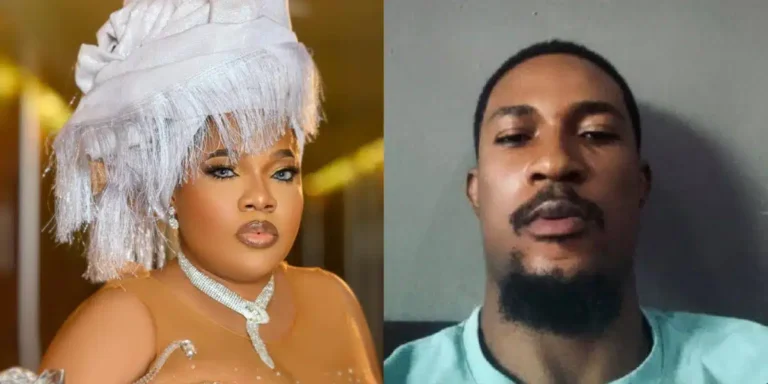
Nollywood actress Toyin Abraham has vehemently refuted widespread claims suggesting her involvement in the alleged re-arrest of X (formerly Twitter) influencer, Big Ayo, a figure with whom she had a prominent online altercation earlier in 2024. The acclaimed film star, known for her prolific career and outspoken nature, issued a swift and unequivocal denial on Tuesday, labeling the reports as "fake and false news." Abraham underscored her complete disengagement from any such legal action, asserting that she was actively engaged in a movie production at the precise moment these fresh allegations began to circulate across social media platforms.
"Arrest Ayo as how, please this is fake and false news. I’m on set filming. Please kindly disregard. I didn’t get Ayo or anyone arrested; it’s all love from me. Thank you and I will advise to kindly take this down please," Abraham stated, her message underscoring both her bewilderment and her desire to quash the rapidly spreading misinformation. This incident marks a significant resurgence of public discourse surrounding the delicate balance between freedom of expression and the potential for cyberbullying, particularly as it pertains to public figures in Nigeria’s vibrant, yet often volatile, online landscape.
The Genesis of the Latest Allegation and Abraham’s Swift Response
The current wave of speculation was ignited by a now-deleted post from an X user identified only as "Khan." This post, which quickly gained traction and was widely amplified before its removal, asserted that Big Ayo had "allegedly been arrested again" and explicitly linked the action to the instigation of the popular actress. The rapid dissemination of this unverified claim immediately rekindled memories of Abraham’s previous legal actions against online detractors, bringing the issue of celebrity-troll interactions back into sharp focus.
However, the narrative began to shift as another X user, Prince Adeshina, stepped forward to directly challenge Khan’s assertion. Adeshina clarified that Toyin Abraham was, in fact, at a film location and had no connection whatsoever to any alleged arrest, advising the public to dismiss the circulating report as fake news. Abraham herself acknowledged Adeshina’s corrective post with a retweet, further cementing her denial. "For the attention of the general public: Toyin Abraham was at a movie location and did not arrest Ayo. We urge the general public to consider the circulating report as fake news," Adeshina wrote, also adding a stern caution that the originator of the claim might be compelled to provide substantiated evidence. This quick debunking by a third party, coupled with Abraham’s direct response, highlights the dual-edged nature of social media platforms: their capacity for rapid information spread, but also for equally rapid corrections.
A History of Online Confrontation: The July 2024 Incident
The resurfaced allegation is deeply rooted in a high-profile incident from July 2024, when Toyin Abraham initiated legal proceedings against individuals accused of persistently cyberbullying her on social media. This earlier confrontation reached a peak when an X user named Jeffery publicly claimed that his mother had been arrested by authorities due to his alleged online trolling activities against the actress. In an emotional and widely shared post, Jeffery recounted how his mother was reportedly picked up from her shop and taken to a police station over actions he vehemently denied committing.
However, Abraham subsequently issued a crucial clarification that reshaped the understanding of the incident. She stated that it was not Jeffery’s mother who had been arrested, but rather his friend, Big Ayo, the very influencer now at the center of the renewed allegations. Abraham accused Big Ayo of a sustained campaign of online abuse, making offensive remarks not only about her but also about her immediate family.
Big Ayo, under his X handle, had indeed posted a highly controversial message directly targeting the actress. In this incendiary post, he accused Abraham of leveraging funds purportedly linked to political support to finance personal matters, including an alleged medical procedure for her husband. This specific accusation, touching upon both her professional integrity and her personal life, served as a significant flashpoint, prompting Abraham to take decisive legal action. The incident underscored her growing frustration with what she described as incessant and deeply personal attacks.
Following Big Ayo’s arrest in July 2024, Abraham publicly defended her decision to involve law enforcement. In a post released shortly after the event, she emphatically stated that she would no longer tolerate insults or derogatory comments directed at her family. She articulated the emotional distress she had endured due to the relentless attacks, warning that she had been pushed to her absolute limit. This public declaration marked a turning point in her approach to online harassment, signaling a firm stance against what she perceived as malicious and defamatory content.
The Political Undercurrent: Tinubu Endorsement and its Aftermath
Toyin Abraham’s ongoing struggles with online critics are inextricably linked to her open and vocal support for Bola Ahmed Tinubu during Nigeria’s hotly contested 2023 general elections. Her endorsement of Tinubu, a prominent political figure who ultimately won the presidency, sparked widespread and often intense reactions across social media platforms. While she garnered support from some quarters, she also became a frequent target of severe criticism from those who opposed Tinubu’s candidacy or questioned her motives.
Critics repeatedly challenged her to justify her support for the then-presidential candidate, demanding that she disclose the "ideas and vision" she claimed the president shared with her. This political affiliation positioned her directly in the crosshairs of a highly polarized online environment, where political opinions frequently devolved into personal attacks. Since her public endorsement, Abraham has remained a consistent target of online criticism, with some users resorting to deeply personal attacks that often extended to her family members, echoing the very type of content Big Ayo was accused of posting. This illustrates the broader trend in Nigerian public life where celebrity endorsements can have profound and lasting consequences on their public image and online interactions.
Legal Framework and Cyberbullying in Nigeria
The context of these incidents is shaped by Nigeria’s legal landscape concerning online conduct, primarily the Cybercrime (Prohibition, Prevention, etc.) Act of 2015, which was recently amended in 2024. This legislation provides a framework for addressing various cyber-related offenses, including cyberstalking, cyberbullying, and defamation committed through electronic means. Sections of the Act, particularly those dealing with the misuse of computer systems and the transmission of false or defamatory information, are often invoked in cases where individuals, especially public figures, feel they have been subjected to online harassment.
For instance, Section 24 of the Cybercrime Act addresses cyberstalking, criminalizing the sending of messages that are "grossly offensive, indecent, obscene or menacing character" or that cause "annoyance, inconvenience or needless anxiety." Similarly, provisions exist to prosecute individuals who disseminate false information with the intent to injure the reputation of another. While the Act aims to curb online excesses, it also raises complex questions about the balance between freedom of speech, a fundamental human right, and the protection of individuals from harm and defamation. Public figures like Toyin Abraham, by virtue of their prominence, often navigate this precarious balance, deciding when to endure criticism and when to seek legal redress. The increasing number of legal actions taken by Nigerian celebrities against online trolls signifies a growing reliance on this legal framework to protect their reputation and personal space.
The Role of Social Media Platforms in Disinformation
The swift spread of the unverified claim regarding Big Ayo’s re-arrest underscores the critical role of social media platforms, particularly X, in contemporary public discourse. These platforms, while facilitating unprecedented connectivity and information exchange, are also fertile ground for the rapid dissemination of misinformation and disinformation. The ephemeral nature of posts, the ease of sharing, and the often-anonymized nature of user accounts contribute to an environment where unverified allegations can quickly gain traction, often before official responses can be mounted.
The "cancel culture" phenomenon, where public figures face severe backlash and calls for their professional ostracism based on perceived missteps or controversial statements, is amplified by these platforms. For celebrities, every public statement, every endorsement, and every interaction is scrutinized, often leading to intense pressure and emotional distress. The responsibility for combating misinformation rests not only with the individuals making and debunking claims but also with the platforms themselves, which are increasingly under pressure to implement more robust mechanisms for content moderation and verification.
Implications for Public Figures and Digital Discourse
The recurring incidents involving Toyin Abraham and online critics like Big Ayo carry significant implications for public figures and the broader landscape of digital discourse in Nigeria. Firstly, they highlight the intense and often relentless scrutiny that celebrities face in the age of social media. The line between constructive criticism and malicious personal attacks frequently blurs, leaving public figures in a difficult position.
Secondly, these events underscore the growing trend of celebrities leveraging legal avenues to combat online harassment. This shift indicates a decreasing tolerance for unbridled trolling and defamation, suggesting that public figures are increasingly willing to push back against online aggression through formal legal channels, rather than simply ignoring it. This could set a precedent for more accountability on social media.
Thirdly, the rapid spread and subsequent debunking of the re-arrest claim serve as a stark reminder of the challenges in verifying information online. It emphasizes the need for media literacy among social media users and encourages a more critical approach to information consumption. The incident also prompts a broader societal discussion on the ethics of online interactions, the boundaries of free speech, and the personal cost of digital vitriol. For public figures, the constant threat of unverified allegations and personal attacks can have profound impacts on their mental health, professional reputation, and personal lives.
Timeline of Key Events
- 2023 General Elections: Toyin Abraham openly endorses Bola Ahmed Tinubu for President, sparking significant online debate and criticism.
- Post-Election Period (Late 2023 – Early 2024): Abraham faces sustained online criticism and personal attacks related to her political stance.
- Early 2024: X influencer Big Ayo posts controversial messages targeting Toyin Abraham, including allegations about her use of political funds for personal matters.
- July 2024: Toyin Abraham takes legal action. Big Ayo is arrested. Initial reports mistakenly claim Jeffery’s mother was arrested, which Abraham later clarifies. Abraham publicly defends her decision to involve law enforcement, citing family protection and emotional distress.
- Current Period (Recent Days): X user Khan posts an unverified claim alleging Big Ayo has been re-arrested at Abraham’s behest.
- Tuesday (Current Incident): Toyin Abraham swiftly and emphatically denies the re-arrest allegations, stating she is on a movie set. X user Prince Adeshina corroborates her denial and urges the public to disregard the fake news.
In conclusion, the latest allegations surrounding Big Ayo’s alleged re-arrest, swiftly denied by Toyin Abraham, serve as a potent reminder of the ongoing tension between public figures and their online critics in Nigeria. While the veracity of the re-arrest claim remains unproven, the incident reignites crucial conversations about cyberbullying, the responsible use of social media, and the legal recourse available to individuals facing online harassment. As the digital landscape continues to evolve, so too will the dynamics of public interaction, necessitating a continuous re-evaluation of ethical online conduct and the pursuit of verified information.