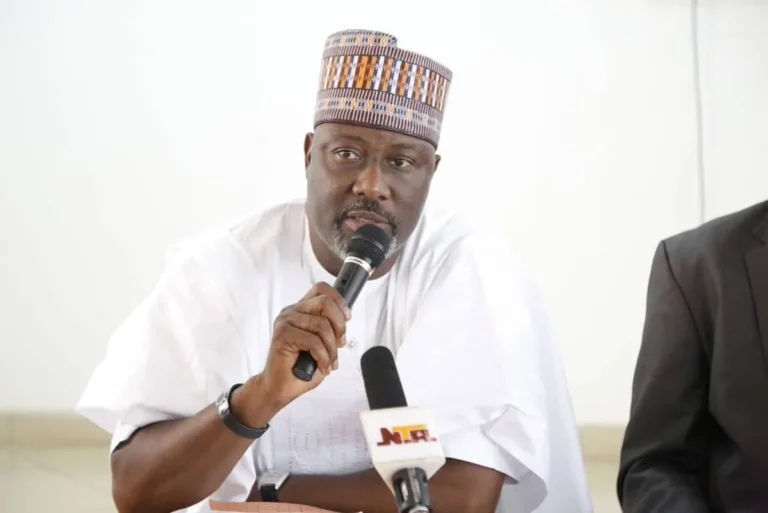
Former Kogi West Senator, Dino Melaye, has launched a vehement critique against the administration of President Bola Tinubu, declaring that any presidential candidate emerging from the African Democratic Congress (ADC) would perform "one million times better" than the incumbent president. This assertion, made during an interview on the ‘Mic On Podcast’ hosted by Seun Okinbaloye and uploaded on Sunday, April 7, 2024, underscores a burgeoning dissatisfaction within certain opposition circles regarding the current state of governance and economic affairs in Nigeria. Melaye’s remarks highlight deep-seated concerns over the nation’s economic trajectory, perceived democratic backsliding, and the alleged influence of non-elected individuals within the corridors of power.
Melaye’s Stinging Critique and the Promise of Superior Governance
Melaye’s commentary was unequivocal, stating, "My brother, anybody among those interested in the presidency in ADC would do one million times better than Tinubu. They can never be a worse president than Tinubu." This bold claim, while hyperbolic in its phrasing, reflects a profound disillusionment with the current administration’s performance, particularly in the economic sphere. President Tinubu, who assumed office on May 29, 2023, inherited a challenging economic landscape characterized by high inflation, a volatile exchange rate, and significant public debt. His administration quickly implemented several ambitious reforms, most notably the removal of the petrol subsidy and the unification of multiple exchange rate windows. While these policies were lauded by international financial institutions as necessary steps towards fiscal sustainability, their immediate impact has been a sharp increase in the cost of living, soaring inflation, and a significant depreciation of the Naira against major international currencies.
For instance, Nigeria’s inflation rate surged to 31.70% in February 2024, up from 29.90% in January, according to the National Bureau of Statistics (NBS). Food inflation, a critical component affecting the average Nigerian household, reached an alarming 37.92%. The Naira, which traded around N750 to a US dollar at the parallel market before the unification, plunged to over N1,600 by early 2024, despite recent gains. These economic realities form the backdrop against which Melaye’s assertion of "one million times better" resonates with a segment of the populace struggling with economic hardship. His statements suggest that even a relatively lesser-known candidate from a party like the ADC could offer more effective solutions or a more empathetic approach to governance.
The African Democratic Congress (ADC) and the Opposition Landscape
The African Democratic Congress (ADC) is one of Nigeria’s registered political parties, founded in 2006. While it has participated in several general elections, it has historically struggled to gain significant national traction, often playing a third-party role behind the dominant All Progressives Congress (APC) and the Peoples Democratic Party (PDP). In the 2023 general elections, the ADC fielded a presidential candidate, but its performance was modest, reflecting the broader challenges faced by smaller parties in Nigeria’s highly competitive political environment. Melaye’s endorsement of the ADC, albeit hypothetical, underscores a potential shift in strategy for some opposition figures who may be exploring alternatives to the traditional two-party dominance. His remarks could be interpreted as a call for a broader coalition or a signal that the opposition is willing to consider diverse platforms in their quest to challenge the incumbent.
Melaye himself has a notable political history, having served as a senator representing Kogi West senatorial district under the platform of the Peoples Democratic Party (PDP). Known for his outspoken nature and often confrontational political style, he has been a vocal critic of successive governments. His own political ambitions have seen him contest for various positions, including the governorship of Kogi State and, more recently, the presidential ticket of the PDP in the lead-up to the 2023 elections. His current stance, prioritizing a united opposition front over personal ambition, signals a strategic pivot aimed at consolidating anti-government sentiments. "My own for now is that we must send Tinubu away. Whoever emerges from consensus or from a primary, I will support," he affirmed, dispelling speculations about joint ticket arrangements and emphasizing a focus on national interest.
Challenging Electoral Integrity and the "Kabiyesi/Igwe" Analogy
A significant portion of Melaye’s criticism centered on the integrity of Nigeria’s electoral process and President Tinubu’s alleged disposition towards democratic principles. He expressed confidence that President Tinubu could be defeated in a credible election, boldly stating his personal capacity to unseat him. "Me, Dino Melaye. Let’s go on a free and fair election," he challenged, adding, "I will beat him flat… in the Federal Republic of Nigeria." This statement, while perhaps aimed at bolstering opposition morale, also highlights the persistent issues surrounding electoral fairness in Nigeria. The 2023 general elections, which brought President Tinubu to power, were marred by controversies, including allegations of voter suppression, technical glitches with the Bimodal Voter Accreditation System (BVAS), and challenges in the timely upload of results to the INEC Result Viewing Portal (IReV). These issues led to numerous legal challenges, with opposition parties questioning the credibility of the process.
Melaye further alleged that the President might not be willing to allow a transparent electoral process, warning that the opposition would insist on fairness. "Let him allow a free and fair contest. And if he doesn’t allow it, we will make him conduct our election. Because he doesn’t want election. He wants to be Kabiyesi. He wants to be Igwe," he asserted. The terms "Kabiyesi" and "Igwe" are honorific titles for traditional rulers in Yoruba and Igbo cultures, respectively, implying absolute authority and unquestionable power. By using these analogies, Melaye suggests that President Tinubu harbors tendencies towards authoritarianism, preferring to rule without genuine democratic accountability or the mandate derived from genuinely free and fair elections. This accusation taps into a broader concern among civil society organizations and pro-democracy advocates who have consistently called for strengthening electoral institutions and processes to ensure credible outcomes. The Independent National Electoral Commission (INEC) has often faced scrutiny regarding its independence and capacity to conduct elections free from political interference.
Concerns Over Governance and Non-Elected Influence
Beyond electoral integrity, Melaye also raised serious concerns about the style of governance under President Tinubu, particularly highlighting the alleged influence of non-elected individuals. He specifically referenced the President’s son, Seyi Tinubu, stating, "My son will not interfere with governance. My son will not summon DGs of parastatals and agencies of government and ministers." This criticism points to a growing public debate in Nigeria about the perceived role of presidential family members and associates who do not hold official government positions but are believed to wield significant power and influence.
Seyi Tinubu has been visible in public events and official engagements, sometimes drawing criticism for his perceived proximity to policy-making and state resources. While the "City Boy Movement," a youth-led initiative that supported President Tinubu’s campaign, continues to be active, its activities and funding sources have occasionally come under public scrutiny. Critics argue that the involvement of presidential children or close associates in government affairs, without formal roles or accountability, blurs the lines between private influence and public duty, potentially leading to conflicts of interest and undermining good governance.
Melaye further cited remarks by Nobel laureate Wole Soyinka, a respected public intellectual, while criticizing the growing visibility of non-elected actors. "Even our respected Wole Soyinka complained about him. You have seen the City Boy Movement and what they are doing," Melaye added. While the specific context of Soyinka’s recent remarks on this particular issue would need to be verified, the Nobel laureate has historically been a fierce critic of governance excesses and democratic infringements in Nigeria. His past pronouncements have often highlighted concerns about nepotism, lack of accountability, and the erosion of democratic institutions. Melaye’s invocation of Soyinka’s name lends intellectual weight to his criticisms, positioning them within a broader narrative of public concern regarding transparency and accountability in government.
Broader Implications and the Path Ahead for the Opposition
Dino Melaye’s outspoken remarks reflect the simmering discontent within the Nigerian political landscape and signal an intensified phase of opposition activism. His call for unity among opposition figures, even to the extent of supporting a consensus candidate, underscores a recognition of the need for a formidable front to challenge the incumbent administration. Opposition figures, he maintained, were already working strategically ahead of future elections, stressing that unity remains key to achieving their objective of "rescuing this country."
The implications of these criticisms are multi-faceted. For the ruling APC, such strong condemnations from a prominent opposition voice necessitate a robust defense of its policies and governance record. While the Presidency has yet to issue an official response to these specific allegations, spokespersons for the All Progressives Congress (APC) have consistently defended the administration’s policies, emphasizing their long-term benefits for economic stability and national development. They often argue that the current hardships are a necessary short-term consequence of painful but essential reforms aimed at correcting decades of economic mismanagement.
For the Nigerian populace, Melaye’s statements contribute to the ongoing national discourse on governance, economic hardship, and democratic accountability. They may galvanize segments of the public who feel disenfranchised or burdened by the current economic climate, potentially shaping public opinion ahead of future electoral cycles. The emphasis on "free and fair elections" and the warnings against autocratic tendencies serve as reminders of the enduring struggle for democratic consolidation in Nigeria.
The coming months will likely see continued political maneuvering and public debate as the opposition attempts to coalesce its forces and articulate a compelling alternative vision. Melaye’s assertions, while controversial and highly critical, serve as a significant data point in understanding the evolving dynamics of Nigerian politics and the challenges facing the Tinubu administration from a determined opposition. The focus on economic performance, electoral integrity, and transparent governance will undoubtedly remain central to these debates, shaping the political narrative as the nation navigates its complex journey.