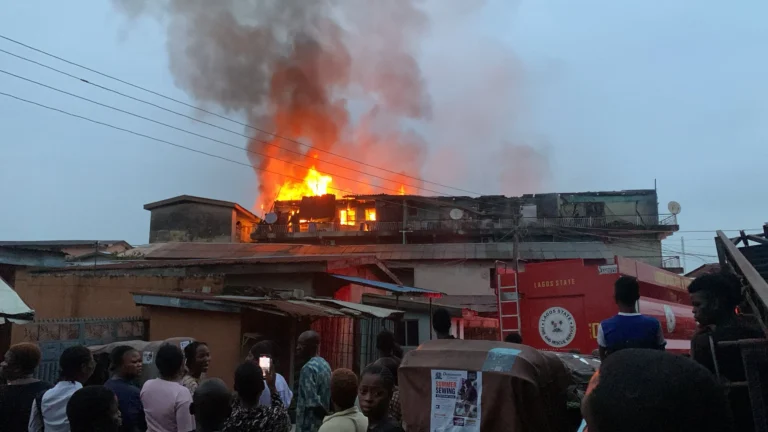
A major fire outbreak in the Ketu-Ikosi area of Lagos State on Sunday morning led to the hospitalisation of two first responders and caused significant damage to a residential complex. The inferno, which reportedly began in the early hours of the day, tore through the upper levels of a three-storey building, necessitating a massive deployment of emergency resources to prevent a wider catastrophe in the densely populated neighborhood.
According to official reports from the Lagos State Emergency Management Agency (LASEMA), the emergency call was received at approximately 6:31 am. The incident occurred at No. 11, Ademola Taiwo Street, Ketu-Ikosi, involving one of a pair of twin three-storey residential buildings. While the swift intervention of the Lagos State Fire and Rescue Service and LASEMA’s "Tiger Squad" prevented the fire from jumping to the adjacent twin structure, the intensity of the blaze and the grueling conditions on the ground took a physical toll on the personnel involved.
Chronology of the Ketu-Ikosi Fire Incident
The timeline of the disaster began shortly after dawn on Sunday. Residents of Ademola Taiwo Street were jolted awake by the smell of smoke and the crackling of flames emanating from the front section of the affected building. By 6:31 am, the Lagos State emergency dispatch system had been alerted, triggering an immediate response from the nearest fire stations and the LASEMA base.
Upon arrival, the Tiger Squad and fire crews observed that the topmost floor of the three-storey building was already heavily engulfed. The fire had originated on the balcony of the front section and was rapidly climbing toward the roof, fueled by household materials and structural elements. The primary objective of the responders was two-fold: to ensure all residents had evacuated the premises and to establish a "fire break" to protect the identical twin building situated just meters away.
For several hours, firefighters battled the flames from multiple angles. The heat, combined with the early morning humidity and the physical exertion required to navigate the upper floors of the building, created a hazardous environment for the responders. It was during this intense combat phase that two officers of the Lagos State Fire and Rescue Service suffered physical collapses.
The two personnel were immediately attended to by the LASEMA Response Team (LRT) on-site. Using a combination of the agency’s specialized ambulance and a response vehicle, the officers were evacuated to a nearby Trauma Centre. As of the latest update from the agency, both firefighters are receiving intensive medical care and have been stabilized, though they remain under observation for smoke inhalation and heat-related exhaustion.
Investigative Findings: The Role of Electrical Surges
Preliminary investigations conducted by LASEMA’s technical team have identified the primary cause of the blaze as an electrical surge. Specifically, the surge originated from a prepaid meter located at the front section of the building’s balcony. This sparked an immediate ignition which then extended to the interior of the topmost floor.
Electrical surges remain a leading cause of residential fires in Lagos, often triggered by fluctuations in the power grid or substandard internal wiring. In this instance, the placement of the meter on the balcony allowed the fire to gain oxygen and spread vertically toward the roof before residents could effectively deploy manual extinguishers.
By approximately 10:00 am, the fire had been successfully contained. However, the agency remained on-site for "dampening-down" operations. This process involves saturated cooling of the affected areas to eliminate residual heat pockets that could potentially reignite. Recovery operations are also currently underway to secure the structural integrity of the remaining floors and to allow for a comprehensive assessment of the property damage.
Supporting Data: The Rising Trend of Urban Fires in Lagos
The incident at Ketu-Ikosi is not an isolated event but part of a broader pattern of fire emergencies that have plagued Nigeria’s commercial capital in recent months. Lagos, with its high population density and complex electrical infrastructure, presents a unique challenge for fire safety management.

Data from the Lagos State Fire and Rescue Service indicates a seasonal spike in fire calls, often exacerbated by electrical instability. Just weeks prior, on June 19, a significant fire was extinguished at the Polaris Bank building on Broad Street, Lagos Island. That incident, which occurred on the third floor of a 17-storey building, was traced back to a stationary saloon car in the parking section.
In the first half of 2024 alone, the state has recorded hundreds of fire-related emergencies ranging from market infernos to residential disasters. The Dosunmu Market fire and the Mandilas Building blaze are other recent examples where electrical faults and poor storage practices led to billions of naira in property losses. The Ketu-Ikosi incident underscores the persistent vulnerability of residential twin-buildings, where the proximity of structures allows for rapid fire transfer if not for the rapid intervention of professional crews.
Official Responses and Public Safety Mandates
The Permanent Secretary of LASEMA, Dr. Olufemi Oke-Osanyintolu, issued a stern advisory following the Ketu-Ikosi incident. He emphasized that the safety of residential buildings is a collective responsibility between the government and the citizenry.
"The agency wishes to appreciate the professionalism and gallantry of all emergency responders, particularly the Tiger Squad and personnel of the Lagos State Fire and Rescue Service, whose swift intervention prevented what could have been a more devastating outcome," the statement read.
Dr. Oke-Osanyintolu further urged residents to prioritize the maintenance of electrical installations. He noted that prepaid meters, while efficient for billing, require proper installation and protection from the elements to prevent the kind of surges witnessed on Sunday morning. He advised the public to:
- Conduct regular inspections of all electrical wiring by certified professionals.
- Ensure that prepaid meters are installed in well-ventilated, dry areas away from flammable materials.
- Install surge protectors and high-quality circuit breakers to mitigate the impact of grid fluctuations.
- Keep the state’s emergency toll-free lines—112 and 767—readily available for immediate reporting.
The Director of the Lagos State Fire and Rescue Service, Margaret Adeseye, has also previously highlighted the importance of "fire-smart" behavior, noting that the speed of reporting is often the difference between a minor incident and a total structural loss.
Broader Impact and Implications for Urban Planning
The Ketu-Ikosi fire brings to the forefront the critical need for stricter enforcement of building codes and fire safety regulations in residential neighborhoods. Many buildings in Lagos are constructed in close proximity, a factor that complicates firefighting efforts and increases the risk of "conflagration," where a fire spreads from building to building.
Furthermore, the hospitalisation of the two firefighters highlights the occupational hazards faced by first responders in Nigeria. Unlike many Western nations where high-tech robotic firefighting equipment is becoming more common, Nigerian firefighters often rely on physical stamina and manual entry into burning structures. This physical toll is compounded by the lack of specialized hydrants in many residential streets, forcing fire trucks to shuttle water from distant sources or rely on tankers brought to the scene.
From a socio-economic perspective, the loss of the top floor of the No. 11 Ademola Taiwo Street building represents a significant displacement for the affected families. While no civilian lives were lost, the destruction of property and personal belongings in a difficult economic climate poses a severe burden on the victims.
As the dampening-down operations conclude, the focus will shift to a structural integrity test. LASEMA and the Lagos State Building Control Agency (LASBCA) typically collaborate following such fires to determine if the heat has compromised the concrete and reinforcement bars of the building. If the structure is deemed unsafe, the residents of the lower floors may face temporary or permanent evacuation to prevent a collapse.
The incident serves as a grim reminder of the volatility of urban living in a mega-city. While the heroism of the two hospitalised firefighters prevented a tragedy, the root cause—an electrical surge from a meter—points to a systemic issue in utility safety that continues to threaten the lives and property of Lagosians. Emergency agencies continue to call for a culture of safety, urging every household to view fire prevention not as an option, but as a life-saving necessity.