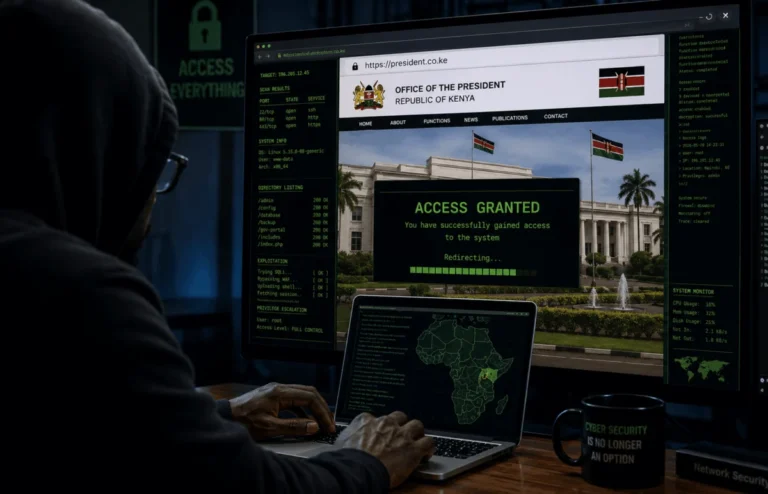
The official website of Kenyan President William Ruto was targeted by a sophisticated cyberattack on Saturday, July 18, leading to a temporary loss of control over the platform and the public display of disparaging messages directed at the administration. The breach of president.co.ke, which serves as a primary digital portal for executive communications, saw the homepage replaced by a defacement screen authored by an unidentified hacking collective. The attackers issued an ultimatum to the Kenyan government, demanding a ransom of five Bitcoins—valued at approximately $317,215—in exchange for withholding what they characterized as "uncomfortable" and sensitive information.
The incident began in the early hours of Saturday morning when visitors to the site were greeted not by official state news, but by a stark message claiming this was the third such warning issued to the President. The hackers’ message was explicit: "This message is the third time for you; before we leak everything about you. Do a payment of 5 bitcoins to the Bitcoin wallet… If you want peace before 6 o’clock this evening." This direct threat of data exfiltration, combined with a hard deadline, sparked immediate concerns regarding the security of Kenya’s national digital assets and the potential exposure of classified state communications.
Chronology of the Breach and Immediate Response
The timeline of the attack suggests a well-coordinated effort to maximize public visibility and pressure. Following the initial defacement, news of the breach spread rapidly across social media platforms, prompting a flurry of speculation regarding the nature of the "uncomfortable" information mentioned by the hackers. By mid-morning, the Kenyan government initiated emergency protocols to regain control of the digital infrastructure.
Information and Communication Technology (ICT) Cabinet Secretary William Kabogo released a formal statement in the afternoon, confirming that the presidential website had indeed been compromised. Kabogo sought to reassure the public and international observers, stating that the government had successfully mitigated the immediate threat. "At this time, there is no evidence of unauthorized access to sensitive data, data exfiltration, or loss of information," Kabogo asserted. He further clarified that as a precautionary measure, access to the presidential website was temporarily restricted to facilitate a comprehensive forensic analysis, containment of the breach, and restoration of services.
Despite the government’s assurances, the site remained offline for several hours as technical teams worked to scrub the servers and implement enhanced security patches. The incident has raised critical questions about the robustness of Kenya’s cybersecurity framework, particularly given the frequency of such attacks on high-profile state portals.
A Pattern of Persistent Vulnerabilities
The July 18 attack is not an isolated event but rather the latest in a series of high-stakes cyber incidents targeting the Kenyan state. In November 2025, a massive breach paralyzed not only the President’s website but also the digital portals of four key ministries: Education, Health, Interior, and ICT. That previous wave of attacks also impacted the Immigration Department, the Directorate of Criminal Investigations (DCI), and the State House website, highlighting a systemic weakness across the government’s digital ecosystem.
Data from the Communications Authority of Kenya (CA) suggests that the country faces millions of cyber threats annually, ranging from simple malware and phishing to complex Distributed Denial of Service (DDoS) attacks and sophisticated ransomware. Kenya’s rapid digitization, while driving economic growth and financial inclusion through platforms like M-Pesa and e-Citizen, has also expanded the "attack surface" for both local and international threat actors.
Security analysts point out that the repeated targeting of the presidency suggests a motive that transcends simple financial extortion. Nick Thiong’o, a Nairobi-based cybersecurity and Artificial Intelligence practitioner, notes that the high visibility of the target is a primary driver. "I don’t think whoever is targeting the president has only financial motives in mind; it’s also for show," Thiong’o explained. "For you to target the head of state, you know you’d actually get the attention that you’re seeking."
Analysis of the "Soft Target" Phenomenon in Government Web Assets
The vulnerability of government websites is often a result of structural and operational failures rather than a lack of available technology. Victoria Robinson, a Cybersecurity Research Analyst at Ethnos Cyber Limited, argues that state domains—specifically those ending in .go.ke—are "sweet spots" for hackers because they offer instant credibility and maximum psychological impact.
"You get press coverage, public panic, and leverage for extortion in one shot," Robinson said. She highlighted that many government websites are treated as static projects rather than living infrastructure. Often built by external contractors who win public tenders, these sites frequently lack long-term in-house ownership. Once the initial contract ends, the rigorous cycle of patching, credential rotation, and vulnerability scanning often falls by the wayside.
Technical audits of similar state platforms across the continent frequently reveal the use of outdated Content Management Systems (CMS) such as older versions of WordPress, Drupal, or Joomla. These platforms, if not updated, contain known vulnerabilities that can be easily exploited by even moderately skilled hackers. Furthermore, the absence of Multi-Factor Authentication (MFA) on administrative panels and the failure to implement IP allow-listing make these sites "low-hanging fruit" for attackers.
The Role of Artificial Intelligence in Modern Cyber Warfare
The rise of generative Artificial Intelligence has fundamentally altered the cybersecurity landscape, lowering the barrier to entry for malicious actors. While the Kenyan government has not explicitly linked the July 18 attack to AI-driven tools, experts warn that the technology is making such breaches more frequent and harder to defend against.
Thiong’o expressed concern that Large Language Models (LLMs) can be "jailbroken" to bypass safety protocols, allowing users to generate sophisticated malware or phishing scripts with minimal programming knowledge. "We’re on the cusp of something that would be recurring because the tools to create malware and prompt injections are easily available," he warned. The ability of AI to automate the scanning of thousands of websites for specific vulnerabilities means that any government portal with unpatched software is likely to be discovered and exploited within minutes of a vulnerability becoming public.
Strategic Recommendations for African Digital Sovereignty
To counter these emerging threats, cybersecurity experts are calling for a fundamental shift in how African governments perceive and protect their digital infrastructure. The consensus is that digital assets must be treated with the same level of security priority as physical borders or national treasuries.
Victoria Robinson outlined a multi-pillar strategy for securing state digital assets:
- Centralized Security Governance: Shifting oversight to a National Computer Emergency Response Team (CERT) with the authority to mandate security standards across all ministries.
- Operational Hygiene: Implementing mandatory, continuous patch cycles and strict access controls, including MFA for all administrative accounts.
- Incident Response Drills: Moving beyond theoretical plans to active, rehearsed "runbooks" that allow for rapid recovery within minutes rather than hours.
- Vulnerability Disclosure Programs: Encouraging ethical "white hat" hackers to find and report bugs before malicious actors can exploit them.
Furthermore, there is a growing call for African nations to invest in "sovereign AI" and local security models. By developing internal technical expertise and collaborating with regional neighbors through the African Union’s cybersecurity frameworks, countries like Kenya can reduce their dependence on external contractors and build more resilient, self-sustaining defense systems.
The Broader Implications for National Security
The breach of the Kenyan President’s website serves as a stark reminder that in the digital age, a country’s homepage is its front door. When that door is defaced, it signals a perceived weakness in the state’s ability to protect its most basic digital functions. While the ICT Ministry has maintained that no sensitive data was lost in this specific instance, the reputational damage and the potential for future, more damaging incursions remain significant.
The demand for Bitcoin also highlights the growing intersection of cybercrime and decentralized finance, making it increasingly difficult for law enforcement to track the movement of extorted funds. As Kenya continues to position itself as "Silicon Savannah," a regional leader in tech and innovation, the security of its public digital infrastructure will be a critical metric for investor confidence and national stability.
The July 18 incident underscores a predictable cycle: a breach occurs, a temporary fix is applied, and the underlying structural vulnerabilities remain until the next attack. Breaking this cycle will require not just technical patches, but a political commitment to funding and maintaining digital infrastructure as a core component of national defense. Without a shift toward proactive, continuous security monitoring, the "uncomfortable" threats of today may become the catastrophic data leaks of tomorrow.