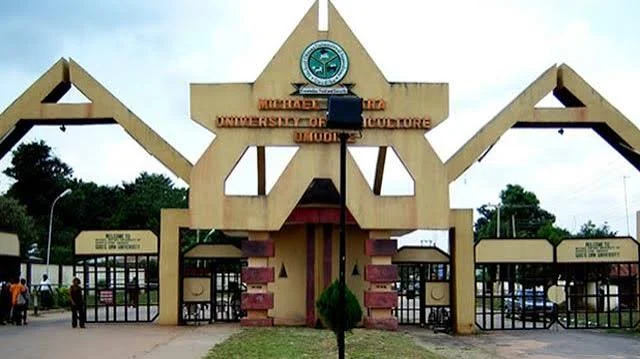
The Michael Okpara University of Agriculture, Umudike (MOUAU), finds itself at the centre of a significant employment dispute, with its management firmly asserting that the current Vice-Chancellor, Professor Ursula Akanwa, had no involvement in the recruitment exercise that led to the disengagement of 127 staff members. This contentious issue has drawn public attention to the university’s internal processes, federal employment regulations, and the intricacies of government financial management systems. The university’s Head of Public Relations and Protocol, Mr. Anyaso Anyaso, addressed journalists on Tuesday, providing a detailed account aimed at clarifying the institution’s position and absolving the current leadership of any culpability in the widely reported staff displacement.
Background: The Mandate of Michael Okpara University of Agriculture
Established in 1992 as a specialized institution, the Michael Okpara University of Agriculture, Umudike, is one of Nigeria’s federal universities dedicated to agricultural research, education, and extension services. Its primary mandate is to train highly skilled manpower in various fields of agriculture, science, engineering, and technology, contributing significantly to national food security, rural development, and socio-economic transformation. Given its specialized nature and federal funding, recruitment into MOUAU, like other federal institutions, is subject to strict federal government guidelines, including obtaining waivers for new hires and adhering to federal character principles to ensure equitable representation across Nigeria. The effective functioning of such an institution relies heavily on a stable and appropriately staffed workforce, making any recruitment irregularity a matter of serious concern for stakeholders.
Federal Recruitment Framework and Waivers in Public Service
Recruitment into Nigeria’s federal public service, including universities, is a highly regulated process. In recent years, due to fiscal constraints and efforts to control the burgeoning public sector wage bill, the Federal Government has often implemented employment freezes. Consequently, any federal institution seeking to recruit new staff typically requires a specific waiver from the Head of the Civil Service of the Federation, often after approval from the Budget Office and other relevant federal agencies. This waiver specifies the number of staff, the cadre, and sometimes even the departments for which recruitment is permitted. The process is designed to ensure that employment is needs-based, fiscally sustainable, and compliant with national policies such as the Federal Character principle, which promotes fairness in the distribution of public service appointments among the diverse ethnic and geographical groups in Nigeria. Non-adherence to these guidelines can lead to severe administrative and financial penalties for institutions and individuals.
Chronology of Events Leading to the Impasse
The core of the dispute at MOUAU stems from a series of events that unfolded primarily in late 2025 and early 2026, culminating in the current administration’s efforts to rectify the situation.
- Late 2025 – Early 2026 (Under Previous Administration): The Federal Government grants a waiver for the recruitment of 426 staff members for the Michael Okpara University of Agriculture, Umudike. This number is subsequently approved by the university’s Governing Council, mandating strict adherence by the then-Vice-Chancellor and management.
- Prior to March 1, 2026: The previous university administration conducts the employment exercise. During this period, despite the approved figure of 426, appointment letters are issued to an inflated number of 618 persons.
- Prior to March 1, 2026: Following the issuance of appointment letters, 553 of these individuals are subsequently captured on the Government Integrated Financial Management Information System (GIFMIS) payroll platform, an attempt to integrate them into the federal payroll system.
- March 1, 2026: Professor Ursula Akanwa officially assumes office as the new Vice-Chancellor of Michael Okpara University of Agriculture, Umudike, inheriting the aftermath of the completed recruitment exercise.
- Post-March 1, 2026: The GIFMIS platform, acting on its inherent programming and federal government directives, processes the uploaded names. Crucially, it only validates and uploads the initially approved figure of 426 staff, automatically excluding the excess entries. This leads to 127 individuals (553 – 426) being effectively disengaged from the payroll, despite having received appointment letters and being initially captured on the system.
- Recent Weeks/Months: The 127 disengaged staff members begin to vocalize their grievances, alleging wrongful termination and humiliation, including forced retrieval of identity cards.
- Tuesday, [Date of Press Conference]: Mr. Anyaso Anyaso, the Head of Public Relations and Protocol, addresses journalists to clarify the university’s stance and exonerate the current Vice-Chancellor.
The Discrepancy: Approved Slots Versus Actual Appointments
The central issue in the MOUAU recruitment saga is the glaring discrepancy between the federally approved staff strength and the actual number of individuals issued appointment letters and attempted to be onboarded. The Federal Government and the university’s Governing Council had explicitly sanctioned the recruitment of 426 staff members. However, records indicate that 618 individuals received appointment letters, representing an over-recruitment of 192 persons. Furthermore, 553 of these individuals were subsequently uploaded onto the Government Integrated Financial Management Information System (GIFMIS) for payroll processing. This figure still exceeded the approved limit by 127. The inherent checks and balances within the GIFMIS platform, designed to prevent unauthorized payments and enforce fiscal discipline, ultimately allowed only the approved 426 names to be retained on the payroll, leading to the automatic exclusion of the remaining 127. This act of over-recruitment, a clear violation of established protocols, has profound implications for both the affected individuals and the university’s governance.
The Vice-Chancellor’s Emphatic Disclaimer
In response to the growing controversy, Professor Ursula Akanwa, through the university’s public relations department, has unequivocally distanced herself from the contentious recruitment exercise. Mr. Anyaso Anyaso reiterated the Vice-Chancellor’s consistent explanation at various university meetings: the entire recruitment process, including the issuance of appointment letters and the initial capture of successful applicants on the payroll system, was concluded before she assumed office on March 1, 2026. This timeline is critical to her defence, establishing that the decisions leading to the over-recruitment were made under the previous administration. Furthermore, Anyaso emphasized that the Vice-Chancellor has no administrative access to the GIFMIS platform to either remove or reinstate any name uploaded. This technical limitation reinforces her claim of being unable to unilaterally alter the outcome dictated by the federal financial system. Her administration’s stance is one of inheriting a pre-existing problem and being bound by the operational dictates of federal financial management tools.
The Government Integrated Financial Management Information System (GIFMIS): A Key Enabler of Fiscal Control
At the heart of the disengagement lies the Government Integrated Financial Management Information System (GIFMIS). GIFMIS is an IT-based system for budget preparation and execution, accounting, treasury, and financial reporting. It was introduced by the Nigerian Federal Government to enhance transparency, accountability, and efficiency in public financial management. For payroll, GIFMIS acts as a gatekeeper, ensuring that only approved staff, whose details align with established quotas and budgetary provisions, are paid. Once a waiver for recruitment is granted and the approved number of staff is entered into the system, GIFMIS will automatically flag and reject any attempt to process payments for individuals exceeding that pre-authorized figure. It does not permit manual override by university authorities at the point of payment processing. This immutable functionality of GIFMIS explains why, despite 553 individuals being initially uploaded, only the approved 426 ultimately remained on the payroll. The system’s design is to enforce fiscal discipline and prevent ghost workers or unauthorized recruitment from burdening the federal treasury.
Plight of the Disengaged Staff: Allegations and Demands
Representatives of the 127 disengaged staff members have vociferously articulated their grievances, presenting a stark contrast to the university’s official narrative. They allege not only the devastating loss of their jobs but also claim to have faced humiliation during attempts by the university management to retrieve their identity cards. Beyond the immediate loss of livelihood, there are also insinuations that these disengaged staff have been replaced by other employees, an allegation that, if true, would suggest a systemic disregard for due process and fairness. The emotional and financial toll on these individuals, who received official appointment letters and had commenced work, is undoubtedly significant. Their demands are likely to revolve around reinstatement, compensation for wrongful disengagement, or a thorough investigation into the circumstances that led to their situation, potentially seeking intervention from labour unions or regulatory bodies.
MOUAU Management’s Official Stance and Denials
In direct response to the allegations from the disengaged staff, Mr. Anyaso Anyaso firmly denied any wrongdoing on the part of the current university management. He stated unequivocally, "MOUAU did not issue sack letters and did not use force to obtain their ID cards." This suggests that the university views the situation not as a "sack" but as a natural consequence of the GIFMIS system rejecting unauthorized entries. The university’s position implies that the disengagement was an automated system response rather than an administrative decision by the current VC. Anyaso also appealed to the public and stakeholders to "disregard insinuations being peddled by mischief-makers, rely only on official university channels for accurate information and refrain from circulating unverified reports." This call underscores the university’s efforts to control the narrative and restore confidence amidst the controversy.
Broader Implications and Analysis
The recruitment imbroglio at Michael Okpara University of Agriculture carries several significant implications, extending beyond the immediate plight of the disengaged staff.
- Financial Integrity and Accountability: The incident raises serious questions about the financial prudence and accountability of the previous administration. Over-recruiting by nearly 45% (618 against 426 approved) indicates a profound disregard for federal directives and budgetary constraints. This could have led to significant financial liabilities if GIFMIS had not acted as a firewall.
- University Governance and Due Process: The controversy highlights potential lapses in internal governance and adherence to due process. The role of the Governing Council, which approved the 426 slots, and its oversight functions will likely come under scrutiny. It questions how such a large disparity between approved and actual recruitments could occur under its watch.
- Staff Morale and Industrial Relations: For the remaining staff, such incidents can breed mistrust, anxiety, and impact overall morale. For the disengaged staff, it’s a traumatic experience that could lead to prolonged legal battles and industrial disharmony.
- Reputational Damage: The university’s reputation, both within academic circles and among the general public, is likely to suffer. Such controversies can deter prospective students, faculty, and research partners.
- Precedent and Future Recruitment: This incident sets a crucial precedent. It reinforces the authority of GIFMIS and federal regulations, making it clear that unauthorized recruitment will not be tolerated or funded. It also underscores the need for stringent internal controls in all federal institutions during recruitment exercises.
Regulatory Scrutiny and Potential Interventions
Given the nature of the allegations and the involvement of federal funds and regulations, several oversight bodies may initiate investigations or interventions:
- National Universities Commission (NUC): As the primary regulatory body for university education in Nigeria, the NUC is responsible for ensuring quality assurance, compliance with federal policies, and good governance in universities. They may conduct an audit of the university’s recruitment processes.
- Federal Character Commission (FCC): If the over-recruitment or subsequent disengagement disproportionately affected certain geopolitical zones, or if the initial recruitment did not adhere to federal character principles, the FCC could launch an investigation.
- Office of the Accountant-General of the Federation (OAGF): The OAGF, which oversees the GIFMIS platform, would be interested in understanding how an institution attempted to bypass approved staff numbers and the measures taken to prevent future occurrences.
- Independent Corrupt Practices and Other Related Offences Commission (ICPC) or Economic and Financial Crimes Commission (EFCC): If evidence of corruption, abuse of office, or fraudulent practices emerges during the recruitment process, these anti-graft agencies could be invited to investigate.
- Labour Unions: Unions representing university staff, such as ASUU (Academic Staff Union of Universities), NASU (Non-Academic Staff Union), and SSANU (Senior Staff Association of Nigerian Universities), would likely engage with the university management on behalf of the affected staff, demanding fair treatment and adherence to labour laws.
The Path Forward: Restoring Trust and Adherence to Due Process
The situation at Michael Okpara University of Agriculture demands a comprehensive and transparent approach to resolution. For the university, it means not only clarifying the current administration’s role but also demonstrating a commitment to rectifying past errors and preventing future recurrences. This may involve:
- Independent Investigation: Conducting an impartial investigation into the recruitment exercise under the previous administration, perhaps by an ad-hoc committee or an external body, to ascertain accountability for the over-recruitment.
- Communication and Transparency: Maintaining open and clear communication channels with all stakeholders, including the disengaged staff, the university community, and the public, providing regular updates on any investigations or resolutions.
- Policy Review: Reviewing internal recruitment policies and procedures to ensure stricter adherence to federal guidelines and prevent any future circumvention of approved waivers and GIFMIS protocols.
- Support for Affected Staff: Exploring avenues for support or alternative arrangements for the disengaged staff, even if the university maintains it did not "sack" them. While the university may not be legally obligated to reinstate them, compassionate consideration could mitigate the human impact and reputational damage.
- Collaboration with Federal Agencies: Working closely with the NUC, FCC, and OAGF to ensure full compliance with all federal directives and regain the trust of regulatory bodies.
The Michael Okpara University of Agriculture, Umudike, stands at a critical juncture. How it navigates this complex issue will not only determine the fate of 127 individuals but also shape its reputation, reinforce its commitment to good governance, and uphold the integrity of federal employment processes in Nigeria. The clarity provided by the current management is a step, but the journey towards full resolution and restoration of trust is likely to be extensive and require sustained commitment to transparency and accountability.