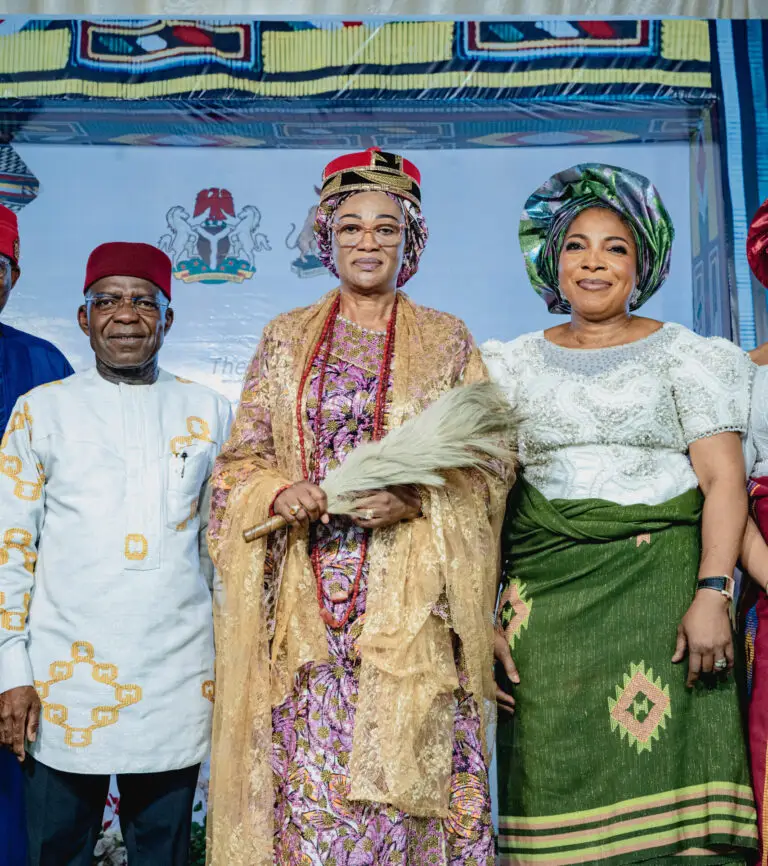
In a significant move aimed at bolstering Nigeria’s rich cultural heritage and stimulating local economies, First Lady Senator Oluremi Tinubu recently visited Abia State, where she not only pledged substantial financial support but also made a symbolic commitment to promote indigenous craftsmanship. During her visit to Aba on Tuesday, Mrs. Tinubu announced a generous donation of N2 billion to the Abia State Government specifically earmarked for the development and promotion of the historic Akwete weaving heritage. This intervention is designed to create jobs, boost the state’s economy, and ensure the sustainability of the centuries-old craft for future generations.
The highlight of the First Lady’s engagement was a personal pledge to Governor Alex Otti: if her husband, President Bola Ahmed Tinubu, secures victory in the 2027 presidential election, she would proudly adorn herself in a wrapper and ‘buba’ – traditional Nigerian attire – meticulously crafted from the prestigious hand-woven Akwete textile for the inauguration ceremony. This promise underscored her deep appreciation for the unique fabric and signaled a powerful endorsement of local Nigerian craftsmanship on a national stage.
A Catalyst for Cultural Preservation and Economic Growth
The N2 billion donation, a substantial investment, is set to become a transformative catalyst for the Akwete community in Ukwa East Local Government Area, the ancestral home of this distinguished textile. Mrs. Tinubu articulated that the gesture extends beyond mere financial aid; it is a strategic investment in developing the Akwete production site, an initiative expected to generate considerable employment opportunities and significantly enhance the economic landscape of Abia State. Her vision is rooted in supporting the state government’s ongoing efforts to preserve the intricate craft, ensuring its survival and prosperity for generations to come.
The First Lady’s admiration for Akwete fabric was palpable as she lauded its distinctiveness and richness. She highlighted the traditional method of its creation – crafted on vertical looms by women in Abia, utilizing natural fibers such as cotton, raffia, and silk. Akwete is renowned for its vibrant colour palette and complex geometric motifs, each pattern often imbued with specific cultural meanings and stories passed down through generations.
"I am in awe of all the richness of what the Akwete fabrics stand for," Mrs. Tinubu remarked, emphasizing the profound connection between traditional attire and cultural identity. "I love traditional outfits because our tradition, our culture tells us who we are. The moment we lose that, we won’t remember where we come from." She celebrated the intergenerational transfer of this "sacred craft," noting that it is "done with love, patience, and endurance." Her message resonated deeply with the local community, as she urged women to continue passing on this cherished tradition to the next generation.
Championing Indigenous Identity: A Call to Action
Beyond the financial pledge, Mrs. Tinubu’s visit carried a powerful message of cultural revival and national pride. She passionately encouraged the younger generation across Nigeria to embrace their cultural heritage, particularly traditional attire, as a vital link between past and present. "We should not let our children forget that," she asserted, advocating for Nigerians to wear African traditional garments with dignity and pride.
Her call to action was specifically directed at the Igbo people, urging them to collectively champion the Akwete fabric. "To the women of Akwete, I heard your cry. I am here to announce to all Nigerians and the Igbo people that it is time to take Akwete fabric to the national stage," she declared. This statement signifies a strategic intent to elevate Akwete from a regional treasure to a national symbol of Nigerian ingenuity and artistry, potentially opening doors to broader markets and international recognition. The N2 billion donation, she reiterated, was her personal contribution to this ambitious project.
Abia State’s Commitment and Ongoing Efforts
Responding to the First Lady’s impactful visit and generous donation, Governor Alex Otti, alongside his wife, Mrs. Priscilla Otti, expressed profound gratitude. They affirmed that the First Lady’s gesture would be instrumental in "significantly transform[ing] Akwete fabric production in the state." Governor Otti described the visit as not only timely but also crucial for the preservation and revitalization of the indigenous craft.
The Governor highlighted that the Abia State Government has been proactively engaging with the Akwete weaving community since 2023, initiating comprehensive efforts to reposition the industry for enhanced economic value. These efforts include identifying and dismantling barriers that have historically hindered the growth of the centuries-old craft. Furthermore, the state government is actively exploring and integrating modern technology to improve production efficiency, enhance product quality, and boost the competitiveness of Akwete fabric in both domestic and global markets. This strategic embrace of innovation, while preserving traditional methods, aims to ensure Akwete’s relevance and profitability in an evolving textile industry.
Governor Otti also took the opportunity to commend President Bola Tinubu for his courageous implementation of economic reforms, particularly the removal of fuel subsidy and the unification of the foreign exchange market. He implicitly linked these reforms to creating a more conducive economic environment that could ultimately benefit local industries like Akwete by fostering stability and predictability for small and medium-sized enterprises (SMEs) involved in production and export.
Stakeholder Endorsements and Recognition
The First Lady’s visit and initiatives garnered widespread support from other prominent figures. Senator Enyinnaya Abaribe, representing Abia South Senatorial District, lauded the women weavers of Akwete, describing them as the "bedrock of the community." He acknowledged their ingenuity and expressed his personal interest in contributing to the construction of a dedicated weaving center, signaling legislative and community support for the project.
In a profound gesture of appreciation and recognition, the Abia Council of Traditional Rulers conferred the prestigious traditional title of "Ugo Nwanyi Abia" (the Pride of Abia Women) upon the First Lady. This honour was bestowed in acknowledgment of her generosity, evident care for the welfare of Nigerian women, and her broader motherly roles within the nation. Such a title not only symbolizes the local community’s acceptance and respect but also elevates the First Lady’s initiative within the cultural framework of the state.
The Enduring Legacy of Akwete: A Deep Dive into its Heritage
The Akwete fabric, known locally as "Akwa Akwete," is more than just a textile; it is a repository of history, culture, and artistic expression. Originating from the Akwete community, a town in Ukwa East Local Government Area of Abia State, Nigeria, the craft has been perfected over centuries. Legend attributes its invention to a woman named Dada Nwakwata, who is said to have developed the intricate weaving patterns that characterize the fabric. While the exact origins are shrouded in oral tradition, what is undeniable is the profound connection of the fabric to the women of Akwete, who have been its primary custodians and innovators.
The weaving process itself is a testament to skill and patience. Unlike many modern textiles, Akwete is traditionally hand-woven on vertical looms, a technique that allows for the creation of unique, complex patterns. The materials used – cotton, raffia, and silk – are often locally sourced, contributing to the fabric’s authenticity and sustainable profile. Cotton provides durability and a soft texture, raffia adds a distinct sheen and stiffness, while silk lends a luxurious feel. The dyes traditionally used were also natural, derived from plants and minerals, resulting in a rich, earthy colour palette before the advent of synthetic dyes introduced more vibrant hues.
The motifs on Akwete fabric are not merely decorative; they are symbolic. Each geometric pattern often tells a story, represents an aspect of nature, or signifies social status. For instance, some patterns are associated with specific families or ceremonies, making the fabric a form of visual communication and identity. The "Ikat" pattern, characterized by its blurred edges, is a particularly challenging technique that requires immense skill in dyeing the threads before weaving. Other popular patterns include the "Akpoche," "Nnadede," and "Ahia," each with its own intricate design and cultural significance. This depth of meaning elevates Akwete beyond a simple garment to a piece of wearable art, reflecting the spiritual and social fabric of the Igbo people.
Historically, Akwete was primarily used for traditional wrappers worn by women, especially during significant events like weddings, festivals, and chieftaincy coronations. It also served as a valuable trade item, contributing to the economic prosperity of the Akwete community. However, in recent decades, the craft faced challenges, including competition from mass-produced foreign textiles, a dwindling interest among younger generations due to perceived lack of economic viability, and limited market access beyond local communities. The First Lady’s intervention and the state government’s efforts aim to directly address these historical impediments.
Broader Implications: Economic Empowerment, Cultural Diplomacy, and National Identity
The First Lady’s initiative carries far-reaching implications across several critical domains:
-
Economic Empowerment and Job Creation: The N2 billion grant, coupled with the development of Akwete production sites, promises to inject significant capital into the local economy. This funding can be utilized for acquiring modern weaving equipment to complement traditional looms, improving infrastructure, providing training in contemporary design and marketing, and facilitating access to quality raw materials. The creation of a more robust production ecosystem will directly translate into new jobs for weavers, dyers, designers, marketers, and ancillary service providers. By boosting production capacity and market reach, the initiative can transform Akwete from a cottage industry into a thriving enterprise, offering sustainable livelihoods to countless individuals, particularly women, who are the primary custodians of this craft.
-
Women Empowerment: The Akwete weaving tradition is predominantly a female enterprise. By investing in this craft, the initiative directly empowers women, enhancing their economic independence, leadership roles within their communities, and overall social standing. Providing resources and market access enables these women to earn better incomes, invest in their families’ education and health, and contribute more significantly to local development. This aligns with broader national and international goals of gender equality and women’s economic inclusion.
-
Cultural Diplomacy and National Identity: Elevating Akwete fabric to the national stage, as envisioned by the First Lady, serves as a powerful act of cultural diplomacy. When a First Lady pledges to wear an indigenous fabric for a national inauguration, it sends a clear message of pride in national heritage and an endorsement of local artistry. This can inspire other Nigerians to embrace and celebrate their diverse cultural attire, fostering a stronger sense of national identity and unity. Furthermore, showcasing Akwete internationally, through trade fairs and cultural exchanges, can project Nigeria’s rich cultural tapestry to the world, enhancing its soft power and attracting cultural tourism.
-
Tourism Potential: Increased awareness and investment in Akwete can significantly boost cultural tourism to Abia State. Tourists, both domestic and international, are often drawn to authentic cultural experiences. The development of weaving centers, workshops, and guided tours in Akwete can attract visitors interested in learning about the craft, purchasing authentic products directly from artisans, and immersing themselves in the local culture. This creates an additional revenue stream for the community and the state.
-
Alignment with Government Policy: This initiative aligns seamlessly with President Bola Tinubu’s "Renewed Hope" agenda, which emphasizes economic revitalization, job creation, support for small and medium-sized enterprises (SMEs), and cultural promotion. By investing in indigenous crafts, the government demonstrates its commitment to diversifying the economy beyond oil, fostering local manufacturing, and preserving Nigeria’s invaluable cultural assets. Governor Otti’s praise for the President’s economic reforms further contextualizes how a stable economic environment is crucial for such cultural and industrial initiatives to thrive.
In conclusion, First Lady Oluremi Tinubu’s visit to Abia State, marked by her significant N2 billion donation and symbolic pledge, represents a multi-faceted approach to cultural preservation and economic development. It is a strategic intervention that seeks to not only revive a cherished Nigerian heritage but also to empower local communities, particularly women, and to project Nigeria’s rich cultural identity onto the national and global stages. The collaborative efforts of the First Lady, the Abia State Government, and local stakeholders hold the promise of transforming Akwete fabric into a beacon of Nigerian pride and a sustainable engine of economic growth.