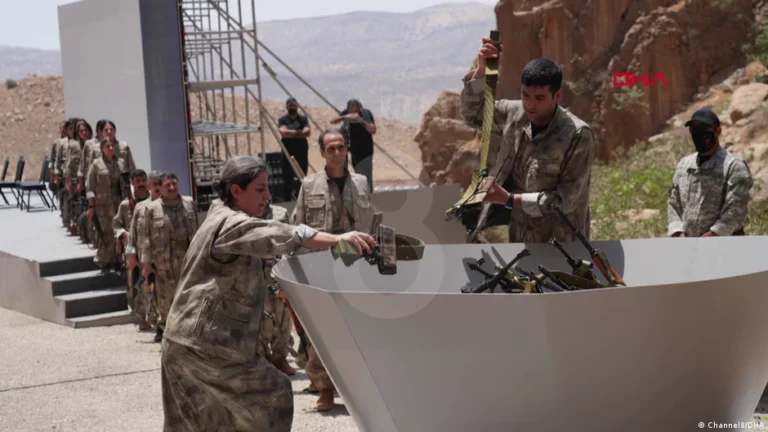
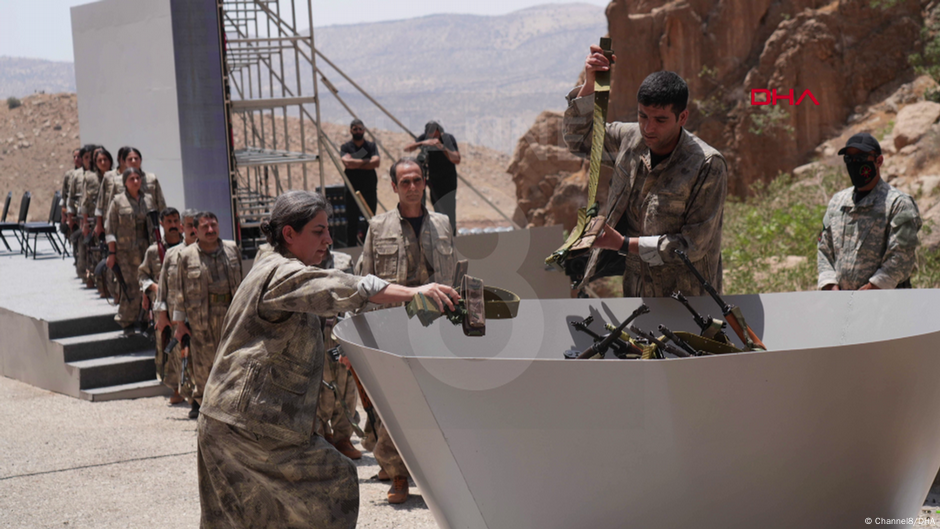
July marks a pivotal anniversary in the protracted and often violent conflict between the Turkish state and the Kurdistan Workers’ Party (PKK), a group designated as a terrorist organization by Turkey, the United States, and the European Union, among others. A year ago, the world witnessed a symbolic gesture of disarmament as PKK fighters in northern Iraq publicly burned their weapons, signaling a potential shift in a decades-long struggle that has claimed an estimated 40,000 lives. This act followed a significant announcement in May of the preceding year, when the PKK declared its intention to cease its "work under the name of PKK," indicating a halt to its armed insurgency that has long sought Kurdish rights or independence within Turkey.
The symbolic disarmament ceremony on July 11, involving approximately 30 PKK fighters, resonated across the region. Fast forward to this year, on the very same date, the city of Diyarbakir, the largest urban center in Turkey’s Kurdish-majority southeast, became the focal point for a crucial conference. Here, human rights activists, academics, and politicians convened to meticulously assess the tangible progress and formidable challenges characterizing the nascent peace process between the Turkish government and the PKK. Organized jointly by Diyarbakir’s local administration and the Human Rights Association (IHD), the conference served as a platform for critical dialogue and reflection.
Background of a Decades-Long Conflict
The Kurdistan Workers’ Party, founded in 1978 by Abdullah Ocalan, emerged from a historical backdrop of perceived marginalization and suppression of Kurdish identity within Turkey. Initially advocating for an independent Kurdish state, the PKK later shifted its stated goals to greater cultural and political autonomy for Kurds within Turkey. Its armed struggle, commencing in 1984, quickly escalated into a full-scale insurgency, characterized by guerrilla warfare, bombings, and various acts of violence against Turkish security forces and civilians. In response, the Turkish state launched extensive counter-insurgency operations, leading to widespread human rights abuses on both sides and a devastating toll on civilian populations in the southeast.
Abdullah Ocalan, the charismatic and controversial leader of the PKK, was captured in Kenya in 1999 and subsequently imprisoned in Turkey, where he remains. For decades, he was unequivocally branded a terrorist by Ankara. However, in a remarkable turn of events, the 77-year-old Ocalan has now emerged as a central figure in the ongoing peace initiative, his directives from prison holding significant sway. It was his call for the PKK to lay down its arms, aiming for full disarmament by February 2025, that has largely galvanized the current efforts, a directive to which PKK members have shown an initial response.
Previous attempts at peace have been fraught with difficulty and ultimately failed to achieve lasting stability. Informal talks between Turkish intelligence agencies and the PKK began as early as 2009, evolving into more formal negotiations between 2013 and 2015. During this period, in March 2013, Ocalan himself declared a ceasefire. However, these earlier initiatives ultimately collapsed, leading to a renewed cycle of violence. The current process, therefore, is viewed with both cautious optimism and a keen awareness of historical precedents.
Chronology of Recent Peace Initiatives and Milestones
The current peace process gained significant momentum with a series of distinct actions:
- May [Previous Year]: The PKK publicly declared its intention to cease its activities under its current name, signaling a strategic reorientation away from armed insurgency. This announcement was a foundational step, setting the stage for subsequent moves towards de-escalation.
- July 11 [Previous Year]: In a highly symbolic move, approximately 30 PKK fighters in northern Iraq participated in a ceremony where they burned their weapons. This act was widely interpreted as a tangible demonstration of commitment to disarmament, albeit on a small scale.
- February 2025 (Ocalan’s Directive): From his prison cell, Abdullah Ocalan issued a clear directive calling for the PKK to fully lay down its arms by February 2025. This authoritative call from the organization’s founder provided a crucial framework and timeline for the peace efforts, encouraging members to engage with the process.
- Following Ocalan’s Call: In response to this directive and the broader shifts, the Turkish parliament established a dedicated committee. This committee undertook extensive consultations, hearing testimonies from approximately 140 representatives spanning various sectors of society, including politicians, civil society organizations, human rights activists, and even relatives of soldiers, veterans, and prisoners affected by the conflict.
- Committee Recommendations: Based on these wide-ranging testimonies, the parliamentary committee put forth a series of recommendations aimed at advancing the peace process. Key among these were proposals for the reintegration into society of PKK members who had renounced violence, as well as a robust verification mechanism for state security institutions to confirm the PKK’s genuine and comprehensive disarmament.
- Ongoing Discussions: Subsequent talks have delved into complex legal and social frameworks, focusing on the conditions for the return or potential prosecution of former PKK members, and pathways for their integration into civilian and political life.
- July 11 [Current Year]: The commemorative conference in Diyarbakir brought together diverse stakeholders to assess the progress made over the past year and deliberate on future steps, marking a year since the symbolic weapons burning.
- Recent Developments: In the weeks leading up to the Diyarbakir conference, there have been further indications of movement. Following a meeting with Ocalan and other prisoners, the pro-Kurdish political party DEM released a statement in which Ocalan reiterated his demand for a robust legal framework to underpin and advance the peace process, emphasizing that "The Kurdish-Turkish alliance is the cornerstone of Anatolia’s shared future." Concurrently, Duran Kalkan, a co-founder of the PKK, expressed optimism in a recent interview, stating his belief that the peace process would not fail due to the significantly altered regional dynamics. Adding to this cautiously positive atmosphere, Turkey’s ruling Justice and Development Party (AKP) has also reportedly adopted a more moderate tone in its recent discourse concerning the peace efforts.
Key Aspects and Demands in the Current Peace Process
The ongoing negotiations navigate a complex landscape of political, legal, and social demands from both sides. A core focus for the Turkish government remains the complete disarmament of the PKK and the reintegration of its members into society, subject to legal frameworks. This includes determining the rules for the return of PKK members, their potential prosecution for past actions, and pathways for their integration into civilian and political life.
From the Kurdish perspective, a central demand is the release of Abdullah Ocalan from prison, along with other political prisoners. The Kurdish side also insists on receiving political and legal guarantees before proceeding with full disarmament. These guarantees are seen as essential for ensuring the sustainability and legitimacy of any peace agreement, protecting Kurdish rights, and preventing a recurrence of conflict. However, the Turkish government has shown reluctance to offer a general amnesty, indicating a preference for a partial amnesty, and has yet to make any concrete commitments regarding Ocalan’s release. Despite this, the more moderate tone recently adopted by the ruling AKP suggests a potential for greater flexibility in future negotiations.
Cihan Aydin, co-chair of the Human Rights Association (IHD) and a prominent lawyer, has proposed a significant symbolic step: designating July 11 as an official day of remembrance. Aydin argues that fostering a vibrant culture of remembrance is crucial for confronting the painful past and inoculating against future conflicts. He also advocates for comprehensive legal solutions for all individuals impacted by the peace process, including the contentious issue of Ocalan’s legal status.
Expert Analysis and Cautious Optimism
Aret Demirci, who heads the Istanbul office of Germany’s Friedrich Naumann Foundation, views the recent developments with "cautiously positive" optimism. He underscores the symbolic burning of weapons as an "historic turning point," noting a crucial difference from previous failed attempts: "And unlike previous peace initiatives, the process has not collapsed at an early stage." This resilience, he suggests, bodes well for the current efforts.
However, Demirci also offers a sobering assessment of the significant hurdles that remain. He cautions that many of the central political questions have largely been deferred or ignored thus far. The fundamental divergence in expectations between the two parties represents the biggest challenge: while the Turkish government prioritizes the PKK’s complete disarmament, the Kurdish side seeks robust political and legal guarantees as a prerequisite for laying down arms. "The parties’ differing expectations are likely to be the biggest challenge in coming months," Demirci predicts.
The optimism, however, is not confined to external observers. Duran Kalkan, a co-founder of the PKK, echoed this sentiment in a recent interview, expressing confidence that the peace process would not fail this time. His rationale stems from a belief that the prevailing geopolitical situation in the region is fundamentally different, creating a unique environment conducive to a lasting resolution.
Geopolitical Shifts and Regional Implications
Indeed, a significant factor influencing the current dialogue is a dramatically altered regional security landscape. Turkey finds itself operating within a geopolitical context vastly different from that of a decade ago, when earlier informal talks with the PKK first began. The Middle East has experienced an intensification of conflicts and realignments, particularly due to escalating tensions involving Israel, Iran, and the United States. Crucially, the evolving situation in Syria plays a pivotal role.
For Turkey, fostering improved relations with its own Kurdish population domestically offers greater diplomatic leverage concerning the Kurdish communities in neighboring Syria and Iraq. This strategic advantage is paramount given Turkey’s long-standing security concerns regarding Kurdish groups across its borders. The Turkish government has historically worried about the potential for PKK members to join Iranian-Kurdish militias operating just over the border.
Furthermore, the dynamics concerning Syrian Kurdish groups have undergone significant transformations. During the Syrian civil war, Syrian Kurdish militias, notably the YPG/SDF (alleged to have links with the PKK), received support from the United States and established a semi-autonomous administration controlling a substantial area almost directly on Turkey’s southern border. This development was a source of immense concern for Turkish security agencies, who viewed it as a direct threat to national security. However, the shifting power balance in Syria has compelled these Syrian Kurdish groups to seek accommodations with the new Syrian government, resulting in a reduction of their complete control over these strategic territories. This changed reality on the ground has, in turn, altered the calculus for both the Turkish state and the PKK and its affiliates, creating new pressures and opportunities for dialogue. Aret Demirci believes these overarching geopolitical transformations are effectively "forcing dialogue" between the PKK and Turkey to advance.
Challenges and the Path to Sustainable Peace
While the current peace process represents a significant and historic undertaking, its long-term success hinges on more than merely the cessation of armed violence. As Demirci eloquently articulated to DW, genuine, sustainable peace requires the emergence of a comprehensive political dialogue that directly addresses fundamental issues such as democratic reforms, the robust establishment of the rule of law, and broader questions concerning Kurdish identity within Turkey.
The path forward remains fraught with significant challenges. The continued arrests of opposition politicians, the removal of democratically elected Kurdish mayors from office, and persistent restrictions on political freedoms cast a long shadow over the peace efforts. As long as these practices persist, the mere cessation of armed conflict will not be sufficient to cultivate a truly durable peace. This inherent ambivalence—the simultaneous historic potential and extreme fragility—currently defines the debate surrounding the process in Turkey.
Adding to the complexity is a palpable lack of transparency. "There is hardly any public information about which agreements have actually been reached and what steps are planned," Demirci noted, highlighting a critical impediment to building public trust and confidence in the process. Without clear communication and an inclusive approach, skepticism can easily take root, undermining the very foundations of peace.
Ultimately, the future of the Turkey-PKK peace process will be determined by the willingness of both sides to bridge their differing expectations—the Turkish government’s insistence on complete disarmament versus the Kurdish side’s demand for political and legal guarantees—and to engage in a transparent, comprehensive dialogue that addresses not just the symptoms of conflict, but its underlying causes. The symbolic burning of weapons a year ago may have lit a beacon of hope, but the arduous journey towards a truly reconciled and peaceful future for Turkey’s diverse population has only just begun.