Unitaid is quietly searching for its next executive leader behind closed doors, a process that has sparked growing demands for transparency as the agency navigates a period of profound institutional and financial instability. Whoever takes the helm of the Geneva-based market-shaping organization will inherit an entity facing acute budget shortfalls, mounting pressure for structural reform within the global health architecture, and a geopolitical landscape increasingly hostile to multilateral aid. As Unitaid marks its 20th anniversary, severe cuts to its core funding from traditional donor nations threaten to disrupt the downstream rollout of its most critical medical breakthroughs, placing years of progress in the fight against HIV/AIDS, tuberculosis (TB), and malaria at significant risk.
The search for a successor to the current Executive Director, Philippe Duneton, represents a watershed moment for the organization. Unlike the public and highly political election processes seen at the World Health Organization (WHO), Unitaid’s transition is being conducted as a standard, confidential executive recruitment. Applications for the post closed in March, and an internal selection panel is currently evaluating contenders in private. While the agency maintains that an announcement will be made "in due course," critics argue that the lack of public vision statements or candidate forums undermines the legitimacy of an organization that manages hundreds of millions of dollars in public funds.

The Unique Mandate of Market Shaping
To understand the stakes of this leadership transition, one must look at Unitaid’s specific niche within the global health ecosystem. Founded in 2006, the agency does not act as a primary procurer of medicines like the Global Fund to Fight AIDS, Tuberculosis and Malaria, nor does it focus on vaccine delivery like Gavi, the Vaccine Alliance. Instead, Unitaid operates "upstream," identifying and addressing the technical and economic bottlenecks that prevent life-saving innovations from reaching low- and middle-income countries (LMICs).
By clearing intellectual property barriers, negotiating early-access agreements, and de-risking new technologies, Unitaid creates the market conditions necessary for larger organizations to scale up treatments. A prime example of this "comparative advantage" is the agency’s recent work on lenacapavir, a long-acting HIV prevention injection. Unitaid’s intervention helped secure generic pricing at approximately $40 per year, a fraction of the cost in high-income markets. Similarly, the agency was instrumental in developing flavored, dissolvable HIV and TB medicines specifically designed for children, a demographic often neglected by commercial pharmaceutical research.
"Put simply, Unitaid’s advantage is identifying and addressing the bottlenecks that stand between innovation and impact," a spokesperson for the agency stated. "We invest early, generate evidence, and help create the conditions for scale."
A Financial Perfect Storm
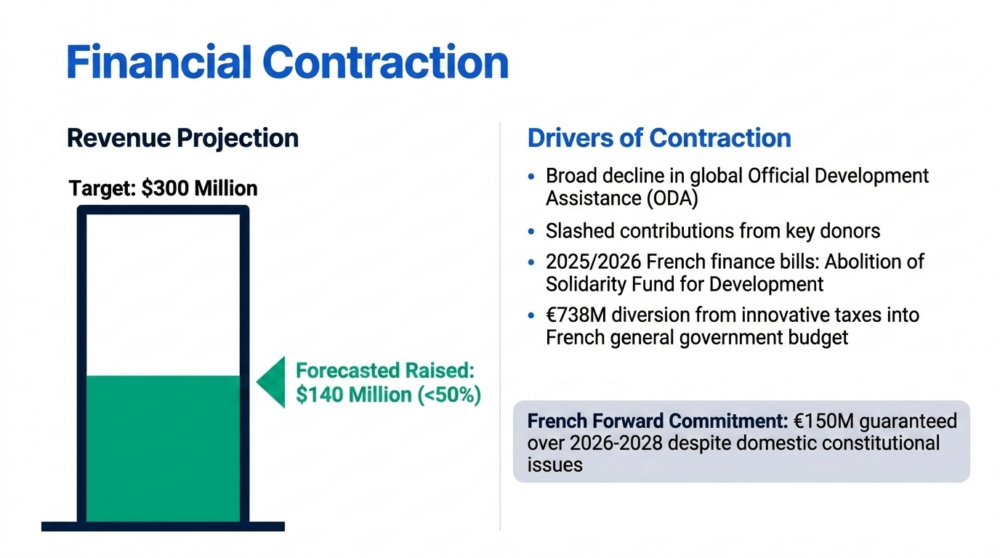
Despite its track record of high-impact interventions, Unitaid is currently facing a dire financial outlook. The agency operates with a relatively lean staff of 110 employees and an annual investment budget target of $300 million. However, recent data from the civil society delegation to Unitaid’s executive board reveals a staggering shortfall. Of its $1.5 billion five-year goal (covering 2023–2027), the agency has raised only $696 million.
For the current fiscal year, Unitaid forecasts raising just $140 million—less than half of its $300 million target. This contraction is driven by a broader trend of major donors slashing Official Development Assistance (ODA) and global health budgets. The United Kingdom, once a stalwart supporter, has significantly reduced its contributions, while France, the agency’s founding architect and largest donor, has faced internal legal hurdles that have complicated its funding streams.
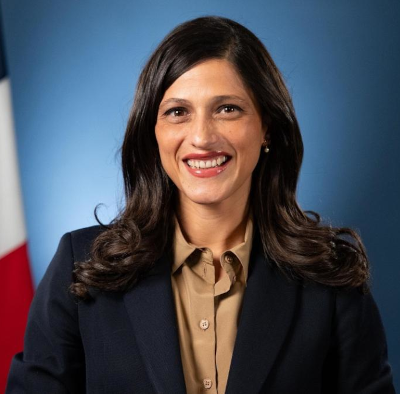
French Minister Delegate for Foreign Affairs, Éléonore Caroit, recently sought to reassure the international community that France’s commitment remains steadfast. "Notwithstanding the re-budgeting prompted by constitutional issues around earmarked tax revenues, France remains Unitaid’s leading partner," Caroit told Health Policy Watch.

The "constitutional issues" refer to a 2021 French law that restricts the use of pre-allocated or "earmarked" taxes. Since its inception, Unitaid has been funded through an "innovative financing" model—a solidarity tax on airline tickets and financial transactions championed by former President Jacques Chirac. However, the 2025 and 2026 French finance bills formally abolished the Solidarity Fund for Development, diverting the €738 million generated by these taxes into the country’s general government budget. While France has committed to providing at least €150 million between 2026 and 2028, the shift from a guaranteed tax-based stream to a general budget allocation introduces new layers of political vulnerability.
Geopolitical Ruptures and the US Position
The financial pressure is exacerbated by the absence of direct support from the United States. Since Unitaid’s founding, Washington has declined to contribute to the agency’s core budget, preferring to channel its global health spending through bilateral programs such as the US President’s Emergency Plan for AIDS Relief (PEPFAR). Since 2003, PEPFAR has invested over $100 billion and is credited with saving 26 million lives.
While this bilateral approach gives the US government greater control over its spending and diplomatic leverage, it leaves multilateral agencies like Unitaid exposed. Furthermore, the agency is indirectly affected by political shifts in Washington; because Unitaid relies on the Global Fund and Gavi to purchase the products it de-risks, any cuts to those "downstream" entities—often targeted by US budget hawks—threaten to leave Unitaid’s innovations sitting on the shelf. Internal 2025 analyses from Unitaid suggest that shrinking global health financing now places half of its "scale-up" products at heightened risk of failure.
The Push for Consolidation vs. Specialization
As donor governments tighten their belts, a debate is raging over whether the current global health architecture is too fragmented. There are growing calls to merge or consolidate agencies like Unitaid, Gavi, and the Global Fund to reduce overhead and streamline the medical supply chain.
The Global Fund and Gavi have already formed a joint task force to explore "structural and non-structural options" for increased efficiency. However, Unitaid and its supporters, including the French government, are pushing back against the idea of a merger. They argue that Unitaid’s specific "end-to-end" mandate—focusing on the technicalities of market entry and intellectual property—would be lost within a larger procurement-focused bureaucracy.
"Merging these entities and their mandates would risk a loss of specificity and expertise, an excessive concentration of missions in one place, and ultimately, less impact for the people who need it most," Minister Caroit warned. She emphasized that Unitaid’s work is complementary to, not duplicative of, the work performed by larger organizations.
This sentiment was echoed at the 79th World Health Assembly (WHA) in May. While delegates discussed the urgent need for global health architecture reform, the final mandate explicitly ruled out recommendations for specific mergers. The focus has shifted instead toward "country health sovereignty" and better alignment of existing funding streams.
Timeline: Two Decades of Unitaid and Global Health Shifts
- 2003: The United States launches PEPFAR, signaling a preference for bilateral global health aid.
- 2006: France, Brazil, Chile, Norway, and the UK establish Unitaid at the WHO to utilize innovative financing (airline taxes) for health.
- 2010–2020: Unitaid successfully de-risks pediatric HIV/TB meds and negotiates price drops for diagnostic tools.
- 2021: France passes a law restricting earmarked taxes, creating a long-term funding challenge for the agency’s original financial model.
- 2023: Global health funding begins a period of "unprecedented contraction" as ODA is diverted to regional conflicts and domestic economic priorities.
- March 2024: Applications for the new Unitaid Executive Director close; the selection process begins behind closed doors.
- May 2024: WHA79 adopts a mandate for architecture reform but rejects forced mergers of health agencies.
- July 2024: Unitaid celebrates its 20th anniversary while reporting a 50% shortfall in its annual funding target.
The Road Ahead for the Next Leader
The stakes of the ongoing leadership race could not be higher. The incoming Executive Director must be both a technical expert in market dynamics and a formidable diplomat. They will be tasked with navigating a volatile funding landscape where traditional Western donors are retreating into more restrictive, bilateral agreements.
The new leader will also need to champion the agency’s relevance in a post-WHA79 world. This includes strengthening direct partnerships with regional bodies like the Africa CDC and the African Medicines Agency to ensure that Unitaid’s innovations can be deployed even if global-level funding remains stagnant.
Furthermore, the demand for transparency is unlikely to go away. As public health experts and civil society groups point out, secret leadership transitions at organizations dependent on public funds can undermine the very "solidarity" that Unitaid was built upon. If the agency is to survive another twenty years, its next leader will have to prove that its upstream interventions are not just a "luxury" of a wealthier era, but an essential component of a functional global health system.
Ultimately, the choice of the next Executive Director will determine whether Unitaid remains an independent, market-shaping powerhouse or is gradually absorbed into a consolidated, and perhaps less specialized, global health architecture. As the internal selection panel continues its deliberations in Geneva, the global health community waits to see if the agency can bridge the gap between its ambitious 20-year legacy and its increasingly precarious financial future.