Former Hungarian Prime Minister Viktor Orban, leader of the Fidesz party, launched a scathing attack on the country’s new government and its prosecuting authorities on Wednesday, alleging that a corruption probe targeting his party was a "politically motivated legal proceeding" designed to undermine the opposition. His accusations came just a day after investigators raided Fidesz headquarters in Budapest, seizing equipment as part of an inquiry into the National Culture Fund (NKA), which the new administration claims was a conduit for systemic corruption during Orban’s long tenure. This dramatic confrontation underscores the profound political upheaval sweeping Hungary, following the unexpected landslide victory of conservative rival Peter Magyar in April’s general elections.
The Raid and Orban’s Outcry
The catalyst for Orban’s latest fiery statements was the Tuesday raid on Fidesz’s central offices. Prosecutors, acting on information related to the National Culture Fund investigation, descended upon the party headquarters, confiscating computer servers and other materials. The NKA is at the heart of allegations that it served as a state-run payment center for Orban’s inner circle and a clandestine fund for election campaigns, diverting public resources for partisan gain.
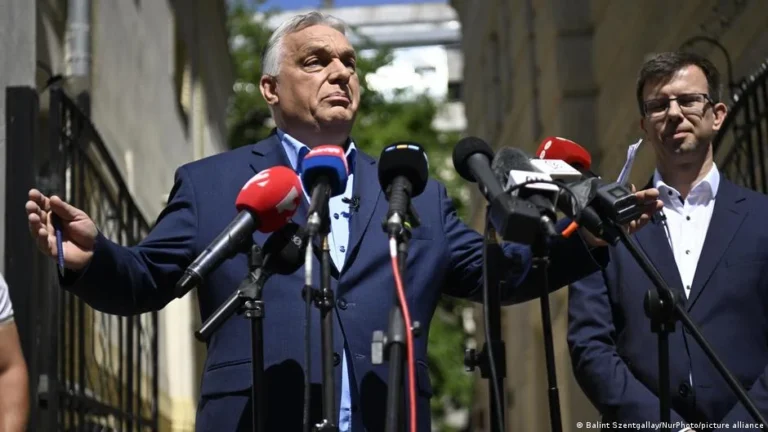
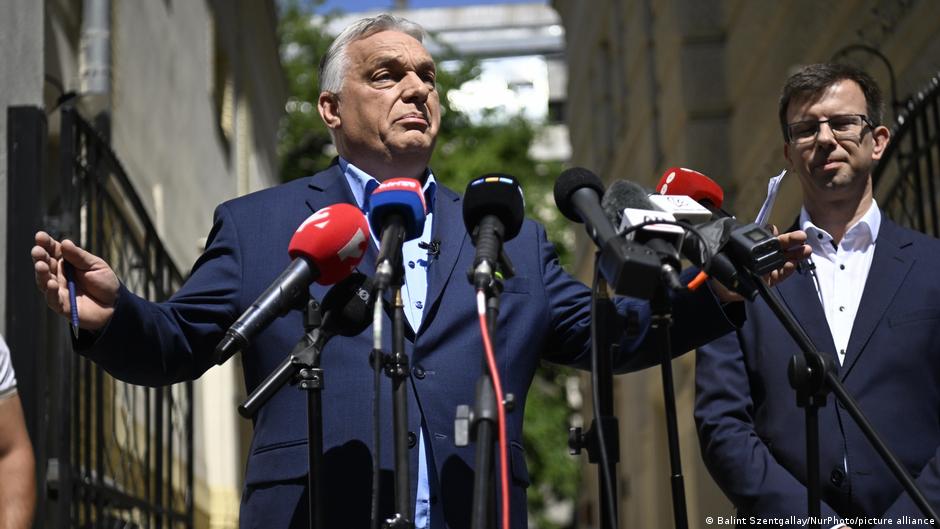
Orban, who served as Prime Minister for 16 consecutive years until his recent electoral defeat, swiftly responded, first with an online "statement of resistance" late on Tuesday night, followed by a combative press conference outside the Fidesz HQ on Wednesday. In these pronouncements, among his strongest since transitioning to an opposition leader role in early May, he vehemently denied any wrongdoing. "The National Culture Fund issue was just a pretext for this [search of the party headquarters]," Orban asserted, framing the probe as a direct assault on his party’s viability. He further elaborated, "By yesterday, I had come to realize what this was all about… This is a politically motivated legal proceeding designed to render Fidesz – which has clearly survived even this heavy political defeat and is growing stronger – legally unviable."
Orban did not stop at refuting the corruption allegations; he escalated his rhetoric, declaring that Hungary had "ceased to be a democratic state" under the new administration. He denounced the measures taken by Prime Minister Peter Magyar as "tyranny" and pledged that he and his party would offer "resistance" through all peaceful means against what he termed an "illegitimate" political system. This strong language signals an entrenched political battle, with Orban portraying himself and Fidesz as the last bastion against what he perceives as a new authoritarianism.
The Rise of Peter Magyar and the Tisza Party
The current political landscape in Hungary represents a stunning reversal of fortune for Orban, who had long dominated the country’s political scene. His fall from power came on April 12, when Peter Magyar’s newly formed Tisza (Respect and Freedom) party secured a decisive victory in the general elections. Magyar, a former Fidesz insider and one-time husband of Orban’s former Justice Minister Judit Varga, emerged from relative obscurity in early 2024 to become the most potent challenger to Fidesz in years. His defection from the ruling party, accompanied by explosive allegations of widespread corruption and double standards within the Orban regime, resonated deeply with a segment of the Hungarian electorate disillusioned with Fidesz’s long reign.
The election results were unequivocal: Tisza garnered more than 55% of the vote, compared to Fidesz’s nearly 37%. Due to Hungary’s first-past-the-post electoral system, this translated into an overwhelming parliamentary majority for Magyar, who now commands 141 of the 199 seats. Fidesz, by contrast, holds a mere 52 seats, a stark reminder of its dramatic loss of political capital. This supermajority is particularly significant as it grants the new government the power to amend the constitution, a power Orban himself frequently wielded during his time in office. Magyar officially took office on May 9, promising swift and systemic changes to dismantle what he consistently refers to as Orban’s "mafia state." The speed and breadth of his initial actions have, indeed, surprised many observers, including some of his own supporters.
Magyar’s Sweeping Reforms: Dismantling the Orban Era
Since assuming the premiership, Peter Magyar has wasted no time in initiating radical reforms aimed at undoing the perceived legacy of Orban-era corruption and consolidating his own power. These actions have been swift and comprehensive, touching upon key institutions and figures associated with the previous government.
One of the most significant moves has been the use of Tisza’s parliamentary supermajority to pass constitutional amendments. These amendments specifically targeted and ended the mandates of two key figures considered staunch Orban allies: President Tamas Sulyok and Constitutional Court President Peter Polt. The removal of a sitting president through a constitutional amendment is an unprecedented step in modern Hungarian history, signaling Magyar’s intent to reshape the institutional landscape fundamentally. While the presidency in Hungary is largely ceremonial, the move effectively severs a symbolic link to the previous administration and allows Magyar to appoint his own preferred candidate. (Magyar’s suggestion of chess star Judit Polgar for the role was reportedly met with a polite refusal, highlighting the complexities of filling such high-profile positions).
Magyar’s government has also directly confronted the issue of media independence. The national public broadcaster M1, which critics, including Tisza, long accused of having morphed into a mouthpiece for Fidesz propaganda, underwent a symbolic yet impactful transformation. Earlier this month, M1 was briefly taken off air, broadcasting a black full-screen apology to viewers, an unprecedented gesture marking the launch of a comprehensive reform process aimed at restoring journalistic integrity and impartiality. This move was widely seen as a direct repudiation of Fidesz’s alleged control over public information.
Further underscoring the shift in power, Prosecutor General Gabor Balint Nagy, appointed just last year, agreed to step down after facing intense pressure from Magyar, who openly branded him an "Orban puppet." This resignation is crucial, as the prosecutor general plays a vital role in initiating and overseeing corruption investigations, a domain where the new government seeks significant changes.
In a move with potentially far-reaching implications for Fidesz’s long-term political viability, Tisza has introduced term limits of 12 years for all lawmakers, including the prime minister and government ministers. Orban himself acknowledged that this measure would effectively exclude most of his party’s veterans, including himself, from standing in future elections, assuming the new laws hold. He invoked historical parallels, lamenting that this "harkened back to the late 1980s and the latter days of Communist dictatorship ‘when there was no democracy in Hungary, there was no rule of law,’" drawing a controversial comparison that highlights the depth of the current political divide.
Magyar has also adopted symbolic gestures to highlight alleged past excesses. His administration opened up former government facilities to the public, showcasing what he claims was the opulence indicative of systemic corruption under Orban’s rule. These actions, often accompanied by strong rhetoric against Orban’s "mafia," serve to reinforce his narrative of a clean-up operation.

International Repercussions and Shifting Alliances
The dramatic political shift in Hungary has not gone unnoticed on the international stage. Orban’s conservative nationalist government had frequently clashed with the European Union over rule of law, democratic backsliding, and judicial independence, leading to the freezing of significant EU funds. His close ties with the Trump White House and his often-antagonistic stance towards Brussels and Ukraine further isolated Hungary from mainstream European and transatlantic policy.
Magyar, upon taking office, immediately signaled a departure from these policies. He has indicated a strong intent to mend ties with Brussels, a move that could potentially unlock billions in frozen EU funds crucial for Hungary’s economy. His administration has also pledged to free up assistance for Ukraine, a stark contrast to Orban’s previous obstructionist stance. These foreign policy adjustments have been largely welcomed by much of Europe, which viewed Orban’s government with increasing concern. Conversely, the Trump White House, which had cultivated a close relationship with Orban, has not hailed Magyar’s victory, reflecting the broader geopolitical implications of the change in Budapest. The new government’s commitment to strengthening democratic institutions and combating corruption could significantly alter Hungary’s standing within the EU and on the global stage, potentially leading to a thaw in relations and a greater alignment with Western liberal democracies.
The Future of Hungarian Politics: A Deepening Divide
The current political climate in Hungary is one of intense polarization and uncertainty. Orban’s Fidesz party, after 16 years of unparalleled dominance, finds itself in a precarious position. The corruption investigations, including the probe into the National Culture Fund, are not only politically damaging but could also lead to legal ramifications for individuals associated with the former government. Some senior Fidesz members have already opted to step out of the political limelight, signaling a potential fracturing within the party. Last week, parliamentary caucus leader Gergely Gulyas stepped down, a notable departure given his prominent role. Similarly, Orban’s long-serving former Foreign Minister, Peter Szijjarto, left politics to take an executive position with Chinese electric carmaker BYD, indicating a broader exodus or re-evaluation of political careers within the Fidesz ranks.
Public opinion surveys further underscore Fidesz’s rapidly diminishing support. A recent poll by Median this week showed a staggering 60% support for Tisza, while Fidesz’s popularity had plummeted to just 18%. This dramatic shift suggests that Magyar’s anti-corruption narrative and swift reforms have resonated strongly with the electorate, leaving Fidesz struggling to redefine its role as an opposition force.
Orban’s declaration of "resistance" against what he deems an "illegitimate" political system sets the stage for a prolonged and potentially bitter political struggle. With a limited number of seats in parliament and facing a resurgent opposition with a supermajority, Fidesz’s ability to effectively resist Magyar’s reforms through legislative means is severely curtailed. This could push Orban to mobilize his remaining base through extra-parliamentary actions, further deepening the societal divide.
The implications for Hungarian democracy are profound. While Magyar’s reforms are hailed by many as a necessary step to restore rule of law and combat corruption, the speed and scope of constitutional changes and institutional overhauls raise questions about the long-term stability of the political system. The challenge for the new government will be to implement its agenda effectively while upholding democratic norms and ensuring genuine institutional independence, rather than merely replacing one dominant political force with another. The coming months will be crucial in determining whether Hungary is truly embarking on a path of democratic renewal or simply entering a new phase of political realignment under a different, albeit equally powerful, leadership.