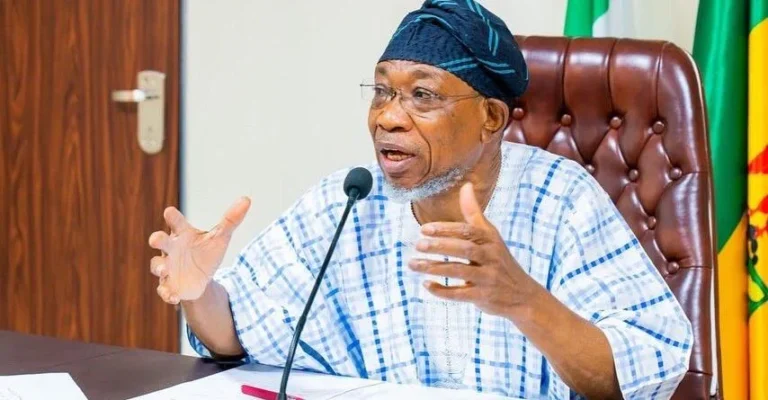
Rauf Aregbesola, a prominent figure in Nigerian politics and currently the National Secretary of the African Democratic Congress (ADC), has recently made a remarkable claim regarding his personal living arrangements during his two terms as the Executive Governor of Osun State. Speaking in a widely circulated video, Aregbesola asserted that he governed the southwestern state for eight years without owning a personal house, instead residing in a friend’s property. He further challenged anyone to provide evidence to the contrary, positioning his claim as a unique and perhaps unparalleled record among Nigerian governors. This declaration, made by a politician with a significant career trajectory from state executive to federal minister, has ignited considerable discussion among political analysts, the public, and anti-corruption advocates, raising questions about the ethics of public service, personal integrity, and the often-opaque nature of asset declarations by elected officials in Nigeria.
The Genesis of a Singular Claim
Aregbesola’s assertion centers on a period spanning from 2010 to 2018, during which he served two consecutive terms as Osun State Governor. In the video, he explicitly stated, "I’m the first governor in Nigeria to rule a state for eight years without owning a house of his own. I stayed in my friend’s house for eight years as a governor in my father’s land. Whoever says that what I’m saying is not true should come out and show me the house I own." This statement is not merely a personal anecdote but a direct challenge to public record and a bold declaration of a particular brand of leadership. The implication behind his words is one of detachment from material accumulation while in office, suggesting a focus on public service over personal enrichment—a narrative that often resonates strongly with a populace weary of perceived corruption in government.
The claim immediately draws attention due to its unusual nature. Typically, state governors reside in an official Government House, a property provided and maintained by the state for the incumbent and their family. Aregbesola’s statement suggests that while he may have utilized the official residence for state functions or administrative purposes, his personal dwelling, where he presumably retreated for private life, was not his own property and was instead a friend’s home. This distinction is crucial and requires careful consideration to fully grasp the weight of his declaration. It challenges the conventional understanding of a governor’s lifestyle and assets, prompting a deeper look into the standards of public accountability in Nigeria.
A Look Back at Aregbesola’s Political Journey
Ogbeni Rauf Adesoji Aregbesola’s political career is marked by various significant roles, providing a rich context for understanding his recent claim. Before his gubernatorial tenure, Aregbesola served as the Commissioner of Works and Infrastructure in Lagos State from 1999 to 2007, under the administration of then-Governor Bola Ahmed Tinubu. This period was instrumental in shaping his administrative experience and political ideology, deeply rooted in progressive politics.
His journey to the Osun State Governorship was protracted and fiercely contested. He ran for governor in 2007 under the Action Congress (AC) banner. Following a controversial election and a lengthy legal battle, the Court of Appeal ultimately declared him the rightful winner, nullifying the election of the incumbent Olagunsoye Oyinlola. Aregbesola was sworn in as Governor of Osun State on November 26, 2010. His victory was seen as a triumph for electoral justice and a testament to his resilience.
During his eight years as governor, Aregbesola implemented several ambitious programs aimed at transforming Osun State. Key initiatives included:
- O’YES (Osun Youth Empowerment Scheme): A flagship program that engaged thousands of unemployed youths in public works, agricultural projects, and environmental sanitation, providing stipends and vocational training.
- O’MEAL (Osun Elementary School Feeding and Health Programme): Providing free, nutritious meals to public elementary school children, significantly boosting enrollment and health metrics.
- Infrastructure Development: Extensive road construction projects, particularly in urban and rural areas, aimed at improving connectivity and economic activity.
- Education Reforms: Including the construction of modern school buildings (Mega Schools) and a unified school uniform scheme.
- Security Initiatives: Focused on improving law and order across the state.
Despite these initiatives, Aregbesola’s second term, from 2014 to 2018, was fraught with economic challenges, largely due to a significant decline in federal allocations exacerbated by a slump in global oil prices. This led to difficulties in salary payments for civil servants and teachers, generating considerable public outcry and political opposition. These challenges often led to heated debates about the state’s financial management and priorities. It is within this complex backdrop of both perceived achievements and significant difficulties that Aregbesola’s claim of personal austerity during his tenure gains particular resonance.
After concluding his governorship in 2018 and handing over to his successor, Gboyega Oyetola (who was also a member of the All Progressives Congress, APC), Aregbesola was appointed the Minister of Interior by President Muhammadu Buhari in 2019. He served in this capacity until the end of Buhari’s administration in 2023, overseeing critical agencies such as the Nigeria Immigration Service, Nigeria Correctional Service, Nigeria Security and Civil Defence Corps, and the Federal Fire Service. His time as Minister was also marked by efforts to reform the passport issuance process, improve correctional facilities, and enhance national security.
More recently, Aregbesola transitioned from the APC to the African Democratic Congress (ADC), a move that signaled a significant shift in his political alignment and underscored internal dynamics within the APC, particularly in Osun State, where his relationship with Governor Oyetola had become strained. His current role as ADC’s National Secretary positions him as a key voice within a growing opposition party, and his recent claim can be seen, in part, as an attempt to define his political brand and that of his new party.
The Nuance of "Owning a House" and Asset Declaration
The core of Aregbesola’s claim hinges on the definition of "owning a house" and how it aligns with the expectations and legal requirements for public office holders in Nigeria. Under Nigerian law, particularly the Code of Conduct for Public Officers enshrined in the Third Schedule of the 1999 Constitution (as amended) and enforced by the Code of Conduct Bureau (CCB), all public office holders are mandated to declare their assets upon assumption and exit of office. These declarations are meant to promote transparency, prevent corruption, and ensure accountability.
When a governor claims not to own a house, it prompts several interpretations:
- No Personal Residence Acquired During Tenure: This is the most straightforward interpretation—that he did not purchase or construct a private dwelling for himself or his family during the eight years he held office.
- No Personal Residence at All: This suggests a state of literal homelessness or reliance on others for accommodation, even before assuming office, which is less common for individuals reaching such high political stature.
- Distinction from Official Residence: As mentioned, governors are typically provided with an official residence. Aregbesola’s claim implies he might have used the Government House for official duties but did not consider it his personal "owned" property, and his private life was conducted from a friend’s house. This raises questions about the protocol and security implications of such an arrangement.
If Aregbesola truly did not own a house throughout his governorship, his asset declarations to the Code of Conduct Bureau would presumably reflect this. These declarations are, in theory, public documents, though access can often be challenging. Proving or disproving his claim would require access to these records and potentially investigations into property registries in Osun State, his home state, and other potential locations. The burden of proof he places on those who disagree with him implicitly shifts the responsibility of verification to the public and oversight bodies.
The practice of asset declaration in Nigeria has often been criticized for its lack of transparency and enforcement. While the law mandates it, the details of these declarations are not always readily accessible to the public, making it difficult to independently verify claims like Aregbesola’s. This opacity often fuels skepticism, even for claims of probity.
Inferred Reactions and Public Discourse
A claim of this magnitude, especially from a former governor and federal minister, inevitably elicits a wide range of reactions across various segments of society:
- Public Admiration and Skepticism: Many Nigerians, disillusioned by pervasive corruption in public office, might view Aregbesola’s claim as a testament to integrity and selflessness, a rare example of a politician not enriching himself at public expense. This narrative could resonate powerfully, particularly among those who value humility in leadership. Conversely, others might express skepticism, viewing it as a carefully crafted political statement designed to burnish his image or distract from past controversies. They might demand concrete proof or point to the challenges of verifying such a claim.
- Political Rivals and Opponents: For political opponents, particularly those within the APC with whom Aregbesola has had recent disagreements, this claim could be fodder for counter-narratives or attempts to discredit him. They might challenge him to release his asset declaration forms or accuse him of grandstanding. Questions about potential conflicts of interest arising from living in a friend’s house for eight years might also be raised.
- Anti-Corruption Advocates and Civil Society: Groups dedicated to good governance and anti-corruption would likely welcome the public discussion initiated by Aregbesola’s claim. They might call for greater transparency in asset declarations for all public office holders and use this as an opportunity to push for reforms that make such records easily verifiable by the public. They would likely emphasize the importance of independent verification rather than simply taking a politician’s word.
- African Democratic Congress (ADC): As the National Secretary of the ADC, Aregbesola’s claim would likely be embraced by his new party as a testament to his character and a model for the kind of ethical leadership the ADC aims to represent. It could be used as a rallying point to distinguish the party from others perceived to be riddled with corruption.
- Former Aides and Colleagues: Those who worked closely with Aregbesola during his tenure might either corroborate his claim, sharing anecdotes that support his narrative of frugality, or, if disaffected, challenge its veracity with their own insights.
Broader Implications for Nigerian Politics and Public Trust
Aregbesola’s assertion carries significant implications for the landscape of Nigerian politics, particularly concerning issues of integrity, public trust, and leadership standards.
- Setting a Precedent or Raising the Bar: If Aregbesola’s claim is substantiated, it would indeed set a remarkable precedent, challenging future and incumbent governors to demonstrate similar levels of personal austerity. It could potentially shift public expectations regarding the personal conduct and material possessions of their leaders. It might encourage a closer examination of the lifestyles of public officials.
- Impact on Political Image and Future Ambitions: For Aregbesola himself, this claim is a potent tool for shaping his political image. As he navigates his role in the ADC, a party positioning itself as an alternative, a reputation for incorruptibility and humility could be invaluable. It could lay the groundwork for future political aspirations, possibly at the national level, by portraying him as a leader distinct from the norm.
- Reinforcing or Eroding Public Trust: The way this claim is received and ultimately verified or refuted will have an impact on public trust in politicians. If Aregbesola’s claim is widely accepted as true, it could offer a glimmer of hope that not all politicians are driven by self-enrichment, potentially bolstering trust. However, if it is perceived as a mere political stunt or is eventually disproven, it could further deepen public cynicism and distrust in the political class.
- Catalyst for Transparency Reforms: The public discourse generated by Aregbesola’s statement could serve as a catalyst for renewed calls for greater transparency in asset declaration processes. Civil society organizations and media outlets might intensify their advocacy for easier public access to the asset declarations of public officials, thereby strengthening accountability mechanisms.
- Ethical Considerations of "Friendship" in High Office: Living in a friend’s house for an extended period as a governor, while potentially demonstrating humility, also opens up ethical questions regarding potential conflicts of interest or undue influence. The nature of the "friendship" and any benefits exchanged, even implicitly, could become subjects of scrutiny, underscoring the delicate balance between personal relationships and public office.
In conclusion, Rauf Aregbesola’s extraordinary claim of governing Osun State for eight years without owning a personal house, instead relying on a friend’s hospitality, is more than just a personal anecdote. It is a bold political statement that challenges established norms, provokes scrutiny of asset declaration processes, and reignites debates about integrity in Nigerian public service. As this claim circulates, it places a significant spotlight on the former governor, inviting both admiration and skepticism, and ultimately contributes to the ongoing, vital conversation about accountability and ethical leadership in Nigeria’s complex political landscape. The challenge he issued for proof underscores the need for greater transparency and verifiable facts in the public domain concerning the assets and conduct of those entrusted with governance.