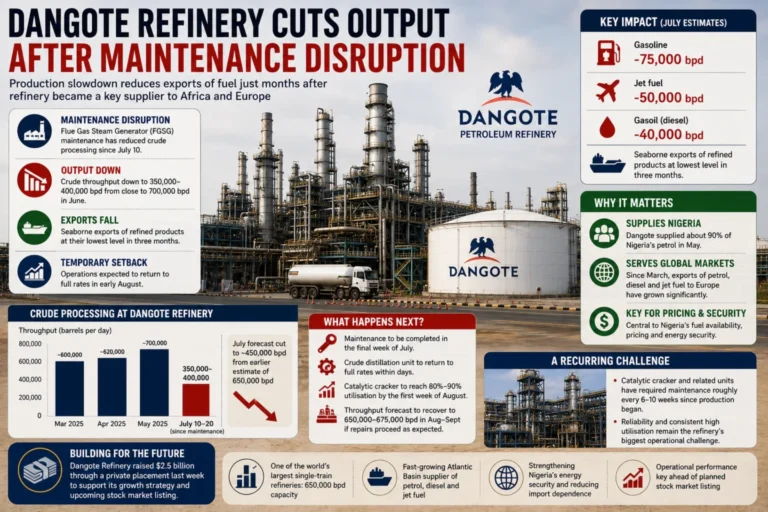
Production at Africa’s largest refinery, the Dangote Petroleum Refinery, has been significantly reduced following essential maintenance work, leading to a notable decrease in refined fuel exports to both African and European markets. This development comes just months after the colossal facility emerged as a pivotal supplier, underscoring its growing influence on the international energy landscape.
Refinery Operations Reduced Amidst Maintenance
According to data from commodity intelligence firm Kpler, crude processing at the 650,000-barrel-per-day refinery experienced a sharp decline, falling to an estimated range of 350,000 to 400,000 barrels per day starting from July 10th. This operational dip has prompted Kpler to revise its July throughput forecast downwards to approximately 450,000 barrels per day, a substantial revision from its initial projection of 650,000 barrels.
The primary driver behind this reduction in output is ongoing maintenance on the refinery’s Flue Gas Steam Generator (FGSG), a critical heat recovery system. This maintenance activity has created operational constraints across the entire plant, necessitating a temporary scaling back of crude processing.
A New Operational Bottleneck
Distinguishing this disruption from previous incidents, Kpler noted that the current maintenance issue is not directly linked to the refinery’s residue fluid catalytic cracker (RFCC). The RFCC has historically been identified as the facility’s principal operational bottleneck, experiencing repeated maintenance cycles since the refinery commenced operations. This new challenge, stemming from the FGSG, suggests a potentially different set of technical hurdles that the refinery is navigating.
Impact on Production and Exports
The reduced processing rates are projected to have a tangible impact on the production of key refined products. Kpler’s estimates indicate a daily reduction of approximately 75,000 barrels of gasoline, 50,000 barrels of jet fuel, and 40,000 barrels of gasoil for the month of July.
Consequently, seaborne exports of refined products from the Dangote refinery have fallen to their lowest point in three months. This contraction in supply from a major exporter is likely to create ripples in regional and international fuel markets, particularly in the Atlantic Basin.
Background: A Rapid Ascent to Global Supplier Status
The Dangote Petroleum Refinery, a monumental undertaking by Nigerian billionaire Aliko Dangote, officially commenced production in early 2024. Its rapid ramp-up in output in the subsequent months was a significant achievement, transforming it into a key player in the global refined products market. In June, the refinery reportedly processed close to 700,000 barrels per day during performance tests, even surpassing its nameplate capacity following optimization efforts that enhanced effective capacity by approximately 10%.
This surge in production enabled the refinery to become one of the Atlantic Basin’s fastest-growing suppliers of refined petroleum products. Since March, Dangote has notably expanded its exports of gasoline, diesel, and particularly jet fuel into Europe. This strategic redirection of product flows has been instrumental in helping to fill supply gaps that arose from reduced refinery exports from Russia and tighter product flows from parts of the Middle East, particularly in the wake of geopolitical events and sanctions.
Broader Implications for Nigeria and Global Markets
The current operational slowdown at the Dangote refinery carries significant implications, extending beyond Nigeria’s domestic fuel market. For Nigeria, a country that has historically struggled with refining capacity and relied heavily on fuel imports, the Dangote refinery’s output has been transformative. The Nigerian Midstream and Downstream Petroleum Regulatory Authority (NMDPRA) had previously indicated that the Dangote refinery supplied approximately 90% of the country’s petrol in May. This highlights the refinery’s central role in ensuring domestic fuel availability and stabilizing prices within Nigeria.
The temporary reduction in production, therefore, raises concerns about potential domestic supply strains, although the full extent of the impact will depend on the duration of the maintenance and the availability of alternative supply sources.
Earlier in July, the refinery had briefly suspended naira-denominated truck loading, a move attributed to pricing reviews, before resuming local currency sales. This incident, coupled with the current production curtailment, underscores the sensitivity of Nigeria’s fuel market to the refinery’s operational status.
Timeline of Recent Events
- Early 2024: Dangote Petroleum Refinery commences production.
- Spring 2024: Refinery gradually increases output and begins significant export operations.
- June 2024: Refinery achieves throughputs nearing 700,000 barrels per day during performance testing.
- July 10, 2024: Crude processing at the refinery begins to decline due to maintenance on the Flue Gas Steam Generator (FGSG).
- Mid-July 2024: Kpler reports reduced processing rates and forecasts lower July throughput. Exports of refined products fall to a three-month low.
- Early July 2024 (prior to production dip): Refinery temporarily suspends and then resumes naira-denominated truck loading after pricing review.
Expert Analysis and Future Outlook
Despite the current setback, industry analysts express optimism that the disruption will be temporary. Kpler projects that the maintenance work is expected to be completed by the final week of July. Following this, the crude distillation unit is anticipated to return to full operating rates within days. The refinery’s catalytic cracker is forecast to reach between 80% and 90% utilization by the first week of August.
If these repair efforts proceed as planned, refinery throughput is projected to recover to between 650,000 and 675,000 barrels per day throughout August and September. This recovery would signal a return to the refinery’s strong performance levels seen in previous months.
Persistent Challenges: Reliability as a Key Concern
However, Kpler also issued a cautionary note, highlighting that reliability remains the refinery’s most significant operational challenge. Since the commencement of production, the catalytic cracker and associated units have undergone repeated maintenance approximately every six to ten weeks. This recurring need for maintenance raises questions about the facility’s long-term ability to sustain high utilization rates consistently, especially as it aims to expand its operations and market reach.
The consistent operational performance of the Dangote Refinery will be closely scrutinized, particularly as the company works to strengthen its financial position ahead of a planned stock market listing. Last week, the company announced a successful private placement of $2.5 billion, intended to support its ambitious growth strategy. The ability to demonstrate sustained operational efficiency and reliability will be crucial for investor confidence and the successful execution of these future plans.
The temporary reduction in output from Dangote Refinery serves as a reminder of the complexities inherent in operating a facility of this scale and its significant impact on both domestic energy security and international fuel supply chains. As the refinery navigates its maintenance cycles, the global energy market will continue to monitor its performance closely.