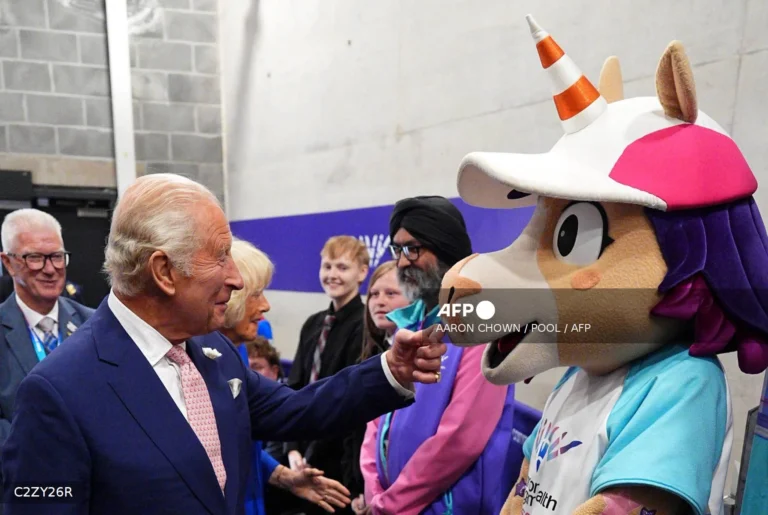
Glasgow, Scotland – July 23, 2026 – His Majesty King Charles III officially inaugurated the 23rd Commonwealth Games in Glasgow today, marking the commencement of a 10-day spectacle designed with a significantly streamlined approach to manage escalating costs. The ceremony, held at the OVO Arena, heralded an event that brings together approximately 3,000 athletes from 74 nations and territories, all vying for 215 gold medals across a focused program of 10 core sports and six para-sports. This marks Glasgow’s second time hosting the prestigious event, having previously done so 12 years prior.
The opening ceremony itself was imbued with a spirit of joviality and a touch of British eccentricity. King Charles III, accompanied by his wife, Queen Camilla, made a memorable entrance emerging from a replica of the TARDIS, the iconic time-traveling police box from the beloved British science fiction series "Doctor Who." This whimsical start set a light-hearted tone before the Royal couple took their seats in the 14,000-capacity Hydro arena, situated at the heart of the city.
In his address to the assembled athletes, King Charles III emphasized the unifying power of sport and the dedication of the competitors. "As we gather, we celebrate the dedication and talent of every athlete and team," he declared. "Your perseverance inspires us, and we eagerly anticipate your achievements in the coming days. As we share our love of sport, and our planet, let us build a harmonious and durable future, for our families and each other." He concluded his remarks with the formal declaration: "It is now my great pleasure to declare the twenty-third Commonwealth Games open."
This year’s Games represent a significant departure from tradition, featuring the first-ever indoor opening ceremony for an event that traces its origins back to the British Empire Games in 1930. The Commonwealth Games, still largely comprised of nations historically linked by British imperial rule, have undergone a profound restructuring in response to challenges that threatened its very existence just three years ago.
The Road to Glasgow: A Rescued Games
The journey to these Glasgow Games has been marked by significant turbulence. In 2023, the Australian state of Victoria, initially slated to host, withdrew its bid, citing overwhelming and spiraling costs associated with staging the event. This decision cast a shadow of uncertainty over the future of the Commonwealth Games, a sporting tradition cherished by many of its member nations.
It was Glasgow, a city with proven experience in hosting major sporting events, that stepped in to salvage the Games. The Scottish city’s commitment to hosting, however, came with a markedly different financial outlook. The projected expenditure for the Glasgow 2026 Games is reportedly a quarter of the cost incurred when the city last hosted in 2014. This fiscal prudence is reflected in the scaled-down sporting program, which features nearly half the number of sports compared to the 19 sports contested at the Birmingham Games four years prior.
A Resilient Spirit: "Extraordinary Things"
The resilience and determination of Glasgow and the Commonwealth Games Federation (CGF) were palpable in the pronouncements made during the opening ceremony. George Black, Chair of Glasgow 2026, eloquently captured the spirit of the city’s response to the crisis. "When the future of these Games was uncertain, Glasgow didn’t ask, ‘Can we?’ We asked, ‘When do we get started?’" Black stated. "Because that’s what we do. We roll up our sleeves and, together, we make extraordinary things happen." This sentiment underscores a pragmatic and proactive approach, prioritizing the continuation of the Games over the grandeur of past editions.
The choice of an indoor venue for the opening ceremony offered a unique and intimate experience for the athletes, allowing them to be welcomed into the arena with a sense of camaraderie. The ceremony was attended by a distinguished array of dignitaries, including the newly appointed UK Prime Minister Andy Burnham and Scotland’s First Minister John Swinney, underscoring the national and international significance of the event.
Geopolitical Echoes and Sporting Rivalries
Amidst the celebrations, a moment of particular poignancy arose during the athletes’ parade. The six-strong team from the Falkland Islands received one of the most enthusiastic ovations of the evening. This reception followed a recent contentious incident during the FIFA World Cup, where Argentine players displayed a banner proclaiming "Las Malvinas son Argentinas" (The Falklands are Argentine) after their victory over England. The historical context of the 1982 conflict over the British Overseas Territory in the South Atlantic lent added weight to the Falklands team’s appearance and the crowd’s supportive reaction.
The Sporting Program: A Focused Competition
The 2026 Commonwealth Games will showcase a carefully curated selection of sports, designed to maximize athlete participation and fan engagement within the revised budgetary framework. The core sports on the program include athletics and swimming, perennial crowd-pleasers that consistently deliver thrilling performances. These are complemented by artistic gymnastics, track cycling, netball, weightlifting, boxing, judo, bowls, and 3×3 basketball.

The para-sport program has also been expanded, marking the largest ever para-sport offering at a Commonwealth Games. This inclusive approach will feature para-athletics, para-swimming, para-track cycling, para-powerlifting, para-bowls, and para-wheelchair basketball, providing a significant platform for para-athletes to compete and inspire.
Stars to Watch: A Glimpse of Potential Champions
The Glasgow Games are poised to feature a constellation of sporting talent, with several athletes already generating significant buzz. Scotland’s own Josh Kerr, fresh from breaking a 27-year-old world record for the mile, is a prominent poster boy for the home nation and a strong contender in the athletics program.
On the track and field, the javelin competition is anticipated to be a highlight, with a compelling showdown expected between Pakistan’s Olympic champion Arshad Nadeem and India’s Neeraj Chopra, a rivalry that has captured the attention of sports fans across the subcontinent.
In the swimming arena, England’s Adam Peaty, a dominant force in breaststroke, will be aiming for gold in both the 50m and 100m events at the very venue where he secured his first international medals 12 years ago. Meanwhile, South Africa’s Chad Le Clos, a celebrated Olympic and Commonwealth champion swimmer, has the opportunity to become the most decorated male athlete in Commonwealth Games history, should he add to his impressive tally of 18 medals.
Analysis: The New Commonwealth Games Model
The decision to slim down the Commonwealth Games program and focus on cost control represents a significant shift in the evolution of multi-sport events. The withdrawal of Victoria underscored a growing concern about the financial sustainability of hosting large-scale international competitions. By scaling back the number of sports and opting for more cost-effective venues and infrastructure, Glasgow 2026 is attempting to create a more viable and enduring model for future Commonwealth Games.
This approach, while potentially disappointing for athletes in sports that did not make the cut, prioritizes the continuity of the Games themselves. The CGF and host cities are grappling with the challenge of balancing tradition and legacy with the realities of modern economic pressures. The success of Glasgow’s more modest Games could serve as a blueprint for other bids, demonstrating that a compelling and inspiring event does not necessarily require the colossal budgets of the past.
The focus on core sports and an enhanced para-sport program suggests a strategic decision to concentrate resources on disciplines with broad appeal and established Commonwealth participation. This may foster deeper competition and greater athlete development within these chosen sports.
Furthermore, the emphasis on sustainability and a "harmonious and durable future" articulated by King Charles III points towards a growing awareness of the environmental and social impact of major sporting events. Future Games will likely face increasing scrutiny in these areas, and Glasgow 2026’s approach may reflect an early adaptation to these evolving expectations.
The inclusion of the Falkland Islands team and the associated geopolitical undertones serve as a reminder of the unique historical and political context of the Commonwealth Games. While the primary focus remains on athletic achievement, the Games continue to be a platform where these historical narratives intersect with contemporary events.
As the athletes settle into competition, the world will be watching to see if Glasgow’s "slimmed-down" approach can deliver the magic and camaraderie that have long defined the Commonwealth Games, proving that resilience and innovation can indeed lead to "extraordinary things." The coming 10 days will not only determine medal winners but also offer insights into the future trajectory of this historic sporting event.