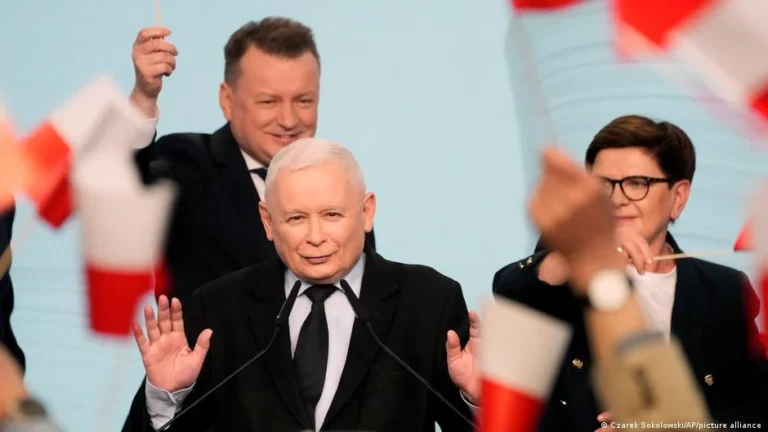
Poland’s dominant right-wing political landscape is experiencing an unprecedented tremor, as Jaroslaw Kaczynski, the venerable head of the Law and Justice (PiS) party, announced on Friday that "over 30 delegates of our group have effectively forfeited their membership." This dramatic declaration marks a severe escalation in the internal power struggle, with Kaczynski directly accusing Poland’s former Prime Minister, Mateusz Morawiecki, and his significant cohort of followers, of orchestrating an attempt to fracture the party. Morawiecki and his allies, however, vehemently deny resigning, asserting instead that they have been "expelled" in a move that signals the deepest crisis for PiS since its inception over two decades ago.
The rupture comes on the heels of a tense, three-hour "last chance" negotiation between Kaczynski and Morawiecki, which concluded late on Thursday without any resolution. The stalemate underscored the profound ideological and strategic chasm that has developed within the party. Piotr Mueller, an EU delegate closely aligned with Morawiecki, articulated the rebels’ position following the failed talks on X (formerly Twitter), stating, "We were looking for understanding, but couldn’t accept subjugation." This sentiment highlights a core disagreement over leadership style and the party’s future direction, moving beyond mere policy differences.
The Ultimatum and Its Immediate Fallout
The immediate catalyst for the split was an ultimatum issued by Kaczynski, demanding that rebel party members deliver a written declaration by midnight on Thursday. This declaration would commit them to refrain from all activities associated with the "Rozwoj Plus" (Development Plus) association, a new political initiative spearheaded by Morawiecki. In Kaczynski’s view, this breakaway association fundamentally challenged and undermined the primacy of the PiS party, threatening its centralized authority and ideological coherence.
Morawiecki, a figure who, despite his senior role as former Prime Minister, has often been regarded as an outsider within Kaczynski’s inner circle, staunchly refused to capitulate. "I’m not signing any loyalty pledge," Morawiecki declared to the Polish television station TVN, drawing a powerful historical parallel. He added, "That’s something one might have required of me in the 1980s," alluding to the era of communist rule in Poland and the persecution his own father faced as a prominent opposition activist. This poignant reference underscored Morawiecki’s conviction that the demand was an affront to democratic principles and individual political freedom, rather than a legitimate party requirement. His refusal effectively sealed the fate of the dissenting delegates.
The exact number of members who have now officially left or been removed from the PiS parliamentary group remains fluid, with initial reports suggesting over 30, potentially including several Members of the Sejm (Poland’s lower house of parliament) and European Union delegates. This defection marks a significant depletion of PiS’s parliamentary strength and political capital, particularly impactful as the party navigates its role in opposition after the 2023 parliamentary elections.
A Deepening Rift: Kaczynski’s "Fist" vs. Morawiecki’s "Two Lungs"
The current crisis is not an abrupt development but the culmination of months, if not years, of simmering tensions and divergent visions for the PiS party. For a quarter of a century, Jaroslaw Kaczynski has been the undisputed architect and dominant force behind the right-wing of Poland’s political spectrum. His leadership style has been characterized by strong centralization, unwavering ideological commitment, and a fierce determination to quash any internal dissent or external challenges to PiS’s right-wing hegemony. Any previous attempts to establish a new, more radical right-wing force in Poland were largely absorbed or successfully marginalized by PiS.
PiS has enjoyed periods of significant power, governing Poland from 2005-2007 and again from 2015-2023. The party has also successfully secured the presidency with Kaczynski’s twin brother, Lech, then Andrzej Duda, and, notably, secured the election of Karol Nawrocki as president, with his swearing-in reported in late 2024 for a term commencing mid-2025. This presidential success provides PiS with a crucial institutional foothold, even as they lost their parliamentary majority in the 2023 general election.
The 2023 parliamentary election marked a turning point. Despite PiS emerging as the single largest party, securing 35% of the vote, they were unable to form a governing coalition. This led to the formation of a pro-European, center-right government under Donald Tusk, pushing PiS into opposition for the first time in eight years. This electoral setback exposed the party to unprecedented internal pressures and external threats, particularly from increasingly vocal and popular far-right groups.
In the wake of this defeat, PiS found itself facing a dilemma. Two parties to its right, the far-right nationalist and libertarian alliance Confederation Liberty and Independence (KWIN) and the extreme right-wing, ultranationalist, traditionalist Confederation of the Polish Crown (KKP), have been steadily gaining traction. Combined, these groups now command more support in opinion polls than PiS alone, siphoning off a significant portion of PiS’s traditional voter base.
Kaczynski’s response to this challenge has been to push PiS even further to the right, attempting to reclaim lost voters by adopting more hardline positions. A clear manifestation of this strategy was his controversial nomination in March of Przemyslaw Czarnek, an ultraconservative, ultra-Catholic former minister of education and science, as the party’s lead candidate for the 2027 parliamentary election. Czarnek, known for his inflammatory rhetoric against the EU, LGBTQ+ rights, and secularism, embodies the "fist" approach favored by Kaczynski and his loyalists. This faction believes the party must act with unwavering resolve, outflanking the confederation parties from the right, even going as far as calling for the halting of military aid to Ukraine amid a Polish-Ukrainian dispute over historical issues.
Morawiecki and his followers view this aggressive shift as a "fundamental mistake." They advocate for a more pragmatic and expansive approach, aiming to broaden PiS’s appeal rather than narrow it. This ideological divergence has been publicly framed as a debate between Kaczynski’s "fist" and Morawiecki’s earlier concept of "two lungs" — implying that PiS should encompass both a hardline conservative core and a more moderate, outward-looking wing. The current split demonstrates that Kaczynski ultimately rejected the "two lungs" metaphor in favor of singular, centralized control.
Morawiecki’s ‘Development Plus’ and a Broader Conservative Vision
Mateusz Morawiecki’s launch of the political association "Development Plus" (Rozwoj Plus) is a direct response to Kaczynski’s strategic pivot. Morawiecki envisions this platform as a vehicle to reach out to new voters, particularly those who might be alienated by PiS’s increasingly radical stance but still identify with conservative values. His goal, he has repeatedly emphasized, is to ensure that right-wing conservatives can return to power in 2027, suggesting a path that might deviate from Kaczynski’s chosen trajectory.
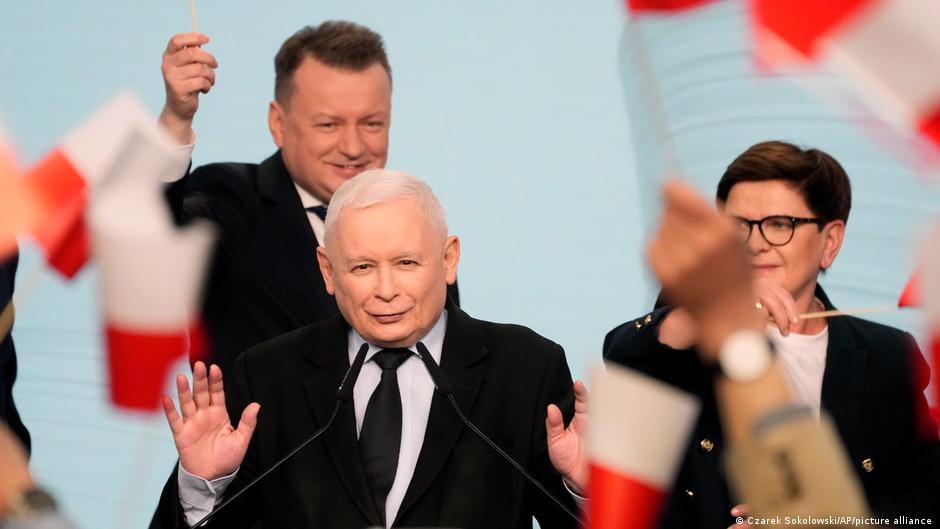
Morawiecki has actively toured the country, engaging with local politicians and businesses, cultivating a network of support. He has announced a significant policy event in late July, inviting 1,000 guests from diverse political backgrounds to discuss Poland’s future, an overt display of his ambition to build a broader coalition. His efforts to expand PiS’s appeal first clashed with Kaczynski in April, when the party head accused him of threatening party unity. While Kaczynski initially appeared to tolerate Morawiecki’s initiatives, even speaking of "two lungs" within the party at the time, that compromise proved short-lived.
Morawiecki’s background as a trained historian who held leading positions in several banks before joining PiS in 2016 positions him somewhat as an outsider to the party’s traditional ideological core. His career trajectory under PiS rule, serving as development minister, finance minister, and finally prime minister, has given him significant executive experience and a more technocratic image compared to many PiS stalwarts. This makes his appeal to potentially more centrist, business-oriented conservative voters distinct from the base that Kaczynski and Czarnek are targeting.
Electoral Ramifications and Shifting Polls
The immediate electoral impact of this split is already visible in recent opinion polls. A survey conducted by Opinia24 for Polish channels TVN and TVN24 on July 22 indicated a significant shift in voter sentiment. Support for Morawiecki himself registered at 6.2%, a notable figure for a nascent, independent political movement. Concurrently, support for PiS plummeted to 17.7%, a stark contrast to the 35% it secured in the 2023 parliamentary election. This dramatic decline suggests that the internal strife is severely damaging the party’s public image and electoral prospects.
The fragmentation of the right-wing vote is now a more tangible threat to PiS’s ambitions to return to power. With KWIN and KKP already siphoning off support, a new Morawiecki-led conservative faction could further dilute the right’s overall electoral strength. While Morawiecki could previously count on the support of approximately 40 members of the Sejm and several EU delegates, it remains uncertain how many will ultimately withstand Kaczynski’s formidable pressure and formally align with the former Prime Minister. The coming months will reveal the true extent of the defection and its implications for the parliamentary balance.
Reactions from Across the Political Spectrum
The center-right governing coalition, led by Prime Minister Donald Tusk, has made no secret of its amusement and satisfaction regarding PiS’s internal turmoil. Foreign Minister Radoslaw Sikorski succinctly captured the mood, quipping, "I love PiS so much, I’d love to have two of them." This sentiment reflects the strategic advantage the ruling coalition gains from the weakening and fragmentation of its primary opposition.
Political scientist Danuta Plecka, speaking on Friday, described the situation as "a gift" to the current government. "All the scandals of recent months are now fading into the background," she explained. "Tusk doesn’t have to do anything, he can just sit by the riverbank and wait for the bodies to float by." This perspective highlights how the internal implosion of PiS diverts public attention from any challenges or criticisms faced by the current administration, offering them a period of relative calm.
Analytical Perspectives: A Genuine Rupture or Calculated Maneuver?
While the immediate optics suggest a genuine and damaging rupture within Poland’s most powerful right-wing party, some analysts offer a more nuanced interpretation. University of Gdansk researcher Danuta Plecka, for instance, has posited that the conflict between Kaczynski and Morawiecki might, in fact, be a staged performance. "There are hardly any programmatic differences between the two," she told TVN, suggesting that the core ideological tenets remain largely aligned. "The main difference between them is in the language and political tactics."
This "staged performance" theory proposes a calculated strategy by PiS to appeal to a broader spectrum of voters. Under this hypothesis, Morawiecki’s role would be to attract more politically moderate, center-leaning conservatives and business-oriented individuals who might be put off by the increasingly radical rhetoric of Kaczynski and Czarnek. After the next parliamentary election, according to Plecka’s prediction, both groups could potentially reunite, forming a formidable right-wing bloc that spans a wider ideological range than PiS could achieve alone. This strategy, if true, would aim to maximize the right-wing vote in a fragmented political landscape.
However, the high-stakes nature of the current confrontation, including public accusations of betrayal, accusations of loyalty pledges reminiscent of authoritarian regimes, and significant drops in poll numbers, makes a purely strategic interpretation challenging. If the split is indeed genuine, the implications are profound for PiS. It risks fragmenting its voter base irrevocably, potentially relegating the party to a diminished role in Polish politics for the foreseeable future. A genuine split would also open up space for new conservative forces to emerge, reshaping the entire right-wing political ecosystem in Poland.
Furthermore, the differing stances on critical issues like the European Union and Ukraine, particularly Czarnek’s hardline anti-EU rhetoric and calls to halt aid to Kyiv, could have significant implications for Poland’s foreign policy and its standing within international alliances. Morawiecki, while a staunch Polish nationalist, generally maintained a more pragmatic approach to the EU during his premiership, understanding the necessity of engagement.
The Future of Poland’s Conservative Landscape
As Poland approaches its next parliamentary election in just over a year, the internal upheaval within PiS creates immense uncertainty. The party, which has been a monolithic force on the right for so long, now faces the prospect of significant internal division. Whether this split ultimately proves to be a temporary tactical maneuver or a permanent ideological schism, its immediate effect is to weaken PiS, distract from its opposition role, and potentially clear the path for the ruling coalition.
The coming months will be crucial in determining the true nature and longevity of this split. The ability of Morawiecki to solidify his new movement, attract sustained support, and withstand Kaczynski’s pressure will define the future contours of Poland’s conservative landscape. For now, the political riverbank is indeed a busy place, with the bodies of old alliances and unchallenged dominance potentially floating by, ushering in a new, more fragmented era for the Polish right.