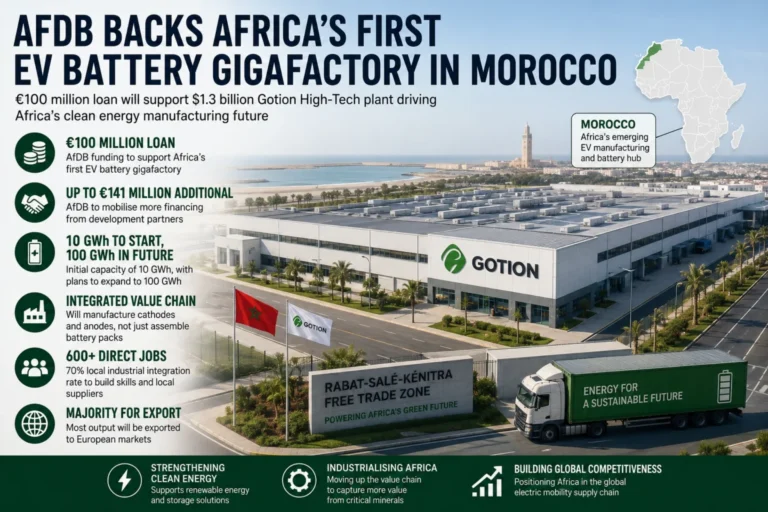
The African Development Bank (AfDB) has officially approved a substantial €100 million (approximately $114 million) loan to catalyze the development of Africa’s inaugural electric vehicle (EV) battery gigafactory. This landmark financial commitment represents a pivotal moment in the continent’s ambitious drive to establish a robust clean energy manufacturing sector, positioning Morocco at the forefront of this burgeoning industry. The project, spearheaded by China’s Gotion High-Tech, signifies a major leap forward in the continent’s industrialization strategy and its integration into global green technology supply chains.
A New Era for African Manufacturing
This significant investment by the AfDB is poised to transform Morocco into a key player in the global electric mobility landscape. The approved loan is earmarked for the construction of an integrated lithium iron phosphate (LFP) battery plant, a crucial component for modern electric vehicles. The facility will be strategically located within Morocco’s Rabat-Salé-Kénitra Free Trade Zone, a region already recognized for its industrial potential and strategic advantages. The total initial investment for this ambitious undertaking is projected to be around $1.3 billion, underscoring the scale and significance of this pioneering venture.
Beyond its direct financial contribution, the AfDB is demonstrating its commitment to mobilizing further capital for the project. The bank plans to leverage its position as the mandated lead arranger to secure an additional €141 million (approximately $161 million) from other development finance partners. This collaborative approach to financing highlights the project’s strong appeal and the confidence of international financial institutions in its viability and its potential to drive sustainable development across Africa.
Ambitious Production Goals and Integrated Value Chain
The Moroccan gigafactory is designed for significant scalability. In its initial phase, the facility is slated to produce 10 gigawatt-hours (GWh) of battery cells and battery packs annually, catering to the growing demand for electric vehicles. However, the long-term vision is even more expansive, with plans to eventually expand the production capacity to a staggering 100 GWh per year. This projected output would place the Moroccan plant among the world’s leading battery manufacturing sites, a remarkable achievement for a facility on the African continent.
A key distinguishing feature of this project is its commitment to establishing a truly integrated battery value chain within Africa. Unlike many existing battery initiatives that focus solely on the assembly of battery packs, the Moroccan facility will undertake the complex manufacturing of cathodes and anodes. These are the two fundamental components that determine a battery’s performance and capacity. By controlling these critical upstream processes, the gigafactory will significantly enhance local value addition and reduce reliance on imported components. This integrated approach is crucial for fostering a self-sustaining and competitive battery manufacturing ecosystem on the continent.
The strategic focus of the production will be on serving international markets, with a substantial portion of the output destined for European consumers. Morocco’s geographical proximity to Europe, coupled with its existing free trade agreements, makes it an ideal launchpad for supplying the rapidly expanding European EV market. This export-oriented strategy not only generates revenue but also firmly embeds African manufacturing within global supply networks.
Morocco’s Ascending Role in the Automotive Sector
This significant investment further solidifies Morocco’s position as Africa’s preeminent and fastest-growing hub for electric vehicle manufacturing. The country has been diligently cultivating its automotive sector for years, attracting major international players and fostering a conducive environment for industrial growth. Morocco already hosts established vehicle production facilities for global automotive giants like Renault and Stellantis. This existing infrastructure and expertise provide a strong foundation for the nascent battery manufacturing industry.
The influx of Chinese investment in battery materials and components has been a significant driver of Morocco’s automotive prowess. Companies such as BTR New Material Group, CNGR Advanced Material, Hailiang, and Shinzoom have already established or are planning significant operations in the country. These investments, alongside the new gigafactory, are creating a comprehensive ecosystem that spans from raw material processing to finished EV components.
The strategic advantages that have drawn these investments to Morocco are multifaceted. Its advantageous geographical location offers seamless access to European markets, a critical factor for export-oriented manufacturing. The country’s network of free trade agreements further reduces barriers to international trade. Moreover, its well-developed automotive industry provides a skilled workforce, established logistics networks, and a supportive regulatory framework. This combination of factors makes Morocco an increasingly attractive destination for companies seeking to diversify their manufacturing bases away from traditional Asian hubs and tap into the growing global demand for electric vehicles.
A Strategic Shift: Industrialization Over Raw Mineral Exports
The development of the Moroccan gigafactory is emblematic of a broader, continent-wide aspiration: to move beyond the role of simply exporting raw critical minerals and instead capture greater value through local processing and manufacturing. Many African nations are rich in the essential minerals required for battery production, such as cobalt, lithium, and nickel. Historically, these resources have often been exported in their raw form, with the majority of the value addition occurring elsewhere.
This new wave of industrialization, exemplified by the AfDB-backed gigafactory, represents a conscious effort to reverse this trend. By investing in downstream processing and manufacturing capabilities, African countries aim to create higher-value jobs, generate more revenue, and build a more resilient and diversified economy. This strategy aligns with the African Union’s Agenda 2063, which emphasizes industrial development, technological advancement, and intra-African trade.
Economic and Social Impact: Job Creation and Skill Development
The economic and social implications of the gigafactory are projected to be substantial. During its initial phase, the facility is expected to generate over 600 direct jobs. This creation of skilled employment opportunities is crucial for economic development and poverty reduction. Furthermore, the project aims to achieve an impressive 70% local industrial integration rate in its first phase. This ambitious target signifies a strong commitment to developing domestic suppliers, fostering local entrepreneurship, and building a robust network of African businesses that can contribute to the battery value chain. The emphasis on local integration will not only boost the Moroccan economy but also serve as a model for other African nations seeking to develop similar industries.
The development of a high-tech manufacturing sector like battery production will also necessitate significant investment in technical training and skill development. This will lead to the cultivation of a specialized workforce capable of operating and maintaining advanced manufacturing facilities, further enhancing the country’s human capital and its competitiveness in the global market.
AfDB’s Vision for a Green Energy Transition
Kevin Kariuki, Vice President for Power, Energy, Climate and Green Growth at the AfDB, articulated the bank’s strategic rationale behind this investment. He described battery storage as a "critical missing piece" in Africa’s ongoing clean energy transition. The ability to store energy generated from renewable sources, such as solar and wind, is essential for ensuring grid stability and reliability. Gigafactories like the one being developed in Morocco will not only contribute to the production of EVs but also play a vital role in developing large-scale battery storage solutions for renewable energy systems.
Kariuki emphasized that projects of this magnitude are instrumental in strengthening renewable energy infrastructure across the continent. By enabling more efficient integration of intermittent renewable sources, these initiatives can accelerate the transition away from fossil fuels and contribute to climate change mitigation efforts. Crucially, the development of these green industries will also lead to the creation of "green industrial jobs," offering sustainable employment opportunities and fostering a more environmentally conscious economy.
The AfDB’s investment in the Moroccan gigafactory is fully aligned with its broader strategic objectives. These include promoting industrialization, enhancing regional integration, and maximizing the value derived from Africa’s abundant natural resources. By supporting projects that move beyond raw material extraction and into sophisticated manufacturing, the bank aims to position the continent more competitively in the global electric mobility supply chains. This strategic foresight is crucial for ensuring that Africa benefits equitably from the global shift towards electrification and sustainable energy solutions. The project represents a tangible step towards realizing Africa’s potential as a significant player in the future of clean transportation and energy.