Over the past eighteen months, a profound and compounding crisis has quietly gripped global public health networks and human rights organizations dedicated to lesbian, gay, bisexual, transgender, intersex, and queer (LGBTIQ) communities. A sweeping retrenchment of international development assistance, spearheaded by major institutional and governmental donors, has severely destabilized grassroots providers. Essential services—ranging from HIV prevention and antiretroviral distribution to emergency crisis response, mental health counselling, and harm reduction initiatives—have faced drastic contractions. The resulting funding vacuum threatens to undo decades of painstaking public health gains, particularly across the Global South where systemic vulnerabilities are most pronounced.
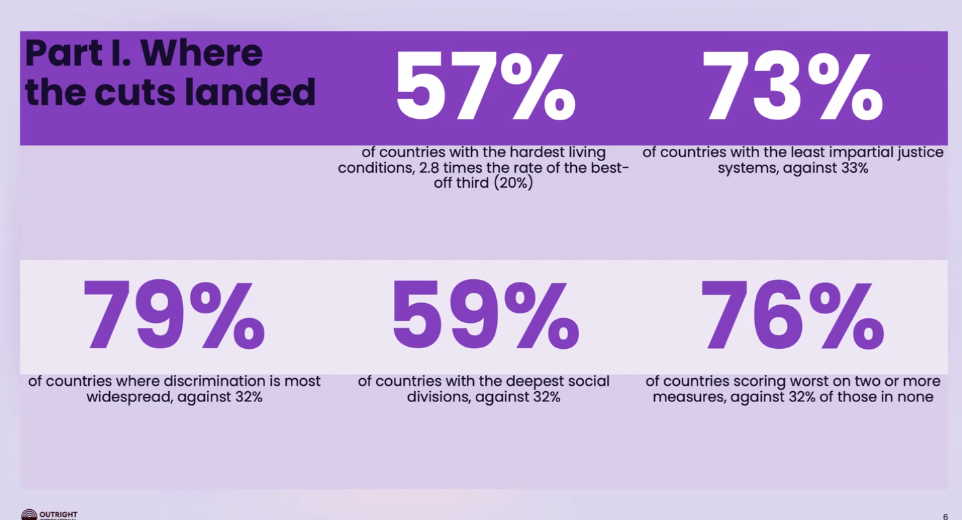
According to a comprehensive report released on Thursday by Outright International, a prominent global LGBTIQ human rights organization, the fallout from these budget reductions exhibits a cruel and paradoxical geography. Organizations operating in countries with the most repressive legal environments, the least impartial justice systems, and the most acute societal divisions have suffered the most catastrophic financial losses. Statistical indicators within the report reveal that groups situated in the harshest socio-political climates were approximately two to three times more likely to experience funding interruptions than their counterparts in more permissive regions. This targeted disenfranchisement has left community-rooted defenders isolated precisely when vulnerable populations face heightened legal persecution and state-sponsored hostility.
The Chronology of the Crisis: Shifts in International Donor Policy

The structural deterioration of the financial ecosystem supporting international LGBTIQ organizations accelerated dramatically following major political shifts in key donor nations, most notably the transition of power in the United States in January 2025. Outright International’s research, drawing on survey data from 229 LGBTIQ organizations spanning 94 countries, indicates that 203 of these groups experienced direct funding terminations or substantial reductions in the wake of the US administrative shift.
Historically, foreign assistance dedicated to marginalized and key populations relied heavily on a mixture of public and private funding streams. However, the operational landscape shifted abruptly when the US federal government moved to scale back or outright terminate targeted funding streams for HIV programs focused on key populations, such as men who have sex with men (MSM) and transgender women. Compounding this shift, the US State Department formally concluded the Global Equality Fund—a foundational public-private partnership established in 2011 that had previously distributed over $100 million to grassroots LGBTIQ organizations worldwide.
These policy modifications triggered an immediate domino effect across multilateral and bilateral aid frameworks. Other governmental donors, philanthropic foundations, and private corporations subsequently initiated their own strategic pullbacks or reductions in development assistance allocations. Consequently, local implementers faced an unprecedented liquidity crunch, transforming a shifting geopolitical landscape into an acute operational emergency for frontline community health workers.
Empirical Evidence and Financial Metrics
The quantitative dimensions of the funding crisis underscore the vulnerability of the global LGBTIQ civil society sector. Data compiled by Outright International demonstrates that the funding contractions have been executed with exceptional speed and magnitude. Nearly half of all surveyed organizations that experienced cuts reported losing at least 50% of their total operating budgets, while three-quarters saw reductions amounting to 25% or more of their financial resources.
Crucially, the blow has fallen disproportionately on small, localized entities. The report highlights that 73% of the affected organizations operate on annual budgets under $250,000. These grassroots operations typically lack financial reserves, endowments, or diversified funding portfolios, leaving them entirely incapable of absorbing sudden, large-scale shortfalls.
This financial vulnerability is further contextualized by broader development assistance figures. According to analyses presented by Outright leadership, donor government support for LGBTIQ communities has historically constituted a negligible fraction of international aid—accounting for a mere four cents out of every $100 distributed through official development assistance between 2023 and 2024. When this already limited baseline was subjected to broad policy revisions, the resulting contraction struck directly at the core of community-led service delivery.
Operational Impacts on HIV Care, Harm Reduction, and Mental Health
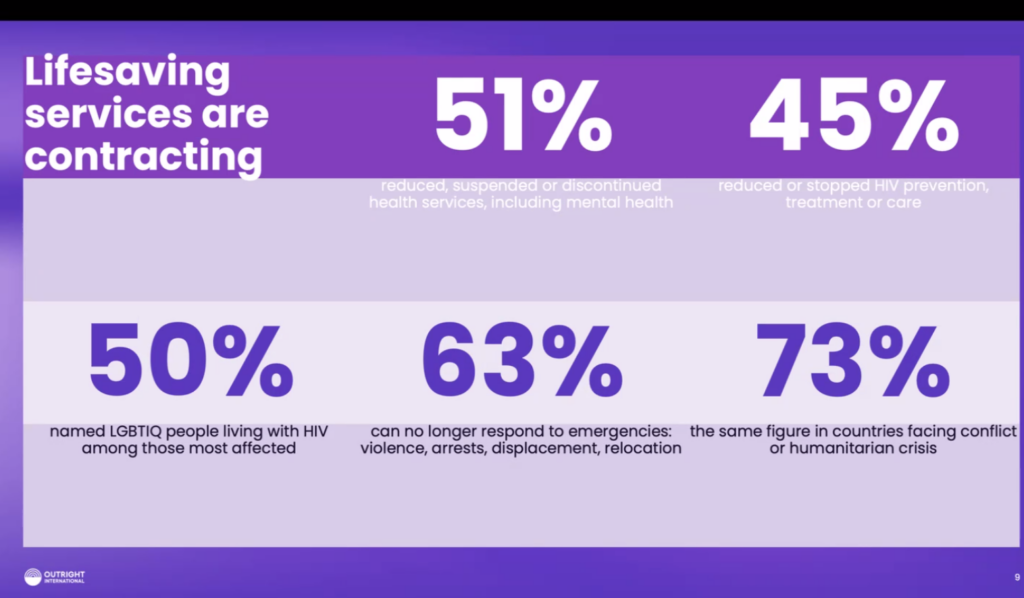
The contraction of financial resources has translated directly into the degradation of life-saving medical interventions. Among the organizations surveyed by Outright, 50% reported being forced to cut essential health services, including vital mental healthcare programs. Regarding the global HIV response specifically, 45% of respondents indicated that they had reduced or entirely discontinued prevention, testing, treatment, or care protocols. Furthermore, half of the organizations identified LGBTIQ individuals living with HIV as the constituency most severely impacted by these retrenchments.
These disruptions are not isolated phenomena. Network data compiled by Global Black Gay Men Connect indicates that 77% of key population organizations surveyed in their networks experienced severe interruptions in the supply chains for antiretrovirals (ARVs), pre-exposure prophylaxis (PrEP), and barrier methods.
Public health experts emphasize that the efficacy of these targeted health services derived precisely from their delivery model: they were administered by community-based organizations possessing deep cultural competence and an innate understanding of local stigma, criminalization dynamics, and fears of exposure. The sudden withdrawal of funding removed these specialized support structures from environments where mainstream public health infrastructure often fails to reach marginalized demographics. Alberto de Belaunde of Outright International emphasized this dynamic during the report’s launch, noting that capital was pulled precisely from regions where queer organizations were fulfilling vital public health functions that no other entities could replicate.
Case Studies from the Frontlines: Closures, Retrenchments, and Personal Tolls
The human cost of the funding crisis is vividly illustrated through testimonies and administrative data from various regions across the globe, revealing a cascading series of institutional failures and personal hardships.
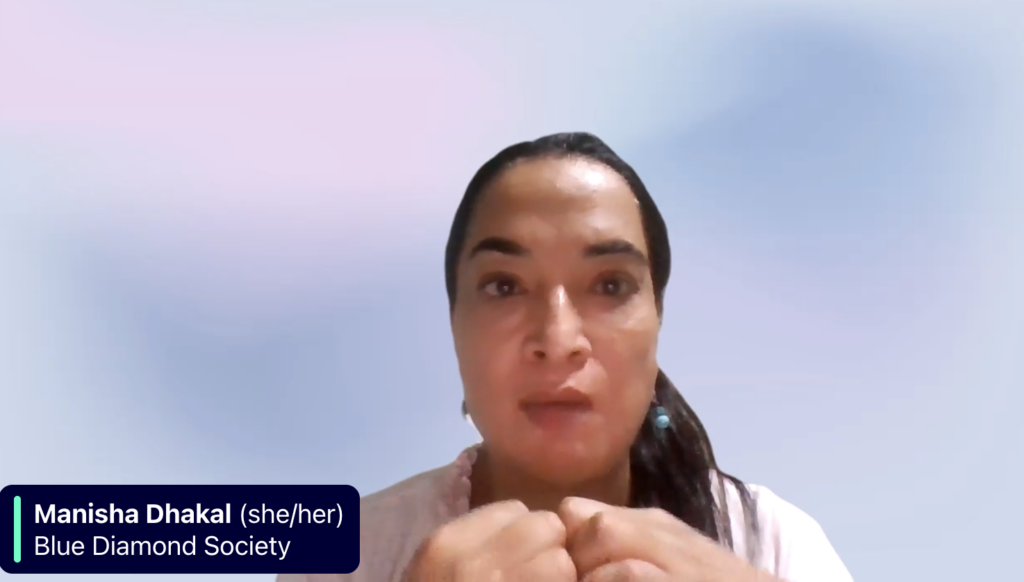
In Nepal, the Blue Diamond Society—a foundational trans-led organization—faced an 85% reduction in funding for an extensive HIV service delivery program operating across 21 districts and 24 clinical sites. The loss forced the organization to shutter clinics and execute widespread staff retrenchments. According to prominent trans activist Manisha Dhakal, the sudden loss of stable institutional employment forced several former aid workers into precarious survival strategies, including sex work, mirroring a broader crisis that saw an estimated 35,000 aid workers lose their livelihoods nationwide following concurrent USAID adjustments.
In East Africa, the convergence of external funding cuts and hostile legislative environments has generated severe protection crises. In Uganda, the implementation of the Anti-Homosexuality Act coincided with state-driven crackdowns surrounding national electoral cycles, generating an explosion in demand for emergency shelter and legal defense. John Grace, coordinator of the Uganda Minority Shelters Consortium (UMSC), reported a 283% increase in distress calls to national crisis hotlines, even as 60% to 70% of the network’s financial backing evaporated. Currently, the consortium possesses the logistical capacity to house, feed, and protect only three out of every ten youths fleeing mob violence, police raids, or family rejection. The desperation has grown so acute that UMSC has documented instances of young individuals trading portions of their life-saving antiretroviral medication on informal markets simply to secure a single daily meal.
Similarly, Kenya’s Mamboleo Peer Empowerment Group reported being forced to dismiss 100 peer educators, outreach workers, and legal aid providers. These personnel served as the vital connective tissue between vulnerable individuals and clinical care, gender-based violence response mechanisms, and emergency shelter systems. Their absence resulted in the immediate cessation of proactive community outreach and the silencing of vital safe spaces.

Additional reports from across regions illustrate the systemic reach of the crisis. In Zimbabwe, organizations reported that medication shortages caused treatment defaults, directly resulting in fatalities among clients. In Malawi, mobile HIV testing clinics tailored for MSM and transgender individuals have been shuttered due to resource constraints. In Türkiye, Kaos GL documented that the withdrawal of the UN Refugee Agency (UNHCR) from a collaborative refugee support initiative forced the closure of a dedicated program office and an 85% reduction in programmatic capacity. Meanwhile, queer-led initiatives in Jordan reported critical shortages in harm reduction kits, escalating community vulnerability to HIV and other sexually transmitted infections.
The Amplification of Risks for Intersex Communities
Beyond the visible disruptions in HIV care and shelter provision, the funding crisis has severely impacted some of the most historically overlooked segments of the broader movement. Intersex individuals—those born with reproductive, genetic, or anatomical characteristics that do not align with typical definitions of male or female—face acute structural neglect.
Human rights reports consistently highlight that intersex infants and children frequently remain vulnerable to medically unnecessary, non-consensual surgeries and interventions designed to modify their sex characteristics. Organizations dedicated to monitoring these practices, educating medical providers, and supporting affected families operate with exceptionally minimal resource bases. The recent wave of funding cuts has forced several of these specialized groups to suspend documentation and advocacy work entirely, leaving vulnerable children without community-based protection against institutionalized medical practices.
Broader Implications and Strategic Recommendations
The simultaneous withdrawal of major governmental and institutional donors occurs against a backdrop of globally coordinated anti-gender political organizing. Neela Ghoshal, Outright’s director of law, policy, and research, noted that the erosion of funding compounds a broader ideological pushback that threatens fragile human rights gains achieved over preceding decades.
Public health analysts warn that the systemic dismantling of community-led health infrastructure will likely produce measurable reversals in regional epidemic control, particularly regarding HIV transmission rates among key populations. Without the trusted intermediaries who navigate local legal barriers and cultural stigmas, public health agencies face profound structural hurdles in re-establishing effective testing, treatment adherence, and prevention paradigms.
In response to these findings, Outright International and allied civil society networks have issued an urgent appeal to international donors, philanthropic foundations, and private sector stakeholders. The recommendations urge funders to bypass conventional, bureaucratic grant cycles in favor of rapid-response mechanisms; to commit to multi-year, flexible financial support that allows organizations to navigate unpredictable regulatory environments; to prioritize the restoration of community-led health and harm reduction services; and to direct capital specifically toward regions experiencing the most severe structural hostility and financial distress.




