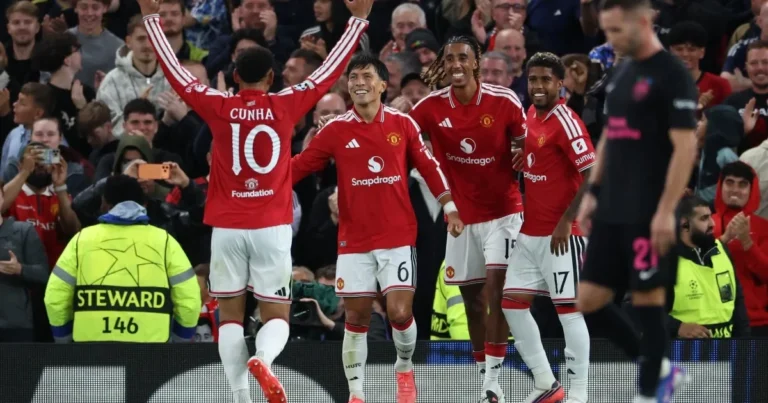
The Theatre of Dreams roared back to life on Thursday night as Manchester United marked their return to the UEFA Champions League with a comprehensive 4-0 demolition of Azerbaijani champions Sabah. After a three-year hiatus from Europe’s premier club competition, the Red Devils delivered an authoritative performance that provided a much-needed morale boost ahead of a pivotal weekend. For Sabah, a club in its relative infancy, the night served as a harsh but invaluable introduction to the highest level of professional football.
A One-Sided Affair at Old Trafford
The gulf in quality between the three-time European champions and the visitors from Baku was evident from the opening exchanges. While Sabah attempted to press with initial confidence in front of a capacity crowd of 74,000, their defensive structure collapsed once the hosts shifted into high gear.
The breakthrough arrived in the 27th minute. Patrick Dorgu, filling in admirably for the rested Luke Shaw, demonstrated his attacking intent by driving down the flank and delivering a pinpoint cross. Matheus Cunha, exhibiting the predatory instincts that have made him a focal point of the United attack, steered the ball home at the near post to ignite the Old Trafford faithful.
The match effectively ended as a contest during a frantic three-minute window before the halftime whistle. A fluid, intricate passing sequence involving Youri Tielemans and Bruno Fernandes carved open the Sabah defense, allowing the United captain to slot home his fourth goal in just two home appearances this campaign. Shortly thereafter, Bryan Mbeumo showcased his vision, threading a ball through for Benjamin Sesko. The young striker, making his first start of the season, rounded goalkeeper Stas Pokatilov with composure before rolling the ball into an empty net to make it 3-0.
The second half was a more measured affair, with Michael Carrick’s side comfortably managing the tempo. The final goal of the evening arrived through a moment of misfortune for the visitors. Following a scooped free-kick from Fernandes, Joshua Zirkzee attempted a clever backheel that was initially blocked. The resulting scramble left the ball loose at the feet of Pokatilov; the Kazakh goalkeeper’s hesitation proved fatal, as Lisandro Martinez capitalized on the error to slam the ball into the net, sealing the 4-0 scoreline.
Context and Historical Significance
Manchester United’s return to the Champions League follows a period of transition under manager Michael Carrick. The club, which has struggled for consistency in the early stages of the domestic Premier League season—securing only four points from three matches against Hull City, Ipswich Town, and Everton—was desperate for a catalyst to stabilize their campaign.
For Sabah, the fixture represented the culmination of a meteoric rise. Having navigated four arduous qualifying rounds, the Azerbaijani side became the first club from their nation to reach the group stage under the current format. The narrative of the evening was further underscored by the presence of Sabah coach Valdas Dambrauskas. For Dambrauskas, a return to Old Trafford was a poignant full-circle moment; years ago, he cut his teeth at the Manchester United Soccer Schools while working multiple part-time jobs to sustain his coaching ambitions.
In the pre-match press conference, Dambrauskas spoke with realism regarding the structural disparities between the two clubs. He acknowledged that his team had "leapfrogged" significant developmental milestones, reaching the Champions League without the benefit of prior experience in the UEFA Europa League or the UEFA Conference League.
Tactical Rotations and Future Implications
With a high-stakes Manchester derby against City looming on Sunday, Michael Carrick utilized the depth of his squad to manage player fitness. Key personnel, including Luke Shaw, Harry Maguire, and Marcus Rashford, were left out of the starting XI, while second-half substitutions allowed the likes of Kobbie Mainoo, Youri Tielemans, and Benjamin Sesko to be rested once the result was beyond doubt.
This tactical flexibility will be essential for Carrick as United navigates a demanding fixture list. The victory provides a necessary cushion for the squad, allowing the manager to integrate new signings and manage the physical load of a congested autumn schedule. However, the club’s leadership remains cognizant that the challenges ahead will be significantly more rigorous.
The true test of United’s European credentials will arrive in five weeks’ time when they travel to face Atletico Madrid. That encounter will provide a more accurate barometer of where this squad stands against the tactical rigidity and defensive tenacity of La Liga’s elite.
Broader Impact on English Football
The result was part of a broader, highly successful week for English clubs in Europe. With Arsenal, Aston Villa, Liverpool, and Manchester City all securing victories in their respective opening fixtures, the Premier League continues to assert its dominance in continental competition.
From an analytical standpoint, Manchester United’s performance highlights the importance of squad depth in the modern Champions League format. The ability to rotate key players while maintaining a high standard of play is a hallmark of successful European campaigns. Furthermore, the win serves to silence, at least temporarily, the criticisms surrounding United’s slow start to their domestic season.
Analytical Perspectives
Data from the match highlights United’s control throughout the 90 minutes. With a high percentage of possession and an efficient conversion rate, the Red Devils demonstrated a level of clinical finishing that had been missing in their previous domestic outings. The contribution of players like Patrick Dorgu, who looked comfortable transitioning from defense to attack, suggests that the club’s defensive options may be more versatile than initially perceived.
Conversely, the defensive errors displayed by Sabah underscore the steep learning curve for clubs entering the elite level of European football. While the scoreline was lopsided, the experience gained by the Sabah players in front of such a historic crowd will likely influence their development in future domestic and European cycles.
Looking Ahead
As the dust settles on the opening round of the Champions League, Manchester United finds themselves in a favorable position. The group stage format demands consistency, and having secured an early three points, the pressure is significantly reduced heading into the away fixture in Madrid.
For the supporters at Old Trafford, the evening was a reminder of the club’s enduring status as a destination for European football. While the domestic season remains the primary focus for the immediate future, the Champions League offers the platform that this squad requires to prove its worth on the global stage.
The victory was not merely about the four goals; it was about reclaiming the rhythm and confidence that define a successful season. By dispatching a debutant side with professionalism and tactical discipline, Carrick has signaled that Manchester United is ready to re-engage with the rigors of elite European competition. Whether this performance will translate into a sustained run in the tournament remains to be seen, but the initial foundation has been laid with absolute clarity. The road ahead remains difficult, but for one night in Manchester, the hierarchy of European football was restored to its traditional order.