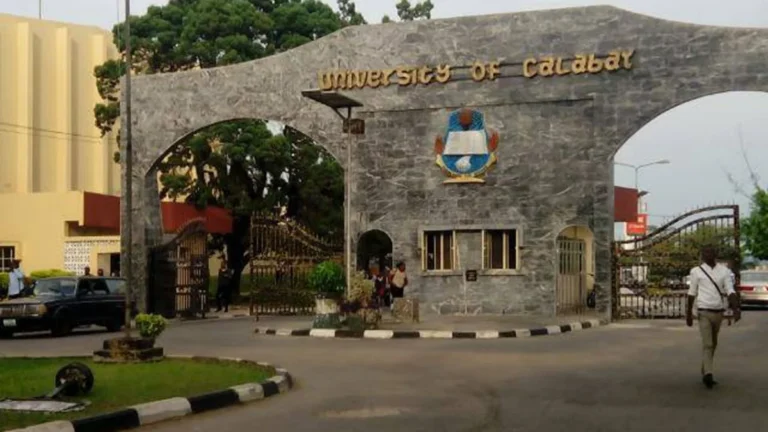
The administration of the University of Calabar (UNICAL) in Cross River State has found itself at the center of a high-stakes legal confrontation after a cohort of 214 second-year law students filed a sweeping lawsuit at the Federal High Court in Abuja. The aggrieved students, who were abruptly removed from the Faculty of Law and ordered back to their original departments, are demanding N5 billion in general and exemplary damages for breach of contract, administrative high-handedness, and violation of their fundamental constitutional rights.
The legal action, lodged on 12 August, names the University of Calabar, the Vice-Chancellor Prof. Offiong Offiong, the University Registrar, and President Bola Tinubu as respondents. At the heart of the dispute is a contentious administrative decision that upended the academic trajectories of hundreds of students who believed their enrollment into the prestigious law programme was legitimate, finalized, and protected by institutional continuity.
The Catalyst for Conflict: A Shift in Leadership and Policy
The controversy burst into the public domain following a directive issued by the UNICAL management in August, instructing 214 second-year Bachelor of Laws (LL.B) students to immediately vacate the Faculty of Law and return to the academic departments where they were initially admitted. The directive materialized after a turbulent meeting held in the institution’s Senate Chamber involving university management, Faculty of Law representatives, the affected students, and delegates from the Law Students’ Association of Nigeria (LAWSAN), UNICAL chapter.
According to university authorities, the intervention was necessitated by a systemic audit of the faculty’s enrollment figures. Vice-Chancellor Prof. Offiong disclosed that out of 435 students currently in their second year, only 221 were officially and correctly processed for admission into the law programme ab initio. The remaining 214 students, the administration claimed, had somehow found their way into the faculty from alternative departments through irregular channels.
Management further justified the mass displacement by arguing that these students would ultimately be rendered ineligible for mobilization to the Nigerian Law School and subsequent call to the bar if allowed to persist under their current admission standing. To remedy the situation, the university temporarily locked the academic and portal accounts of the affected students, cutting off their access to lectures, grades, and ongoing coursework. As a palliative measure, the institution offered to either refund their 2025/2026 academic session school fees or grant them free tuition for the 2026/2027 academic year should they return to their original departments.
The Students Account: Good Faith, Legitimate Expectations, and Broken Promises
The legal documents filed before the Federal High Court present a radically different narrative, detailing a systemic breakdown of administrative accountability that unfairly penalizes innocent scholars. Ogana Lawrence Lukpata, the second claimant, submitted a comprehensive affidavit on behalf of the 214 students, painting a picture of systemic betrayal.
According to the affidavit, the claimants were duly admitted into the UNICAL Faculty of Law spanning the 2023/2024 and 2024/2025 academic sessions. Upon receiving their offers of admission, the students fulfilled all prescribed institutional requirements: they accepted the offers, paid their acceptance fees, successfully navigated physical and document verification screenings, and religiously paid their school fees across nearly three academic years.
Furthermore, the students actively participated in the academic life of the institution. They registered for approved law courses, attended lectures regularly, submitted continuous assessment assignments, and sat for formal examinations supervised by the university. Having successfully passed these evaluations, they progressed seamlessly from the 100 level to the 200 level, with some advanced cohorts even touching the threshold of the 300 level.
The crisis deepened when the university instructed the students to undergo Joint Admissions and Matriculation Board (JAMB) regularisation—a standard administrative procedure for regularizing anomalous admissions—for which the students dutifully paid the requisite processing fees.
The students allege that the administrative bottleneck began shortly after Prof. Offiong Offiong, a professor of Chemistry, assumed office as vice-chancellor. Prof. Offiong succeeded Prof. Florence Obi, a professor of special education, whose five-year tenure concluded on 1 December 2025. Upon taking office, Prof. Offiong reportedly refused to endorse or validate the initial regularisation documents processed during his predecessor’s administration. The students claim they were told that the existing forms did not bear his specific authorization, forcing them to restart the arduous JAMB regularisation process and incur additional financial costs.
The breaking point arrived on 5 August when Prof. Offiong announced the mass expulsion of the 214 students from the law faculty. The students assert that this drastic step was executed without adherence to natural justice. None of the 214 students were served administrative queries, handed notices of allegations, summoned before a disciplinary panel, or afforded an opportunity to defend their student status. Crucially, none of the affected individuals have been investigated, indicted, or found culpable of examination malpractice, academic fraud, or any form of gross misconduct.

The claimants reserve particular ire for the university’s shifting of blame. Rather than holding institutional staff accountable for whatever administrative lapses occurred during the admission and regularization processes, the management elected to penalize students who acted in absolute good faith.
Legal Arguments: Contractual Obligations and Executive Continuity
Through their legal counsel, led by Okpi Bernard, the plaintiffs have asked the Federal High Court to resolve several crucial questions of law and administrative propriety.
The core of their legal argument rests on the doctrine of contract. The students maintain that their formal admission letters, acceptance of offers, payment of prescribed institutional fees, official course registrations, successful examination completion, and compliance with JAMB regularisation directives collectively forged a valid, binding, and subsisting legal contract between themselves and the University of Calabar.
Additionally, the suit invokes the principle of executive continuity and administrative estoppel. The plaintiffs argue that a sitting vice-chancellor cannot arbitrarily, unilaterally, or retroactively invalidate official acts, admissions, JAMB regularisation approvals, and institutional commitments executed by his predecessor in office simply due to a change in university leadership, especially when such actions prejudice innocent third parties.
The suit also questions whether the university acted ultra vires under Section 18 of the University of Calabar Act by demoting, ejecting, and transferring students, or locking their academic portals, without first initiating formal disciplinary proceedings or establishing guilt of academic dishonesty.
Finally, the plaintiffs address the inclusion of President Bola Tinubu as a respondent. They ask the court to determine whether the President, acting in his capacity as the appointing authority and visitor to federal tertiary institutions, holds a statutory responsibility to intervene and prevent unlawful, oppressive administrative decisions that threaten citizens’ fundamental right to education.
Reliefs Sought from the Federal High Court
The 214 students are pressing the court for substantial legal remedies to redress the wrongs they claim have been inflicted upon their academic and professional aspirations.
In addition to the N5 billion in damages, the claimants are seeking:
- A formal judicial declaration that valid legal contracts exist between them and the university based on their admission processes and fee payments.
- A ruling that the current vice-chancellor is legally bound by the doctrine of executive continuity, barring him from nullifying valid admissions granted under the previous administration.
- A declaration that their removal from the Faculty of Law and the restriction of their portal access violate Section 18 of the University of Calabar Act and infringe upon their constitutional right to a fair hearing.
- A permanent injunction restraining the university authorities from demoting, transferring, ejecting, or denying them access to learning opportunities within the Faculty of Law.
- A mandamus order directing President Bola Tinubu to exercise his supervisory powers over the institution to correct administrative overreach.
Recognizing the urgency of their situation, the students have simultaneously filed a motion on notice seeking interim protective orders. They are asking the court to grant an interlocutory injunction halting the enforcement of the 5 August directive pending the determination of the substantive suit. Furthermore, they seek a mandatory order compelling the university to immediately unblock and restore full, uninterrupted access to their academic result portals, course registration pages, and learning management systems.
Broader Implications for Nigerian Tertiary Education
This unfolding legal battle at the University of Calabar touches on systemic vulnerabilities within Nigeria’s higher education framework. Incidents of over-admission, administrative discrepancies during inter-departmental transfers, and friction between successive university administrations are not entirely isolated phenomena across the country’s federal universities.
However, the decision of over 200 students to collectively challenge a federal university and the presidency in court marks a notable escalation in student advocacy and legal recourse. If the Federal High Court rules in favor of the claimants, it could establish a powerful legal precedent reinforcing the doctrine of administrative continuity across Nigerian public institutions. It would signal that students who fulfill all institutional requirements in good faith cannot be victimized or used as collateral damage in internal administrative turf wars or retroactive policy overhauls.
As the matter proceeds to the courtroom, all eyes remain fixed on the judiciary to untangle the complex web of administrative responsibility, contractual law, and students’ rights at the University of Calabar.