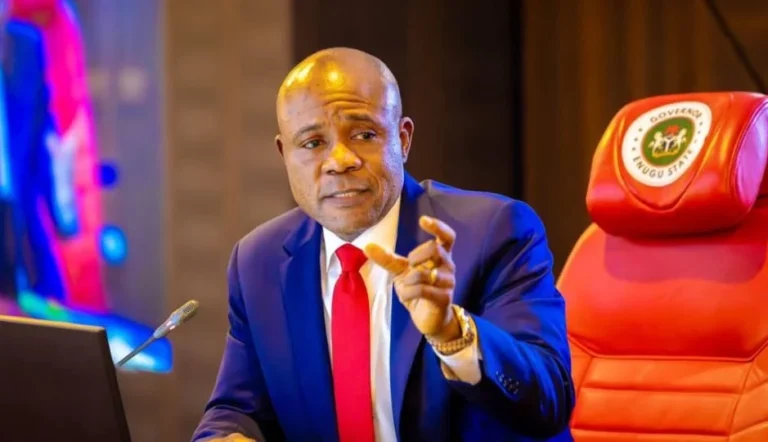
In a sweeping administrative maneuver aimed at bolstering governance structures and reinforcing grassroots political engagement, Enugu State Governor, Dr. Peter Mbah, has approved the immediate appointment of 101 political aides. The appointments, which cut across various sectors of public administration, economic development, and community relations, were officially announced on Monday in a public service statement signed by the Secretary to the State Government, Prof. Chidiebere Onyia.
The latest round of appointments marks one of the most substantial expansions of the executive support structure under Governor Mbah’s current tenure. Structured into a strict three-tier hierarchy, the newly expanded administrative team comprises seven Special Advisers, six Senior Special Assistants (SSAs), and 88 Special Assistants (SAs). According to the state government, all appointments take immediate effect, signaling an urgent push by the administration to optimize service delivery, streamline policy implementation, and consolidate political structures across the 17 local government areas of the state.
Breakdown of the Three-Tier Administrative Structure
The newly unveiled list reflects a deliberate effort to blend seasoned technocrats with grassroots political actors. The appointments are distributed across critical governance portfolios, ranging from conflict resolution and economic development to creative industry advancement and environmental sanitation.
The Special Advisers (SPAs)
At the apex of the new appointments are seven Special Advisers tasked with driving high-level policy formulation, strategic stakeholder management, and inter-governmental synergy. Heading this tier is Chief S.N.C. Nwagu, who assumes office as the Special Adviser on Conflict Resolution and Mediation—a vital portfolio given the rising need for communal harmony and security alignment in rural districts.
Other notable appointments in the Special Adviser category include Hon. Dr. Fidelis Odo, who will oversee Inter-Governmental Affairs and Co-ordination, and Augustine Okoli, charged with Policy Affairs and Analysis. Hon. Pedro Nwankwo takes charge of Stakeholders Relations and Community Affairs, while Chimezie Nkwuo is assigned to Economic Development. Rounding out the top-tier advisory council are Chief Vitalis Okonkwo as Special Adviser on Grassroots Coordination and Peter Andy Omeje, who will steer Commerce and Business Development.
The Senior Special Assistants (SSAs)
The mid-tier echelon features six Senior Special Assistants deployed to handle specialized strategic sectors. Among them is renowned Nollywood actress and public figure Rachael Okonkwo, who has been appointed Senior Special Assistant on Film and Creative Industry Development. This appointment signals the Mbah administration’s ongoing interest in leveraging the vibrant creative economy and youth-centric sectors to drive employment and cultural tourism in Enugu State.
Other senior appointees include Barrister Okey Ude (Inter-Party and Mobilisation), Hon. Chinedu Chukwunwike (Party Monitoring), and Barrister Peter Chukwujekwu Ogbe, who will ensure Legal and Regulatory Compliance. Additionally, Chukwudi Ozoeluba has been assigned to Boundary and Land Dispute Resolution, while Frank Udemezue takes over Small and Medium Enterprise (SME) Development, a core pillar of the state’s economic transformation agenda.
The Special Assistants (SAs)
Forming the largest block of the new appointees are 88 Special Assistants whose portfolios drill down into specific micro-sectors, rural communities, and targeted demographics. These portfolios cover an extensive range of public utility and social welfare domains, including forest protection, health facility maintenance, market decongestion, road infrastructure maintenance, women mobilization, youth engagement, and social media communication.
Prominent figures within the SA cadre include Hon. Alachi Aaron Onu (Forest Protection and Conservation), Dr. Okwoigwe Modestus Ndubuisi (Health Facility Maintenance), Mrs. Eucharia Anunobi (Women Mobilisation, Enugu-North Zone), Hon. Okwudili Onuora (Security Intelligence), and Chukwudi Nwatu (Social Media). Other key portfolios span Town Union Co-ordination, Civic Education and Voter Awareness, Non-Indigene Relations, Cultural Orientation, and Digital Innovation.
Background Context and Political Implications
The decision by Governor Mbah to inject 101 new political aides into the state apparatus has generated significant discourse among political analysts, civil society observers, and residents alike. While executive expansions of this scale are common within Nigerian sub-national politics, particularly as administrations approach mid-term milestones or prepare for subsequent electoral cycles, they often draw mixed reactions regarding fiscal sustainability and administrative efficiency.
Political scientists and governance experts in Enugu have been quick to dissect the underlying strategic calculus of the appointments. Dr. Ifeanyi Nnamani, a prominent political scientist based in Enugu, noted that the heavy emphasis on portfolios such as inter-party relations, grassroots mobilization, voter awareness, and community engagement points heavily toward strategic political positioning.
"The spread of these appointments, particularly the inclusion of specialists in youth engagement, women mobilization, and inter-party relations, is a classic pre-election and consolidation strategy," Dr. Nnamani observed. "It is fundamentally about strengthening the ruling party’s structure down to the ward level, neutralizing opposition narratives, and ensuring that the administration’s infrastructural and economic policies are effectively communicated to the grassroots electorate."
Supporters of the administration argue that given Enugu State’s expansive rural communities and diverse socio-political landscape, decentralized representation is essential for inclusive governance. They maintain that appointing dedicated focal persons for specialized areas—such as market sanitation, non-indigene relations, and environmental protection—ensures that government policies do not merely exist on paper in the state capital, but are actively monitored and executed at the grassroots level.
Conversely, fiscal watchdogs have frequently cautioned against the bloating of recurrent expenditure through large-scale political appointments. Critics often argue that expanding political offices places a heavy burden on state treasuries, potentially crowding out capital investments in critical infrastructure, healthcare, and education. However, the Mbah administration has consistently maintained that its economic policies are designed to drastically expand the state’s Internally Generated Revenue (IGR), thereby creating the fiscal headroom necessary to support governance and development initiatives concurrently.
Chronology of Administrative Appointments Under Governor Mbah
Since assuming office, Governor Peter Mbah’s administration has periodically restructured its bureaucratic and political architecture to match its ambitious four-year development blueprint.
- May 29, 2023: Dr. Peter Mbah is sworn in as the executive governor of Enugu State, immediately outlining a radical agenda to grow the state’s GDP from $4 billion to $30 billion.
- June – July 2023: Initial appointments of key commissioners, special advisers, and permanent secretaries are made to constitute the foundational executive council.
- Late 2024 – 2025: Interim reviews of government parastatals and ministries lead to targeted replacements and minor cabinet reshuffles to improve project execution velocity.
- June 2026: The Enugu State Government announces the approval and immediate deployment of 101 Special Advisers, Senior Special Assistants, and Special Assistants, marking the largest single-batch political appointment phase of the current administration.
Next Steps for the Appointees
Following the public service announcement by Prof. Chidiebere Onyia, the newly appointed aides are expected to undergo documentation processes before officially assuming their respective duties across various ministries, departments, and agencies (MDAs).
As these 101 aides step into their roles, the primary metric by which their performance will be judged—both by the state government and the citizens of Enugu—will be their ability to bridge the gap between policy formulation in the state capital and tangible developmental impacts in local communities, markets, and neighborhoods across the state.