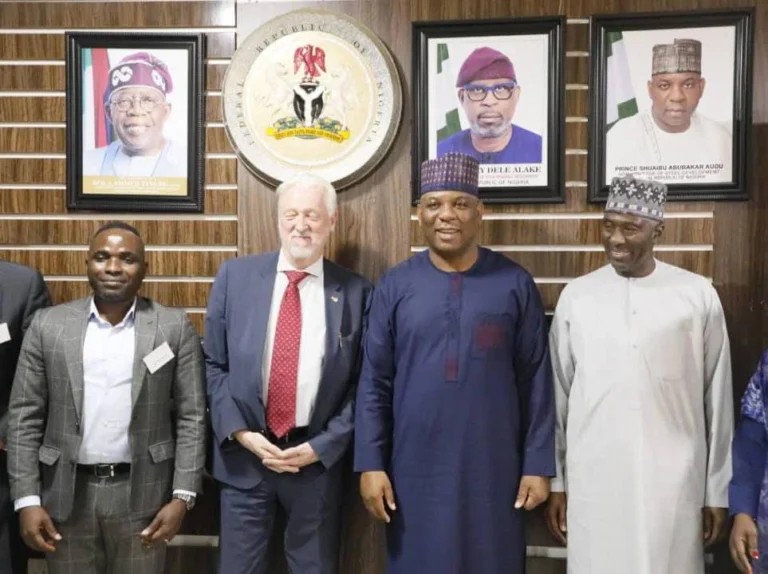
The Federal Government of Nigeria has officially accelerated its push to revitalize the nation’s dormant steel sector by formalizing a strategic partnership with German Original Equipment Manufacturers (OEMs). This diplomatic and industrial engagement, held at the Ministry of Steel Development headquarters in Abuja, marks a pivotal shift in Nigeria’s industrial policy. By targeting the integration of advanced German technology, equipment manufacturing, and systematic technology transfer, the administration aims to transition from a resource-dependent economy to a value-added industrial powerhouse.
The high-level meeting, which featured Minister of Steel Development Prince Shuaibu Abubakar Audu and a delegation led by the Head of VDMA-German OEMs, Dr. Chux Onaa, serves as the operational follow-up to the 9th German-African Economic Forum held earlier this year in Dortmund. This move is designed to translate high-level bilateral discourse into tangible industrial output, specifically targeting the bottlenecks that have historically hindered Nigeria’s steel production capacity.
A Chronology of Diplomatic and Industrial Engagement
The current partnership did not emerge in a vacuum; it is the culmination of a deliberate series of diplomatic maneuvers aimed at repositioning Nigeria as a regional industrial hub.
The timeline of this collaboration can be traced back to early 2024, when the Federal Government identified the steel sector as a primary pillar of the "Renewed Hope Agenda." Recognizing that the Ajaokuta Steel Mill and other smaller metallurgical plants required more than just financial capital—specifically requiring modern engineering expertise—the Ministry of Steel Development sought partnerships with nations possessing world-class industrial manufacturing bases.
- Q1 2024: The Ministry of Steel Development was restructured under the current administration, signaling a prioritization of the sector.
- Mid-2024: Nigerian officials participated in the 9th German-African Economic Forum in Dortmund, Germany. During this summit, representatives from both nations identified critical gaps in mineral processing and engineering services.
- September 2026: The recent visit by the German OEM delegation to Abuja solidified the framework for technical cooperation. This visit provided the German manufacturers with an on-the-ground assessment of Nigeria’s mineral resource potential and the current state of industrial infrastructure.
The Strategic Importance of German Engineering
Germany’s VDMA (Verband Deutscher Maschinen- und Anlagenbau) represents over 3,000 member companies, primarily in the mechanical engineering sector. Their involvement in Nigeria is significant because the country’s steel sector currently suffers from a reliance on outdated, inefficient, or non-functional equipment.
By inviting these OEMs, Nigeria is seeking to bypass the "trial-and-error" phase of industrialization. Instead of attempting to reinvent basic steel-making machinery, the Federal Government is negotiating the localization of assembly and maintenance. According to ministerial statements, the focus areas include:
- Mineral Processing: Utilizing German-engineered crushers, separators, and concentrators to maximize the purity of Nigeria’s iron ore, coal, and limestone deposits.
- Capacity Development: Establishing training centers where Nigerian engineers can be certified to operate and maintain high-tech metallurgical equipment.
- Local Value Chains: Moving away from the raw export model to a domestic model where Nigerian steel is used to manufacture machinery locally, thereby reducing the massive foreign exchange outflow currently spent on imported industrial goods.
Official Perspectives and Policy Alignment
Prince Shuaibu Abubakar Audu emphasized that the government is committed to creating an "enabling environment" for international investors. This is a crucial admission, as foreign direct investment (FDI) in the Nigerian steel sector has been historically dampened by concerns over power supply, infrastructure gaps, and regulatory uncertainty.
"Nigeria possesses significant mineral and metallurgical raw material resources, alongside a large and growing market," the Minister noted during the briefing. "We are committed to creating an environment that is not only competitive but also technology-driven and sustainable."
Ambassador Nura Abba Rimi, the Permanent Secretary of the Ministry, contextualized this move within the broader framework of President Bola Tinubu’s economic reforms. By elevating steel development to its own ministry, the government has signaled that industrialization is no longer a peripheral goal but a central pillar of national security and economic growth.

From the German perspective, Dr. Chux Onaa noted that the delegation’s presence is a testament to the viability of the Nigerian market. He highlighted that German technologies are particularly suited for the scale of operations required for Nigeria’s infrastructure projects, including the production of construction-grade steel for railways, roads, and bridges—areas currently dominated by expensive imports.
Fact-Based Analysis: Implications for the Nigerian Economy
The move to partner with Germany has profound implications for Nigeria’s economic trajectory. Historically, the Nigerian steel sector has been hampered by a lack of private sector integration and insufficient investment in the "midstream" of the value chain—the process of turning iron ore into usable steel.
1. Reducing the Import Burden:
Nigeria spends billions of dollars annually on the importation of steel and iron products. According to trade data, building materials, particularly steel rods and structural beams, constitute a significant portion of the nation’s import bill. By domesticating production through German-assisted facilities, Nigeria could potentially save up to $2 billion in foreign exchange annually, strengthening the Naira in the long term.
2. Job Creation and Skill Acquisition:
The transition from a raw material exporter to an industrial processor has a multiplier effect on employment. For every job created in primary steel production, economic studies suggest the creation of three to five auxiliary jobs in logistics, maintenance, fabrication, and administrative services.
3. Infrastructure Development:
Nigeria’s infrastructure deficit is one of the most cited barriers to growth. Access to locally produced, high-quality steel will significantly reduce the cost of major infrastructure projects. Currently, the logistics of importing steel from Europe or Asia adds a substantial premium to the cost of government-funded road and bridge projects.
Challenges and Future Considerations
While the alliance with German OEMs is a positive development, industry analysts point to the necessity of addressing the "infrastructure triad": electricity, logistics, and policy stability. Steel production is an energy-intensive process. For this partnership to yield success, the Federal Government must ensure that the energy sector reforms, currently underway, provide the stable, high-capacity electricity required for heavy industrial manufacturing.
Furthermore, the "technology transfer" component of the agreement will be the true test of the partnership. Past collaborations in Nigeria’s industrial sector have often failed due to a lack of local knowledge absorption. To avoid repeating these mistakes, the Ministry must ensure that the Memorandums of Understanding (MoUs) resulting from these meetings include strict requirements for local content, knowledge sharing, and the establishment of local research and development units.
Looking Ahead
The visit by the German delegation concludes a phase of exploratory talks and initiates a phase of technical feasibility studies. Over the coming months, the public can expect announcements regarding specific pilot projects, potentially involving the deployment of mobile processing units or the establishment of specialized steel fabrication workshops in industrial zones.
As Nigeria continues to pivot away from its reliance on crude oil revenues, the success of the steel sector will serve as a barometer for the efficacy of the current administration’s industrial policy. The synergy between German engineering precision and Nigeria’s vast mineral endowment holds the promise of a revitalized industrial sector, capable of anchoring the next generation of Nigerian economic development. The commitment demonstrated by both the Ministry of Steel Development and the German delegation suggests that this partnership is not merely a symbolic gesture but a deliberate, calculated step toward long-term industrial sovereignty.