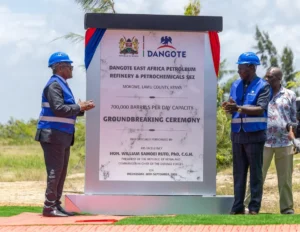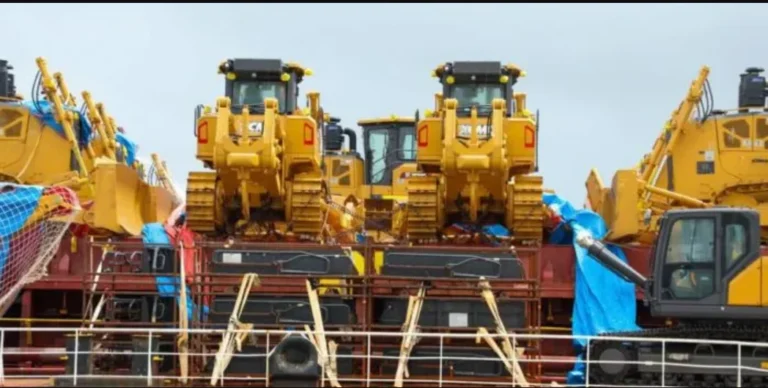
The Port of Lamu has officially entered a new phase of logistical and economic transformation with the arrival of 2,930 metric tonnes of heavy machinery and construction materials destined for the upcoming Dangote East Africa refinery and petrochemical complex. Delivered by the 190-metre-long Chinese-flagged bulk carrier MV Da Yang, this initial shipment represents a critical operational shift from project preparation to physical site mobilization. The delivery precedes the highly anticipated groundbreaking ceremony scheduled for September 30, 2026, which is expected to draw regional heads of state, top government officials, and local community leaders to the coastal county of Lamu.
According to statements from the Kenya Ports Authority (KPA), this monumental project—valued at approximately KSh2 trillion, or roughly $15 billion—is designed to reshape the energy architecture of Kenya and the broader East and Central African regions. The arrival of the heavy industrial cargo underscores the serious intent of both the Kenyan government and the Dangote Group to fast-track the development of a facility that promises to redefine petroleum processing, distribution, and energy security across the continent.
Chronology of Events and Strategic Momentum
The logistical milestone at the Port of Lamu follows a rapid succession of high-level diplomatic and industrial engagements aimed at bringing the ambitious refinery project to fruition. In the days leading up to the MV Da Yang’s arrival, Kenyan President William Ruto undertook a high-profile tour of Africa’s largest operational refinery—the Dangote petroleum and petrochemical complex located in Lagos, Nigeria. During his visit to Nigeria, President Ruto received comprehensive briefings on large-scale refining operations, supply chain logistics, and the massive crude-processing capabilities required to run a multi-billion-dollar facility.
Building upon the momentum of the Nigerian site visit, preparations within Kenya have accelerated exponentially. Deputy President Kithure Kindiki confirmed that national and regional coordination committees have finalized security, logistical, and protocol arrangements for the September 30 groundbreaking ceremony. The convergence of presidential inspections, high-level diplomatic assurances, and the physical delivery of construction hardware illustrates a coordinated, fast-tracked strategy to transition the Lamu project from conceptual blueprints to tangible, ground-level execution.
Scaling Up: Infrastructure and Processing Capacities
When fully completed and operational, the Dangote East Africa refinery is slated to be the largest petroleum processing plant in the region, boasting a design capacity of up to 700,000 barrels of crude oil per day. This gargantuan processing power is expected to position Kenya not merely as a consumer of refined petroleum, but as a major net exporter of refined fuel products to neighboring landlocked and coastal economies.
To feed this massive facility, the supply chains must be equally robust. KPA officials have outlined plans to source crude oil locally from the Lokichar basin in Turkana County, while also supplementing domestic supply with imports from other East and Southern African nations, as well as international markets outside the continent. This multi-sourced feedstock model necessitates a complete revamp of regional transportation networks. Consequently, the Lamu refinery project is intrinsically linked to broader infrastructural blueprints, including the long-discussed development of a dedicated crude oil pipeline stretching from Turkana to the Port of Lamu.
Official Responses and Maritime Milestones
The arrival of the MV Da Yang was met with high-level recognition from Kenya’s maritime authorities. Captain William Ruto, the Chief Executive Officer of the Kenya Ports Authority, personally welcomed the vessel and commemorated the occasion by presenting a first-call certificate and an honorary plaque to the ship’s master, Captain Wang Shengli.
Addressing media and maritime stakeholders at the port, CEO Captain Ruto emphasized the profound national importance of the cargo delivery.
"The arrival of this vessel is very critical and shows the Government’s commitment to ensuring this project succeeds. It will be a game changer for the entire region," Captain Ruto stated, highlighting that Lamu Port is fully prepared to absorb the massive surge in maritime traffic, specialized vessel handling, and industrial logistics that the refinery project will demand over the coming years of construction and operation.
Broad Economic Implications and Regional Impact
The establishment of a KSh2 trillion refinery and petrochemical hub in Lamu carries profound economic, geopolitical, and industrial implications for East Africa. For decades, many nations in the region have remained heavily dependent on imported refined petroleum products, exposing their domestic economies to volatile global fuel prices, foreign exchange shortages, and supply chain bottlenecks. By domesticating large-scale refining capabilities, Kenya aims to stabilize fuel costs, reduce import bills, and secure a reliable energy buffer for industrial expansion.
Furthermore, the project is anticipated to act as an economic multiplier for Lamu County and the wider coastal corridor. The transformation of Lamu into a premier crude and fuel gateway will stimulate ancillary sectors such as marine services, bunkering, warehousing, road and pipeline engineering, and local hospitality. Thousands of direct and indirect jobs are projected to be created during the construction phase and subsequent operational lifecycle, providing a significant boost to local employment and technical skills transfer.
For the Dangote Group, the venture into Kenya represents the successful international expansion of an industrial vision that proved its viability in West Africa. By replicating its strategic heavy-industry model in East Africa, the conglomerate is stitching together an inter-continental refining network designed to power Africa’s collective economic independence. As the September 30 groundbreaking ceremony approaches, the successful offloading of the 2,930-tonne cargo stands as the physical proof that East Africa’s largest energy endeavor is finally underway.