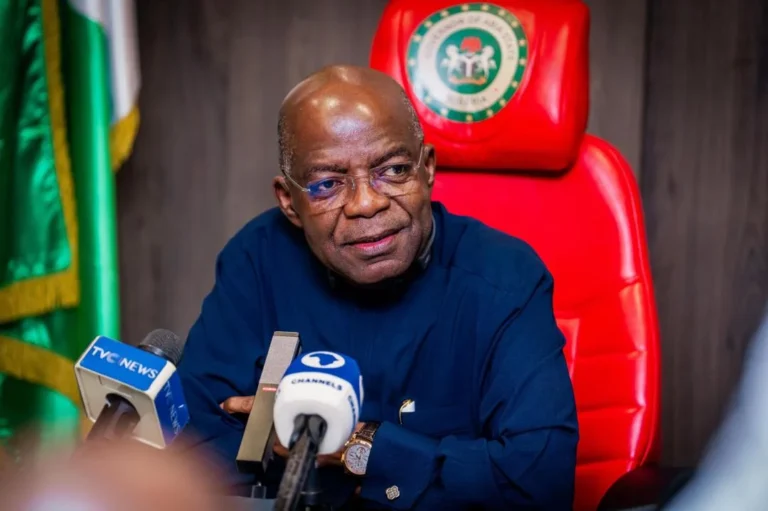
Governor Alex Otti of Abia State has issued a passionate appeal to investors and business owners who previously relocated their operations away from the state, urging them to return and capitalize on the newly established, business-friendly ecosystem. Speaking on Sunday during the commissioning of a high-end hospitality facility in the commercial nerve center of Aba, Governor Otti highlighted the profound transformation his administration has steered over the past three years. He emphasized that deliberate policy frameworks, aggressive infrastructural revamps, and a renewed commitment to security and ease of doing business have fundamentally altered the state’s economic landscape.
The commissioning of the new facility—identified as the ORIS Signature Hotel, owned by Chief Executive Officer Owelle Greg Okafor—served as a practical testament to the shifting fortunes of Aba. Once burdened by severe infrastructural decay, chaotic urban planning, and widespread business flight, the city is steadily reclaiming its historical status as a vibrant manufacturing, trading, and hospitality hub in Nigeria’s Southeast region.
The Genesis of Economic Revival: Addressing Infrastructural Deficits
When Governor Otti assumed office, the state of critical economic infrastructure, particularly in Aba, was a major deterrent to private sector investment. Decades of neglect had left arterial roads impassable, crippled local industries, and forced numerous small- and medium-scale enterprises (SMEs) to shutter their doors or relocate to neighboring states like Rivers, Akwa Ibom, or Lagos.
Chief among these infrastructural nightmares was the legendary Port Harcourt Road in Aba. For years, the stretch had deteriorated into an impassable swamp of debris, erosion, and abandoned properties, effectively cutting off vital commercial linkages. Governor Otti recalled the dire state of the corridor upon his assumption of office, noting that his administration prioritized clearing obstructions, dismantling systemic bottlenecks, and executing a total rehabilitation of the route.
Beyond Port Harcourt Road, the state government initiated a comprehensive urban renewal program. This included the reconstruction of strategic internal roads, the implementation of a more efficient waste management system, and the restoration of public utilities. By tackling these structural deficits head-on, the administration aimed to lower the cost of doing business, reduce logistical friction for merchants, and restore investor confidence.
Timing and Urgency: A Window of Opportunity for Capitalists
During his address at the hotel commissioning, Governor Otti did not mince words regarding the urgency of seizing the moment. He noted that the window for early-bird investment advantages in Abia is rapidly narrowing as more progressive elements recognize the state’s economic potential.
"Time is ripe for investment in Abia," Governor Otti stated, cautioning prospective investors who might adopt a wait-and-see attitude that they risk losing out on prime commercial real estate and market share once the economic transformation reaches full maturity. He reiterated that his administration remains steadfast in providing the necessary security, regulatory ease, and physical infrastructure to ensure that both indigenous and foreign investments yield maximum returns.

The governor’s economic strategy hinges on public-private synergy. While the government focuses on heavy capital expenditure—building roads, improving power supply initiatives, and streamlining tax administration—private investors are expected to drive job creation through manufacturing, real estate, hospitality, and technology.
Economic Implications: Employment, GDP Growth, and IGR
The commissioning of the ORIS Signature Hotel is viewed by economic analysts as more than just a real estate milestone; it represents a micro-indicator of a broader macroeconomic recovery within Abia State. Governor Otti underscored the multifaceted benefits of such private sector ventures, explicitly linking them to the administration’s core governance metrics: job creation, poverty reduction, and internally generated revenue (IGR) expansion.
- Employment Generation: With unemployment remaining a critical national challenge, private investments in the hospitality and service sectors provide immediate, direct jobs for skilled and unskilled labor, ranging from hospitality management to facility maintenance.
- Gross Domestic Product (GDP) Contribution: Increased commercial activities within Aba and Umuahia directly boost the state’s economic output, diversifying local revenue streams away from exclusive reliance on federal allocations.
- Internally Generated Revenue (IGR): A thriving business environment broadens the tax base organically. As businesses flourish and expand, corporate and consumption taxes contribute to state coffers, enabling the government to fund further developmental projects without excessive borrowing.
- Boost to Tourism and Business Travel: The influx of corporate travelers, traders, and tourists requires modern accommodation and recreational facilities. Investments like the ORIS Signature Hotel bridge the infrastructural gap, making Aba a more attractive destination for regional and international business conferences.
Stakeholder Reactions and Broader Industrial Impact
The business community in Abia State has largely responded with cautious optimism to the governor’s overtures. Local trade associations, manufacturing unions, and chambers of commerce have acknowledged the tangible improvements in road connectivity and urban security within Aba.
Owelle Greg Okafor, CEO of ORIS Signature Hotel, praised the state government’s proactive approach to governance, noting that the political will displayed by Governor Otti’s administration was the primary catalyst that inspired his confidence to sink substantial capital into the Aba market. Okafor called on other diaspora investors and business magnates of Abia origin to look homeward, stressing that wealth creation at home has a multiplier effect that transcends individual corporate profits.
Economic analysts observe that Abia’s geographical positioning places it at a strategic advantage. Bordered by several commercial and agricultural powerhouses, Aba has historically served as the commercial heartbeat of the Southeast. However, decades of infrastructural neglect had eroded its competitive edge. If the current trajectory of aggressive infrastructural renewal is sustained, Abia could effectively position itself as the primary investment destination east of the Niger, drawing back capital that fled to safer economic havens over the last twenty years.
Conclusion and Outlook for the Future
As Governor Otti’s administration presses forward with its multi-sectoral development agenda, the challenge ahead lies in sustaining the momentum of reform. Ensuring long-term maintenance of rehabilitated infrastructure, maintaining transparency in public administration, and continuously improving the ease of doing business will be critical to keeping displaced investors rooted permanently in the state.
For now, the message from the seat of power in Umuahia and the commercial trenches of Aba is unequivocal: Abia is open for business, and the administration is ready to partner with visionary entrepreneurs willing to contribute to the state’s renaissance.