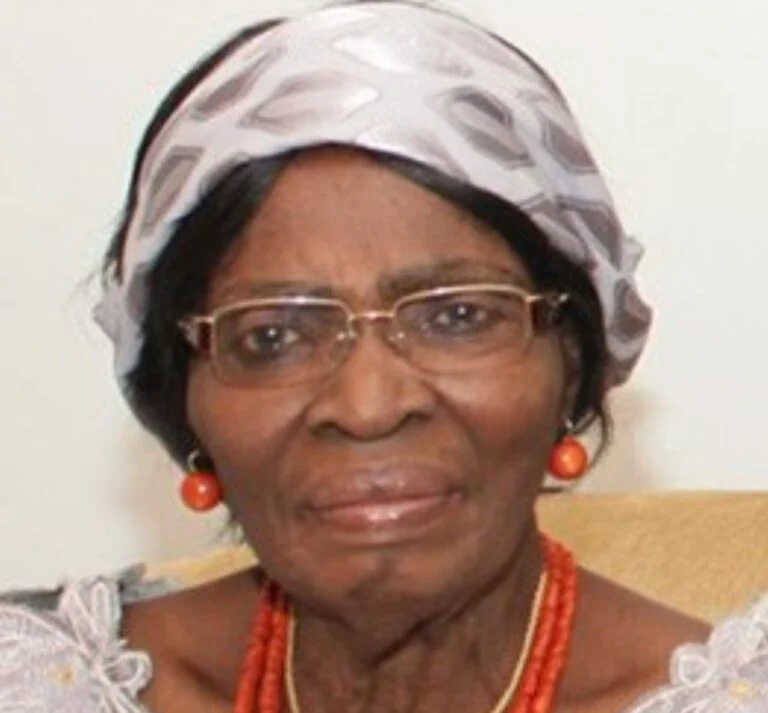
The matriarch, who passed away at the age of 96, leaves behind a legacy that transcends her immediate family, spanning the realms of academia, traditional governance, and gender advocacy. Her death marks the end of an era for the Okonjo dynasty of Ogwashi-Uku, a family that has consistently occupied the upper echelons of Nigeria’s intellectual and political life. President Tinubu, in an official statement issued through his Special Adviser on Information and Strategy, Bayo Onanuga, lauded the late professor as a champion of women’s empowerment and a revered matriarch whose life was defined by intellectual distinction and an unwavering commitment to societal advancement.
A Life of Academic and Societal Significance
Professor Kamene Okonjo was far more than a royal consort; she was a distinguished sociologist whose academic contributions reshaped the discourse on gender dynamics in post-colonial Nigeria. Her body of work remains a cornerstone of African gender studies, specifically her pioneering research into the political and social roles of Igbo women living west of the River Niger.
Her seminal 1976 essay, The Dual-Sex Political System in Operation: Igbo Women and Community Politics in Midwestern Nigeria, provided a groundbreaking framework for understanding how traditional African societies balanced power between genders. Unlike Western frameworks that often imposed a singular, hierarchical view of power, Prof. Okonjo illustrated how the "dual-sex" system allowed women to exercise political autonomy and influence community affairs through their own distinct institutions. Her subsequent work, The Role of Women in Social Change among the Igbo of Southeastern Nigeria Living West of the River Niger (1980), further solidified her reputation as a scholar who viewed traditional structures not as relics of the past, but as dynamic, functioning entities capable of navigating the pressures of modernization.
Chronology of the Okonjo Family Legacy
The Okonjo family’s trajectory has been inextricably linked to the development of Nigeria’s intellectual landscape.
- 1928: Birth of Kamene Okonjo.
- 1950s–1970s: Academic career flourishes as she engages in deep sociological research, bridging the gap between traditional Igbo structures and modern academic inquiry.
- 1976: Publication of her most cited work on the dual-sex political system, which challenges prevailing anthropological narratives regarding African women.
- 2007: Her husband, Chukwuka Okonjo, a renowned mathematician and economist, is crowned the Obi of Ogwashi-Uku, elevating the family to the pinnacle of traditional governance in Delta State.
- 2012: A dark chapter in the family history occurs in December when Kamene Okonjo, then 82, is kidnapped from the palace in Ogwashi-Uku. Her release after five days of captivity became a national focal point, highlighting the volatile security environment at the time.
- 2019: The passing of Obi Chukwuka Okonjo on September 13, at the age of 91, in Lagos.
- 2026: The passing of Prof. Kamene Okonjo at the age of 96.
The 2012 Kidnapping: A Flashpoint in Nigerian Politics
The abduction of Prof. Kamene Okonjo in 2012 serves as a grim reminder of the risks associated with public service in Nigeria. At the time, her daughter, Dr. Ngozi Okonjo-Iweala, was serving as the Minister of Finance and Coordinating Minister for the Economy under the administration of President Goodluck Jonathan.
Dr. Okonjo-Iweala later revealed in her memoirs that the kidnappers had explicitly demanded her resignation and departure from the country. The abduction was widely interpreted as an attempt to intimidate the Finance Minister, who was spearheading a rigorous, albeit controversial, effort to remove fuel subsidies and clean up the oil sector. The event underscored the high stakes involved in the family’s dedication to national service. Despite the trauma, Prof. Okonjo maintained her dignity and commitment to her community, remaining a pillar of support for her seven children, the most prominent of whom would go on to become the first woman and first African to lead the World Trade Organisation.

Official Responses and National Mourning
President Tinubu’s tribute acknowledged that the loss of Prof. Okonjo is not merely a family bereavement but a national one. By highlighting her ability to combine "professional excellence with dedication to family, community, and the preservation of traditional institutions," the President emphasized the model she provided for contemporary Nigerian women.
The Delta State government and various academic institutions have also signaled their intention to honor the late professor. Her influence extended to the University of Nigeria, Nsukka, and various scholarly circles where her research remains part of the mandatory reading for students of sociology and African history. Her peers in academia remember her as a stern but encouraging mentor, a woman who demanded rigor in research and integrity in character.
Broader Impact and Implications for Gender Studies
The death of Prof. Kamene Okonjo invites a retrospective look at the evolution of gender studies in Nigeria. At a time when the discipline was heavily dominated by Eurocentric perspectives, Prof. Okonjo utilized her position as a researcher to validate the indigenous political systems of Nigeria.
Her passing serves as a poignant moment to reflect on the "dual-sex" political system she documented. In contemporary Nigeria, the struggle for gender parity in political participation remains a contentious issue. Prof. Okonjo’s work suggests that the exclusion of women from modern Nigerian politics is a departure from the historical norm, rather than a continuation of traditional practice. This argument remains a potent tool for activists and policymakers advocating for increased female representation in the National Assembly and local government councils.
Conclusion: A Legacy of Resilience
The legacy of Kamene Okonjo is defined by a rare synthesis of intellectual rigor and traditional grace. She navigated the transition from colonial rule to independence, witnessed the civil war, and survived the complexities of modern political life in Nigeria, all while maintaining her focus on the sociological truths of her heritage.
As the Okonjo family prepares for her final rites, the outpouring of condolences from the highest levels of government and international institutions reflects the stature she commanded. For Dr. Ngozi Okonjo-Iweala and her siblings, the loss is personal; however, for the academic community and the people of Ogwashi-Uku, it is the passing of a matriarch who redefined the boundaries of what a woman could achieve in the public and private spheres.
President Tinubu’s closing prayers—that God would grant her eternal rest and comfort those who mourn her—resonate with a nation that recognizes the immense contribution of a woman who spent nearly a century shaping the intellectual and cultural identity of her people. The life of Kamene Okonjo serves as an enduring testament to the power of education, the strength of the traditional family unit, and the necessity of preserving the history of those who came before us. As she is laid to rest, her writings will undoubtedly continue to serve as a beacon for future generations of sociologists seeking to understand the nuanced, powerful, and often overlooked roles of women in the history of Nigeria.