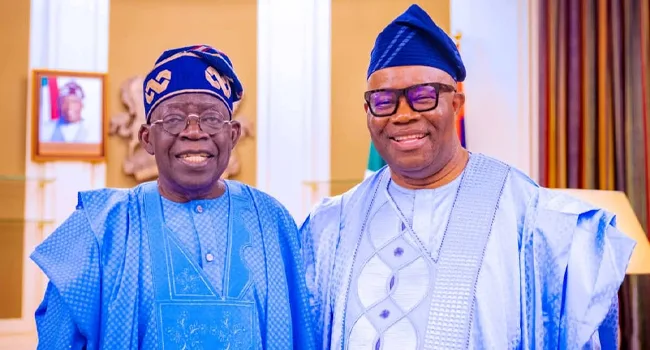
The complex and often polarized landscape of Nigerian politics has once again taken center stage as Senate President Godswill Akpabio launched a vociferous defense of President Bola Ahmed Tinubu’s administration. Speaking from his office in Abuja during a high-profile courtesy visit by a prominent northern youth coalition, Akpabio made startling allegations that relentless online criticism directed at the presidency is a manufactured phenomenon driven by financial incentives. Addressing members of the Arewa Revival Project, a socio-political youth group representing the 19 northern states, the nation’s number three citizen urged the younger demographic to reject what he characterized as digital propaganda and instead focus on physical, community-level mobilization to secure President Tinubu’s re-election bid in the upcoming 2027 general elections.
The high-stakes encounter, which culminated in the presentation of an award to Akpabio for his contributions to national development, highlights the early maneuvers and ideological battlegrounds shaping Nigeria’s political future. As the ruling All Progressives Congress positions itself to defend its mandate against a fragmented and increasingly vocal opposition, the battle for the hearts, minds, and screens of the Nigerian electorate—particularly the influential youth demographic—has intensified. Akpabio’s remarks not only shed light on the administration’s anxieties regarding public perception and social media narratives but also signal a concerted push by the legislative arm to anchor the executive’s continuation on structural economic reforms and imminent security overhauls.
Anatomy of a Political Visit: The Arewa Revival Project Engagement
The meeting between Senate President Akpabio and the Arewa Revival Project, led by its national coordinator, Mustafa Ibrahim, was ostensibly convened to honor the former Akwa Ibom State governor for his stewardship of the National Assembly. However, the gathering quickly transformed into a strategic political brainstorming session regarding the administration’s trajectory and the imperatives of continuity.
Mustafa Ibrahim, speaking on behalf of the 19 northern states, praised Akpabio for fostering legislative synergy with the executive branch, noting that the National Assembly under his leadership has passed critical interventions aimed at stabilizing the country. In response, Akpabio capitalized on the platform to address the growing wave of public discontent, particularly on platforms like X (formerly Twitter), Facebook, and TikTok, where economic hardship, inflation, and soaring living costs have fueled blistering attacks against President Tinubu.
According to the Senate President, the digital outcries do not accurately reflect the organic sentiment of the Nigerian populace. Instead, he asserted that a significant portion of the virulent commentary is orchestrated by political detractors who fund cyber-operatives to sow discord and undermine public trust in democratic institutions. "It is not going to be easy for you because most of those who are attacking the President and attacking these young men on social media are being paid. You are not being paid," Akpabio told the visiting youths. He challenged them to bypass the digital noise by engaging directly with citizens at the grassroots level, arguing that physical interactions would reveal the true, long-term value of the administration’s policies.
Economic Reforms and the Defense of a Post-Mono-Economy Transition
A cornerstone of Akpabio’s address was a robust defense of President Tinubu’s aggressive economic restructuring agenda, which has faced severe public backlash due to the immediate hardships it imposed on ordinary Nigerians. Since assuming office in May 2023, Tinubu has instituted sweeping policy shifts, most notably the removal of the decades-long petrol subsidy and the unification of foreign exchange windows. While international financial institutions and fiscal conservatives have broadly lauded these measures as necessary steps to avert national bankruptcy, the domestic reality has been characterized by hyperinflation, eroding purchasing power, and widespread social distress.
Akpabio, however, framed these painful adjustments as the birth pangs of a transformed nation, asserting that Tinubu has successfully steered Nigeria away from its historical vulnerability as a mono-economy. For decades, the West African powerhouse has remained dangerously dependent on crude oil revenues, rendering its national budget susceptible to global oil price shocks and production fluctuations.
"I expect the Nigerian youth to rise above social media propaganda because this President has managed to take us out of a mono-economy—an economy that was dependent only on crude oil," Akpabio stated, pointing to recent executive initiatives, including comprehensive tax reforms and the dismantling of outdated legislative frameworks. He went as far as claiming that no previous Nigerian leader since independence has matched the developmental milestones achieved by the current administration, adding that the National Assembly holds its collective head high in endorsing Tinubu for a second term in 2027.
This unvarnished endorsement from the legislature underscores the deep institutional alignment between the executive and legislative branches, a dynamic that critics argue has occasionally compromised the legislature’s oversight function, but which supporters view as essential for decisive governance.
The Security Imperative: State Police and the Promise of Decentralisation
Beyond economic policy, security remains the preeminent litmus test for the Tinubu administration. Years of insurgency in the Northeast, banditry and mass kidnappings in the Northwest and North-Central regions, separatist agitations in the Southeast, and cult-related violence in the South have severely strained conventional security forces.
During his engagement with the northern youth leaders, Akpabio addressed this existential concern head-on, offering a definitive timeline and strategic update on one of the most contentious constitutional debates in Nigeria’s recent history: the establishment of state police.
Decentralised policing has long been championed by governors, civil society organizations, and constitutional lawyers who argue that a centralized police force controlled exclusively from Abuja is ill-equipped to manage localized security threats. Opponents, however, have historically expressed fears that state governors could weaponize local police forces against political opponents and minority groups.
Despite these historical hesitations, momentum for constitutional reform has reached a critical tipping point. Akpabio revealed that the legislative process to amend the constitution to accommodate state policing is advancing at an unprecedented pace, driven by overwhelming buy-in from subnational legislatures.
"As I speak with you now, for the first time in the history of Nigeria, it may not take us a month before we have a state police system—decentralised policing in the country—because about 30 states have endorsed the amendment to the Nigerian constitution to bring about a state police system," Akpabio disclosed. With Nigeria comprising 36 states, an endorsement by 30 state Houses of Assembly comfortably surpasses the two-thirds threshold required under Section 9 of the 1999 Constitution (as amended) to effect structural changes.
Seeking to project absolute confidence, the Senate President offered an encouraging message to the youth contingent regarding the nation’s security outlook. "I always tell them that the devil that you see today, you will soon see them no more. Very soon, we shall overcome the insecurity that we face today. So feel confident as you go round campaigning."
Broader Context and Political Implications for 2027
Akpabio’s remarks arrive at a critical juncture in Nigeria’s political calendar. Although the general elections are still months away, political parties and coalitions are already positioning themselves for what promises to be a fiercely contested electoral battle. The ruling All Progressives Congress (APC) faces the formidable task of defending its record against an energized opposition that seeks to capitalize on public frustration over inflation, cost-of-living crises, and security gaps.
By targeting the youth demographic—who constitute the largest voting bloc in Nigeria—leaders from both sides of the aisle are keenly aware that electoral victory in 2027 will largely depend on which narrative gains traction among the younger generation. Akpabio’s caution against social media narratives reflects a growing anxiety among political elites that digital platforms serve as echo chambers for anti-establishment sentiment, largely immune to traditional political messaging.
Political analysts note that while grassroots mobilization remains a potent force in Nigerian elections—where community networks, traditional rulers, and local patronage structures still dictate voting behavior—the growing digital literacy and connectivity of urban and semi-urban youths present a unique challenge. The friction between online discontent and offline political loyalty will likely define the contours of the 2027 campaign.
Furthermore, the public endorsement of Tinubu’s second-term ambition by the Senate President solidifies the internal consensus within the ruling party, signaling that despite pockets of dissent and legislative negotiations, the party’s leadership remains firmly united behind the incumbent president.
As the constitutional amendment processes for state police near completion and the executive continues to defend its fiscal consolidation strategies, the coming months will test the efficacy of the government’s dual approach: legislative reform coupled with aggressive grassroots advocacy. Whether northern youths and the wider Nigerian electorate will embrace the administration’s long-term vision in the face of present economic realities remains the central question as the nation marches toward 2027.