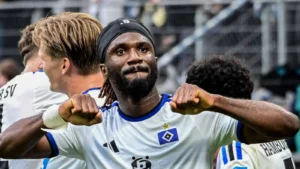
The French football landscape is currently grappling with the sudden and dramatic collapse of the leadership structure at Ligue 1 side Le Havre. Former Chelsea and Senegal striker Demba Ba has officially stepped down from his role as sporting director, a position he had held for a mere four months. His departure, which comes amidst a period of extreme volatility for the Normandy-based club, follows the high-profile exit of club president Jean-Michel Roussier and the dismissal of head coach Didier Digard. This triple-pronged departure has left the historic club, known as "Le Doyen," in a state of profound uncertainty as they navigate a precarious position at the foot of the league table.
The Catalyst: A Weekend of Despair
The instability that culminated in the resignation of Demba Ba was triggered by a catastrophic performance on the pitch. Over the weekend, Le Havre hosted defending French champions Paris Saint-Germain at the Stade Océane. The resulting 5-1 defeat was not merely a loss; it served as a brutal illustration of the gulf in class and tactical cohesion between the two sides. For the Le Havre board, the heavy scoreline acted as the final straw in a season characterized by offensive impotence and defensive fragility.
Following the final whistle, the club’s hierarchy moved swiftly to terminate the contract of manager Didier Digard. Digard, who had been tasked with stabilizing the squad following a difficult preseason, found himself unable to extract consistent performances from a roster that has struggled to adapt to the rigors of top-flight football. However, the decision to fire Digard was met with immediate, fierce opposition from within the club’s own executive ranks.
A Leadership Vacuum: Roussier and Ba Depart
The firing of Didier Digard did not go unchallenged. Club president Jean-Michel Roussier, who had been a staunch defender of the manager’s long-term project, viewed the dismissal as an unnecessary and counterproductive reaction to a single poor result. In an act of protest against what he perceived as interference from the ownership group, Roussier tendered his resignation, signaling a complete breakdown in the club’s governance.
Demba Ba, who had arrived with significant fanfare earlier this year to oversee the club’s sporting strategy, chose to follow suit shortly thereafter. According to reports from French publication L’Équipe, Ba felt that the internal climate had become untenable, with his vision for the club’s sporting direction misaligned with the reactionary measures favored by the ownership. The simultaneous loss of the president and the sporting director has created a power vacuum that few clubs could weather without significant disruption to their day-to-day operations.
Chronology of a Crisis
The current turmoil is the culmination of a season that has been fraught with difficulty since the opening day. To understand the gravity of the situation, one must look at the timeline of events that has led Le Havre to this nadir:
- Pre-Season Preparation: The club entered the 2024/2025 campaign with high ambitions, bringing in Demba Ba to modernize their recruitment and scouting networks.
- Early Season Struggles: By mid-September, it became evident that the team was struggling to convert possession into points, leading to mounting pressure on the coaching staff.
- The October Slump: A string of defeats saw the club slide into the bottom three, with the team failing to find the back of the net in crucial "six-pointer" matches against relegation rivals.
- The PSG Debacle: The 5-1 home loss to Paris Saint-Germain served as the breaking point, exposing the lack of tactical identity and the mental fatigue within the squad.
- Executive Exodus: Within 48 hours of the PSG match, both Didier Digard and Jean-Michel Roussier exited the club, followed shortly by the resignation of Demba Ba.
Statistical Context of the Relegation Battle
The numbers facing the current Le Havre squad are, by any metric, alarming. Having played nine league fixtures, the club has managed to secure only two points. This leaves them firmly rooted at the bottom of the Ligue 1 table, with a goal difference that suggests both a lack of clinical finishing and a defense prone to individual errors.
Statistically, Le Havre’s conversion rate—the percentage of shots that result in a goal—is among the lowest in the top five European leagues this season. Furthermore, their expected goals against (xGA) metrics suggest that they are conceding high-quality chances at a rate that is unsustainable for a team hoping to maintain top-flight status. The lack of a clear, unified leadership structure now threatens to exacerbate these on-field issues, as players often look to the boardroom for reassurance during prolonged losing streaks.
The Ownership Challenge: Blue Crow and the Road Ahead
At the heart of the controversy is the ownership group, Blue Crow. Having acquired the club with the intent of professionalizing the sporting structure, they now find themselves in a position where their interventions have arguably destabilized the organization. The pressure on Blue Crow is now immense; they are tasked with finding a new president, a new sporting director, and a new head coach, all while the season continues to accelerate.
Industry experts suggest that the club is at a critical juncture. Without a cohesive plan, the prospect of relegation to Ligue 2 is becoming increasingly likely. A drop in status would not only have severe financial ramifications for the club, which relies on the broadcast revenue and prestige of the top flight, but it would also jeopardize the long-term investment strategies that Blue Crow had initially promised to the fans.
Implications for the Future of the Club
The departure of Demba Ba, a respected figure in football circles, carries implications beyond the immediate vacancy. It sends a signal to potential recruits and candidates for the coaching role that the working environment at Le Havre is currently volatile. High-level professionals are often wary of joining organizations where the executive hierarchy is in flux, fearing that their own projects might be cut short by similar reactionary decision-making.
Furthermore, the fans of Le Havre, a historic club with a proud tradition, are increasingly vocal about the need for stability. The "Le Doyen" identity is built on a history of resilience, but the current management crisis tests the patience of a fanbase that has seen too much turnover in the executive suite. The immediate task for the owners is to appoint a leader with the stature and experience to command respect from the dressing room and the board alike.
Analyzing the Sporting Direction
When Demba Ba joined Le Havre, the narrative centered on his ability to bridge the gap between the academy and the first team, utilizing his extensive network to bring in talent that might otherwise be overlooked by larger clubs. His resignation halts this process mid-stream. The club now faces a "lost" transfer window or, at the very least, a period of transition where recruitment will be based on necessity rather than the long-term scouting strategy Ba was developing.
The analytical view is that Le Havre must now pivot to a "crisis management" style of leadership. This often involves appointing a coach with a proven track record of avoiding relegation, someone who can prioritize defensive organization over aesthetic football. However, finding such a figure requires a stable board—a commodity currently missing in Le Havre.
Looking Toward the Next Matchday
As the club prepares for its next fixture, the uncertainty is palpable. With no permanent head coach or executive leadership to steer the ship, the responsibility falls on the interim staff to maintain morale. The psychological toll of the past week cannot be underestimated. A team that has only managed two points in nine games is already fragile; the knowledge that their leaders have abandoned the post only adds to the sense of isolation felt by the players.
The upcoming weeks will define the remainder of the season for Le Havre. Whether they can stabilize their operations or continue the downward spiral remains to be seen. The departure of high-profile names like Roussier and Ba has cleared the path for new faces, but it has also left the club with a significant deficit of institutional knowledge and professional stability.
Final Reflections
The case of Le Havre serves as a cautionary tale for modern football clubs. In an industry where the margin for error is razor-thin, the relationship between ownership, the executive board, and the coaching staff is paramount. When that relationship fractures, the results on the pitch invariably suffer. For Demba Ba, the decision to walk away was one of principle, but for the club, it is a reality check. The path to recovery is narrow, and it begins with a fundamental rebuilding of the leadership structure, a task that must be handled with care, transparency, and a long-term vision that has, thus far, been sorely lacking.
As the dust settles on this tumultuous period, the eyes of the footballing world will be on the Normandy coast to see who steps up to fill the void. The survival of Le Havre as a competitive force in Ligue 1 depends entirely on the actions taken in the next few weeks. The departure of key figures is rarely the end of a club, but it is a definitive end to an era—and for Le Havre, it is an era that will be remembered for the speed at which ambition dissolved into crisis.