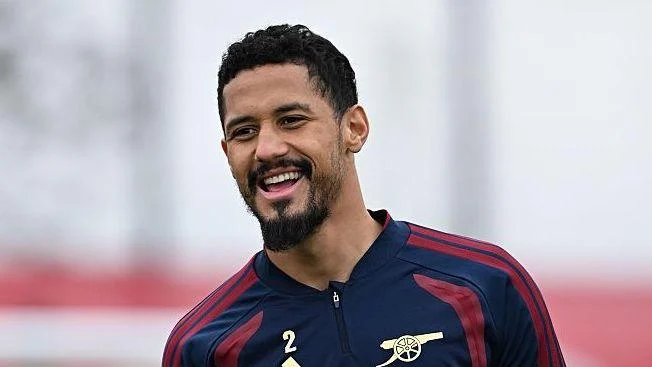
Arsenal Football Club has received a significant defensive boost as William Saliba officially resumed full first-team training on Tuesday, November 3, marking the end of a grueling four-month rehabilitation process. The French international, who has been sidelined since July 2026, participated in the entirety of the Gunners’ training session at London Colney, signaling a critical turning point in his recovery from a severe back injury.
The 25-year-old defender’s return arrives at a pivotal juncture for Mikel Arteta’s side as they navigate a dense schedule of domestic and European competitions. While the coaching staff and medical team are exercising extreme caution, the sight of Saliba moving freely on the pitch provides a much-needed psychological and tactical lift to a squad that has navigated the opening months of the 2026/27 campaign under significant defensive strain.
A Chronology of the Injury and Recovery
The ordeal began on July 15, 2026, during a high-stakes World Cup semi-final clash between France and Spain. Saliba, who had been a mainstay in the French defensive line, suffered the back injury following an awkward landing during a contested aerial duel. The immediate prognosis was grim, with scans revealing significant structural stress that necessitated a long-term layoff.
Upon returning to North London, the Arsenal medical department established a comprehensive recovery timeline. Throughout August and September, Saliba was restricted to individual strength-and-conditioning work, focusing on core stabilization and range-of-motion exercises. By October, the defender transitioned to light ball work and non-contact drills, carefully monitored by physiotherapists to ensure the integrity of his spine and surrounding musculature.
The milestone reached this week—rejoining the main group—represents the final phase of his reintegration. Having cleared all cognitive and physical exertion tests, Saliba’s focus now shifts toward regaining match sharpness, which is notoriously difficult to replicate through training alone.
Tactical Implications and Defensive Stability
The absence of a defender of Saliba’s caliber would typically destabilize even the most robust backline; however, Arsenal’s defensive resilience has remained a talking point this season. The summer acquisition of Ezri Konsa from Aston Villa proved to be a masterstroke of recruitment. Konsa, paired with the ever-reliable Gabriel Magalhães, has formed a formidable partnership that has maintained a high defensive line and facilitated ball progression from the back.
Statistically, Arsenal has conceded an average of 0.8 goals per game during Saliba’s absence, a testament to the tactical flexibility implemented by Arteta. Konsa’s ability to step into the right-sided centre-back role allowed the team to maintain its high-press system without sacrificing defensive cover. Nevertheless, the return of Saliba offers a different dimension. His superior recovery pace and ability to operate in wide spaces when the fullbacks push high provide Arsenal with a tactical versatility that is vital against high-intensity counter-attacking sides.
The looming "selection headache" for Arteta is a positive problem to have. With three high-caliber centre-backs now fit and available, the rotation policy will become an essential tool in preventing burnout and managing the squad’s load through the winter months.
Analyzing the Champions League Context
The timing of Saliba’s return aligns with the mid-stage of the UEFA Champions League group phase. Arsenal is scheduled to face Slavia Prague on Wednesday, November 4. While it is highly improbable that Saliba will be rushed into the starting XI for this fixture, his presence in training allows for a tactical shift in the bench composition.
For a manager like Arteta, who prioritizes tactical continuity, having Saliba available as a closing option—or as a safeguard for late-game defensive transitions—is invaluable. If he continues to progress without setback, his return to the starting lineup is likely earmarked for the upcoming Premier League weekend, pending further physiological data from this week’s sessions.
Official Stance and Medical Protocol
While the club has remained characteristically tight-lipped regarding specific medical details, sources close to the training ground suggest that the decision to reintegrate Saliba was data-driven. Arsenal utilizes advanced biomechanical sensors during training to monitor workload intensity, and Saliba’s output metrics during Tuesday’s session met the high-performance thresholds required for professional competition.
"The medical team has done an extraordinary job, but we are looking at the long-term health of the player," a club spokesperson noted, emphasizing that the "cautious approach" is not merely about the next match, but about the remainder of the season. The strategy is to integrate him into match-day squads incrementally, ensuring that his transition from training intensity to competitive match intensity is seamless.
Broader Impact on the 2026/27 Season
As the Premier League approaches the hectic festive period, the importance of squad depth cannot be overstated. Arsenal is currently competing on three fronts: the Premier League, the Champions League, and the domestic cup competitions. The return of a cornerstone player like Saliba provides the necessary squad depth to compete for silverware on all fronts.
Furthermore, Saliba’s return is expected to have a ripple effect on the confidence of the entire defensive unit. His leadership and communication at the back are often cited by his peers as catalysts for the team’s composure under pressure. As Arsenal looks to consolidate its position in the top four of the Premier League table, the reintegration of their premier defender serves as a psychological boost that may prove as valuable as the technical contributions he brings to the pitch.
The upcoming international break in mid-November also provides a strategic opportunity. If Saliba can navigate the next 10 days of training without incident, he will be able to utilize the break to engage in full-contact training sessions, effectively "fast-tracking" his match fitness to a level comparable to his teammates who have been playing consistently since August.
Conclusion: The Path Forward
The return of William Saliba is not merely a personnel change; it is a signal of Arsenal’s intent for the remainder of the 2026/27 campaign. Having weathered a four-month storm without one of their primary defensive assets, the Gunners have emerged with a more robust squad and a deeper understanding of their defensive capabilities.
As the team prepares for the clash against Slavia Prague, the focus remains on incremental progress. The fans, the management, and the player himself understand that while the worst of the injury layoff is over, the work to return to peak form is a continuous process. For Mikel Arteta, the primary goal is to ensure that when Saliba eventually steps back onto the pitch for a full 90 minutes, he does so with the confidence and physical readiness that established him as one of the most formidable defenders in European football.
As the club continues to navigate a challenging season, the integration of Saliba will be monitored with intense interest by analysts and supporters alike, serving as a bellwether for Arsenal’s aspirations of securing major honors this year.