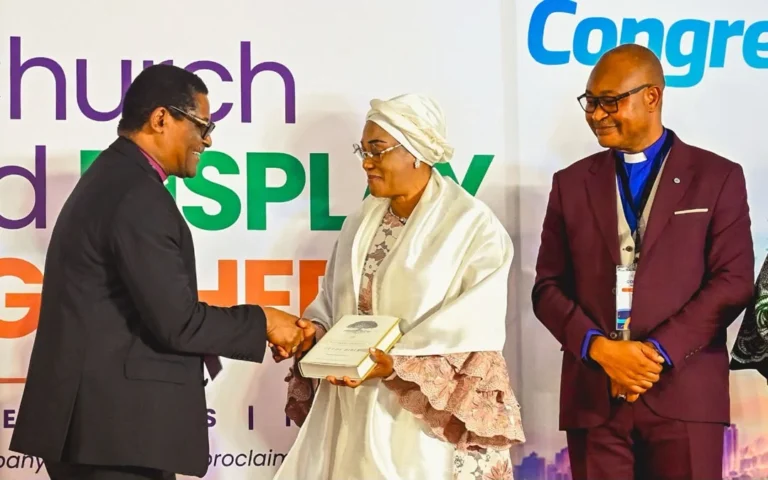
The Nigerian capital of Abuja played host to a monumental gathering of Christian leaders, missionaries, and organizations this week as the Lausanne Nigeria Congress 2026 officially commenced its three-day national assembly. Bringing together over 5,000 delegates from across the nation’s diverse geopolitical zones, the congress serves as a critical checkpoint for the country’s religious community. The event’s central proceedings on Wednesday drew national attention when Nigeria’s First Lady, Senator Oluremi Tinubu, delivered a compelling keynote address challenging the Christian community to bridge the gap between religious rhetoric and everyday civic action.
Addressing the mammoth crowd at the Abuja gathering, the First Lady emphasized that the tenets of the Christian faith must extend far beyond the pulpit and manifest practically in the socio-economic development and moral fabric of the nation. Flanked by high-ranking clerics, including the Archbishop Metropolitan and Primate of All Nigeria, Church of Nigeria (Anglican Communion), Most Rev. Henry Ndukuba, and the National Chairman of the Lausanne Nigeria Christian Mission, Rev. Yunusa Sabo Nmadu, Mrs. Tinubu underscored the indispensable role religious institutions play in national cohesion. Her remarks resonated deeply within a country currently navigating complex socio-economic reforms, security challenges, and the continuous search for enduring national unity.
The Imperative of Moral Leadership and Community Building
Expanding on the congress theme, "Let the Church Declare and Display Christ Together," the First Lady articulated a vision where the church acts as a primary agent for social stabilization and moral reclamation. She noted that while spiritual declarations remain vital to the Christian mission, the physical manifestation of Christ’s character through compassionate engagement with society is equally paramount.
"The Church in Nigeria has a vital responsibility to nurture hope and compassion, strengthen families, mentor our young people, encourage peaceful coexistence, and help build communities where every person is treated with dignity," Mrs. Tinubu stated, as conveyed in a press statement released by her Senior Special Assistant on Media, Busola Kukoyi.
She further challenged the delegates to evaluate their communal impact, reminding them that the credibility of their message is inextricably linked to their lifestyle and social contributions. Citing biblical principles, notably Matthew 5:16, she reminded the audience that true faith translates into visible acts of kindness, justice, and community upliftment. The First Lady urged church leaders to translate the high-level deliberations of the three-day congress into actionable initiatives that can be localized within individual congregations, grassroots organizations, and vulnerable neighborhoods throughout the country’s 36 states and the Federal Capital Territory.
A Call to Overcome Divisions: Perspectives from Church Leadership
Echoing the First Lady’s sentiments, the National Chairman of the Lausanne Nigeria Christian Mission, Rev. Yunusa Sabo Nmadu, addressed the internal fractures that have historically hindered the collective efficacy of the Nigerian church. In his address, Nmadu issued a stern call for the body of Christ to transcend denominational, tribal, and ethnic boundaries, which he identified as major impediments to holistic national development.
"The Nigerian Lausanne Congress in Abuja serves as a call for the unified Nigerian church to both proclaim the gospel and embody Christian values through social action," Nmadu remarked. He brought to the fore a critical paradox facing contemporary Nigerian Christianity: while the past two decades have witnessed exponential numerical growth in church membership and the proliferation of mega-churches, there has simultaneously been a noticeable decline in the church’s moral and socio-political influence on public life. Nmadu argued that regaining this lost ground requires a deliberate shift from mere pulpit rhetoric to tangible community-based interventions, advocacy for the oppressed, and active participation in peace-building initiatives.

Reinforcing this call for unity, Most Rev. Henry Ndukuba, Archbishop, Metropolitan and Primate of All Nigeria and Chairman of the Board of Trustees for the mission, focused his remarks on the ultimate spiritual reality transcending earthly boundaries. With a sharp focus on eternal objectives, Archbishop Ndukuba reminded the congregation that sectarian divisions and denominational labels carry no weight in heaven, urging leaders to foster a spirit of ecumenical cooperation on earth.
Historical Context and Evolution of the Lausanne Movement
To fully understand the weight and significance of the 2026 Abuja congress, one must examine the rich history of the global Lausanne Movement. Founded by the legendary American evangelist Dr. Billy Graham, the movement traces its roots back to July 1974, when the first International Congress on World Evangelization was convened in Lausanne, Switzerland. That landmark gathering brought together over 2,300 evangelicals from 150 nations to address the challenges of global evangelism, resulting in the historic Lausanne Covenant—a document that has since shaped modern evangelical missiology, social responsibility, and cross-cultural mission strategies.
Over the decades, the Lausanne Movement has expanded its footprint globally, holding major international congresses every decade, alongside numerous regional and national consultations. The movement’s core philosophy emphasizes the inseparable link between proclamation (verbal sharing of the gospel) and demonstration (social action, justice, and compassion). The convening of the Nigerian chapter in 2026 represents a localized iteration of this global mandate, contextualized specifically to address the unique challenges facing the West African nation, including religious tolerance, economic equity, good governance, and national security.
National Intercession and Preparations for 2027
Beyond theological debates and strategic missiological planning, the 2026 Lausanne Nigeria Congress also served as an important platform for national intercession. Given Nigeria’s complex political landscape and the looming electoral cycle, delegates dedicated significant time during the three-day event to offer fervent prayers for the nation’s leadership and stability.
Special prayer sessions were led by prominent clerics for President Bola Ahmed Tinubu, members of his cabinet, state governors, legislators, and judicial officers. Furthermore, with the 2027 general elections on the horizon, church leaders offered collective prayers for peaceful civic engagement, the integrity of the electoral process, and the avoidance of election-related violence. The inclusion of these civic prayers underscores the deeply ingrained intersection of faith and politics in Nigeria, where religious leaders are frequently looked upon to provide moral compasses during times of political transition.
Broader Implications and Socio-Economic Impact
The convergence of thousands of Christian leaders in Abuja carries significant socio-economic and cultural implications for Nigeria. Analysts point out that when religious networks with extensive grassroots reach—such as those represented under the Lausanne banner—commit to community development, education, and youth mentorship, the impact can rival government intervention programs.
By challenging the church to focus on human dignity, poverty alleviation, and youth mentorship, leaders like First Lady Oluremi Tinubu are leveraging the cultural capital of religious institutions to address systemic issues. In a nation where a significant percentage of the population looks to religious institutions for psychological comfort and social safety nets, the church’s active involvement in economic empowerment and moral education is viewed as indispensable.
However, experts also note that the true test of the 2026 Lausanne Congress will lie in its implementation phase. As delegates prepare to return to their respective states and dioceses, the challenge will be translating the lofty ideals of unity, social action, and dignity into measurable community projects. Whether the historic gathering in Abuja will spark a measurable renaissance in Christian social responsibility across Nigeria remains to be seen, but the event has undeniably set a high benchmark for religious discourse in the country.