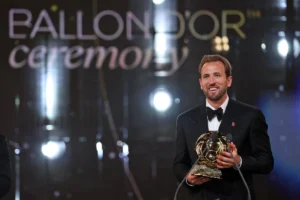
The 70th edition of the Ballon d’Or ceremony, held on Monday, October 26, 2026, at the historic London Palladium, served as a definitive celebration of the 2025/26 football season. As the most prestigious individual accolade in world football, the event brought together the sport’s premier athletes, coaches, and administrators to acknowledge a campaign defined by unprecedented goal-scoring records, international tournament drama, and the rise of a new generation of tactical brilliance. In a night of high-profile recognition, Harry Kane and Alexia Putellas emerged as the headline victors, cementing their places in the annals of football history.
The Historic Triumph of Harry Kane
Harry Kane’s ascension to the 2026 Ballon d’Or podium marks a watershed moment for English football. The England captain and Bayern Munich talisman secured the award following a statistical output that bordered on the extraordinary. During the 2025/26 campaign, Kane netted 61 goals in 51 appearances across all competitions, a feat that propelled Bayern Munich to a domestic league and cup double. His clinical efficiency in the Bundesliga, combined with his tactical intelligence, made him the clear favorite among the voting panel.
Beyond his club success, Kane’s impact was felt on the world stage during the 2026 FIFA World Cup. Serving as the focal point of the England attack, he scored six goals, leading the Three Lions to the semi-finals. This international consistency was the final catalyst for his selection. By capturing this trophy, Kane becomes the first English player to win the Ballon d’Or since Michael Owen in 2001, effectively ending a 25-year drought for English football. The emotional significance of this achievement was underscored by his poise on stage, where he acknowledged the collective effort of his teammates at both Bayern and the England national setup.
Alexia Putellas: A Legacy Furthered
The women’s Ballon d’Or saw the continued dominance of Spanish midfielder Alexia Putellas. Winning the award for the third time in her career, Putellas has reaffirmed her status as the most influential figure in modern women’s football. Her 2025/26 season was characterized by technical mastery, vision, and leadership in the middle of the park, serving as the heartbeat of a dominant Barcelona side.
The voting committee’s decision to award Putellas reflects not only her individual statistical contributions—such as her assist rates and successful pass completions—but also her intangible impact on the growth of the game. Having navigated high-pressure matches at both the club and international levels throughout the year, Putellas remains a benchmark for excellence. Her victory signals a period of sustained dominance for Spanish football, which continues to produce talent capable of dictating the tempo of the global game.
The Rise of the Next Generation
A significant portion of the evening was dedicated to the "Young Talent of the Year" awards, which highlighted the shift in the footballing landscape. Lamine Yamal, the Barcelona and Spain prodigy, captured the men’s Young Talent of the Year award. His meteoric rise was further underscored by his third-place finish in the overall Ballon d’Or voting—a rare feat for a player of his age. Analysts point to his dribbling success, chance creation, and tactical maturity as indicators that he is already operating at an elite level.
In the women’s category, Vicky López, also representing Barcelona, claimed the Young Talent of the Year honor. Her rise mirrors that of her club colleague, with scouts and coaches praising her versatility and composure under pressure. The success of both Yamal and López reflects the robust developmental systems currently in place at Barcelona, which continue to provide the primary pipeline for talent entering the senior ranks of European football.
The Sócrates Award and Social Impact
The ceremony also emphasized the responsibility that modern footballers have toward societal issues, best exemplified by the presentation of the Sócrates Award to Arsenal forward Bukayo Saka. The award, which recognizes a player’s commitment to charitable endeavors and social impact, highlights Saka’s ongoing efforts in youth development and community support programs. Saka’s work off the pitch has been lauded for its transparency and long-term commitment, proving that the influence of elite athletes extends far beyond the stadium walls.
Chronology of the 2025/26 Season
The journey to the London Palladium began in August 2025 with the kickoff of the European domestic leagues. The following timeline tracks the key moments that shaped the 2026 voting:
- August 2025: Domestic campaigns commence; Harry Kane hits the ground running for Bayern Munich, establishing an early rhythm in the Bundesliga.
- January 2026: Mid-season evaluations see Barcelona’s dominance in the Primera División Femenina, with Putellas and López driving the team toward a potential treble.
- June 2026: The FIFA World Cup takes center stage. Kane’s six-goal haul cements his case for the individual honor, while emerging stars like Lamine Yamal gain global recognition for their performances in international knockout rounds.
- August 2026: The UEFA Champions League and other continental tournaments conclude, with club performances finalized for the consideration of the 100-member voting panel of journalists.
- October 26, 2026: The 70th Ballon d’Or ceremony is held in London, finalizing the season’s accolades.
Statistical Analysis and Voting Context
The Ballon d’Or is decided by a panel of international journalists who evaluate players based on three core criteria: individual performance and decisive/impressive character; team achievements and titles; and class and fair play. This year, the voting data suggests a heavy weighting toward players who performed in both high-stakes club competitions and major international tournaments.
Kane’s efficiency rating—averaging over 1.2 goals per game—placed him in a statistical tier shared only by the most legendary strikers in the history of the sport. His ability to adapt to high-pressing systems in Germany while maintaining his role as a creative playmaker for England provided the necessary breadth of impact that the voting panel prioritized. Conversely, Putellas’s victory highlights the importance of consistency; despite facing increased competition from a rising pool of young midfielders, her tactical awareness remained unmatched throughout the 2025/26 season.
Broader Implications for Global Football
The 2026 ceremony signifies a transition period for the sport. As veteran stars like Kane maintain their grip on the highest honors, the emergence of players like Lamine Yamal and Vicky López suggests that the next five years will be defined by a new cohort of players who are breaking into the professional ranks earlier and with greater impact.
Furthermore, the emphasis on the Sócrates Award highlights a shift in how the industry views "success." Increasingly, the Ballon d’Or brand is moving to align itself with values beyond pure athletic output, promoting the idea that the greatest players are also those who contribute to the betterment of their communities.
Reaction from the Footballing Community
While the awards have been largely met with approval, the competitive nature of the voting process has sparked discussions among pundits regarding the criteria for the "Young Talent" awards. Some analysts have suggested that the performance gap between established veterans and breakout talents is narrowing, noting that the voting margins for the top three spots in the men’s Ballon d’Or were the closest they have been in over a decade.
Official representatives from both Bayern Munich and FC Barcelona have praised the ceremony for its commitment to celebrating the global nature of the sport. As football continues to evolve, the 2026 Ballon d’Or remains a critical barometer of who is currently at the apex of the game. With the 2026/27 season already underway, the focus has shifted to which players will sustain this level of excellence and which emerging talents will challenge the incumbents in the next iteration of this historic competition.
In summary, the 70th Ballon d’Or was a testament to the enduring appeal of the game. By honoring the technical brilliance of players like Kane and Putellas, the resilience of veterans, and the raw potential of the youth, the event successfully encapsulated the multifaceted nature of professional football in 2026.