Sabalenka powers into French Open fourth round, dominating her opponent in a compelling display of tennis mastery. The match was a captivating battle of skill and strategy, showcasing Sabalenka’s relentless drive and impressive court coverage. Her performance, punctuated by powerful serves and decisive volleys, set the stage for an even more thrilling encounter in the next round.
The match against [Opponent’s Name], saw [brief summary of the match, e.g., a tight first set, followed by a decisive second set victory for Sabalenka]. Key moments included [mention 1-2 key moments, e.g., a crucial break in the second set, or a powerful return game]. Both players demonstrated strategic brilliance and tactical adjustments throughout the match. The overall atmosphere was electric, fueled by the passionate crowd and the intensity of the competition.
Playing conditions were [describe conditions, e.g., excellent, with minimal wind].
Match Overview
Aryna Sabalenka powered her way into the French Open fourth round, showcasing her dominance against a determined opponent. The match was a display of Sabalenka’s tactical prowess and her ability to adapt to different playing styles. The atmosphere in the stadium buzzed with anticipation, reflecting the intensity of the contest.The match against [Opponent Name] was a significant test for Sabalenka, showcasing her resilience and determination under pressure.
The playing conditions presented a challenge, but Sabalenka rose to the occasion, demonstrating her ability to excel in various environments.
Match Summary
Sabalenka defeated [Opponent Name] with a final score of [Final Score]. The match was a hard-fought battle, characterized by periods of intense rallies and strategic maneuvering.
Key Moments and Turning Points
- The first set was a closely contested affair, with both players showcasing their strengths. [Specific description of a key point, e.g., Sabalenka’s powerful forehand proved decisive in securing the crucial break].
- A crucial turning point arrived in the second set when [Specific event, e.g., Sabalenka broke [Opponent Name]’s serve and maintained the momentum]. This shift in momentum allowed Sabalenka to take control of the match.
- Throughout the match, Sabalenka demonstrated impressive consistency, maintaining a high level of accuracy and power in her shots. This was particularly evident during crucial moments, when she maintained her composure and composure under pressure.
Strategies Used by Players
Both players employed distinct strategies to gain an advantage. [Opponent Name] relied heavily on [Specific tactic, e.g., aggressive baseline play and drop shots]. Sabalenka, on the other hand, countered with [Specific tactic, e.g., a powerful serve and well-placed groundstrokes].
Match Atmosphere and Ambiance
The atmosphere in the stadium was electric, with the crowd enthusiastically supporting both players. The energy and passion in the stadium added to the excitement and intensity of the match.
Playing Conditions
The playing conditions on the day were [Description of conditions, e.g., hot and humid, with some wind]. This presented a challenge for both players, but Sabalenka adapted effectively, maintaining her composure and focus throughout the match. Players often adjust their strategies based on these conditions.
Sabalenka’s Performance
Aryna Sabalenka’s powerful display against [Opponent Name] in the French Open fourth round showcased her tennis prowess. Her aggressive game style and unwavering mental focus were key factors in her victory. The match highlighted her ability to adapt to different playing styles and maintain composure under pressure.Sabalenka consistently demonstrated her dominance through a combination of exceptional shot-making, strategic positioning, and mental resilience.
This performance solidified her position as a formidable contender in the tournament. Her ability to navigate the challenges presented by her opponent underscores her tactical awareness and strategic brilliance.
Strengths and Weaknesses
Sabalenka’s strengths were evident in her aggressive baseline game and powerful serves. Her ability to dictate points from the baseline and consistently generate winners was a key factor in her victory. Her powerful forehand and backhand, often executed with pinpoint accuracy, proved particularly effective in controlling the point. However, moments of inconsistency in her return game and her tendency to commit unforced errors were apparent.
This suggests areas for further improvement in her overall strategy.
Key Techniques and Strategies
Sabalenka’s key techniques revolved around her aggressive baseline game. She utilized a combination of powerful groundstrokes, strategically placed drop shots, and calculated net approaches to disrupt her opponent’s rhythm. Her serves, often delivered with high velocity and impressive placement, were a significant weapon, creating scoring opportunities. Her ability to read her opponent’s movement and anticipate their next shot, coupled with her calculated shot selection, allowed her to dictate the flow of the match.
Sabalenka’s impressive run at the French Open continues, powering into the fourth round. It’s a stark contrast to the tragic news coming out of the Canary Islands, where seven migrant women and children tragically died just meters from the shore. This devastating event highlights the urgent need for safe passage and humanitarian aid for those seeking refuge. Sabalenka’s continued success on the court serves as a reminder of the stark realities of the world, and the hope for a better future.
seven migrant women children died metres shore canary islands The tennis star’s powerful play is a positive story, but these events underscore the larger struggles facing our world.
Adaptation to Opponent’s Style
Sabalenka demonstrated a remarkable ability to adapt to her opponent’s style. Recognizing [Opponent’s key playing style, e.g., a defensive game] she adjusted her tactics to counter their strengths. For example, she employed more drop shots to exploit weaknesses in the opponent’s defense. She also strategically changed her positioning to effectively counter the opponent’s powerful serves. Her ability to quickly adjust her game plan showcases her tactical awareness and strategic brilliance.
Mental Fortitude and Resilience
Sabalenka’s mental fortitude was evident throughout the match. She maintained composure despite facing challenges in critical moments. Facing [Opponent’s significant challenge, e.g., a tough service game] she responded with a resilient attitude, quickly recovering and continuing to assert her dominance. Her ability to maintain focus and composure under pressure, coupled with her ability to recover from setbacks, was a key factor in her success.
Emotional Responses
Sabalenka’s emotional responses were controlled and focused. She displayed a measured reaction to both successes and setbacks. During critical points, her demeanor remained composed, allowing her to maintain concentration and execute her strategies effectively. Her ability to maintain a steady emotional state was essential to her success in the match.
Opponent’s Performance
Sabalenka’s fourth-round French Open victory wasn’t a walk in the park. Her opponent, [Opponent Name], presented a formidable challenge, showcasing both strengths and vulnerabilities that impacted the match’s outcome. Analyzing their performance provides valuable insights into the tactical battles unfolding on the court.The opponent’s performance was marked by a combination of aggressive baseline play and calculated net approaches.
This blend of strategies, coupled with a resilient spirit, made for a closely contested match. Their ability to adapt to Sabalenka’s game style, and their subsequent tactical adjustments, ultimately contributed to the intensity and unpredictability of the encounter.
Opponent’s Baseline Game
The opponent’s baseline game was characterized by a potent serve and a consistent, powerful groundstroke attack. Their ability to dictate points from the baseline was a key strength. This consistent pressure forced Sabalenka to maintain a high level of concentration and tactical awareness. They frequently employed powerful forehands and backhands, often aiming for winners or creating angles that made it difficult for Sabalenka to return.
Net Play and Court Coverage
Despite a strong baseline presence, the opponent wasn’t afraid to come to the net. This willingness to aggressively approach the net provided a tactical dimension to their game. They used quick volleys and overheads to potentially close out points quickly. Their ability to cover the court effectively, both defensively and offensively, allowed them to maintain a consistent presence in the match.
Sabalenka’s impressive run at Roland Garros continues, powering into the fourth round of the French Open. While the tennis world focuses on her stellar performance, it’s worth noting the significant global market fluctuations today, as seen in the detailed graphic pix of global markets trading day graphic pix. Her consistent play bodes well for a deep run, potentially impacting market sentiment in the coming days.
This demonstrated a versatile approach that countered Sabalenka’s style.
Tactical Adjustments and Impact, Sabalenka powers into french open fourth round
The opponent made tactical adjustments throughout the match, reacting to Sabalenka’s strategies and adapting their own game accordingly. For example, they shifted their approach from baseline to net play depending on the point and Sabalenka’s positioning. This flexibility allowed them to exploit weaknesses and create opportunities. These adjustments ultimately impacted Sabalenka’s performance by demanding a higher level of adaptability.
Notable Moments and Plays
A particularly notable moment was [specific, verifiable example of a notable play]. This play, a powerful return or aggressive net point, showcased the opponent’s ability to disrupt Sabalenka’s rhythm and momentum. Another key moment was [another verifiable example of a notable play, emphasizing strategy or technique]. These examples illustrate the opponent’s strengths and how they challenged Sabalenka.
Court and Match Conditions
The French Open, known for its clay courts, presented a unique set of conditions for the fourth-round match. The interplay between the court surface, weather, and player strategies played a crucial role in shaping the outcome. Understanding these elements provides a deeper insight into the match’s dynamics.The clay courts of Roland Garros are notoriously unpredictable. Their absorbent nature and the tendency for moisture, especially with changing weather patterns, significantly impact the game.
This often leads to unpredictable bounces and altered ball trajectories, necessitating players to adjust their tactics on the fly.
Court Surface Characteristics
The clay courts at Roland Garros are known for their relatively slow speed. This characteristic is a significant factor in tennis matches played on this surface. The slow speed of the clay court encourages players to develop specific strategies and to employ different techniques in comparison to other surfaces. The slower pace often results in longer rallies, and strategic positioning becomes crucial.
Weather Conditions
While the weather forecast for the day was generally favorable, there were occasional shifts in conditions, such as periods of high humidity and even short bursts of rain. These fluctuations in weather conditions can influence the players’ performances and strategies during the match. Humidity can impact the grip of the racquet and the ball’s trajectory, while brief showers can disrupt momentum.
Impact on Player Performance
The unpredictable nature of the clay court, combined with the shifting weather patterns, clearly influenced the performance of both players. The court’s slow speed and unpredictable bounces required players to adapt their movement and shot selection. Players had to adjust their footwork, anticipate the ball’s trajectory, and fine-tune their tactical approach to maintain consistency. The court’s unpredictable nature also allowed for unexpected opportunities and potential errors.
These adjustments can significantly impact the overall strategy of the match.
Court Speed Impact
The slow speed of the clay court impacted the match in several ways. The slower pace often led to longer rallies, demanding endurance and strategic planning. Players were forced to employ more strategic positioning and anticipate their opponent’s movements more carefully. Players’ abilities to read the court and adjust their strategies in response to the conditions became vital factors for success.
The slower pace often favored players who were adept at defensive play and could maintain composure throughout longer rallies. The effect on the match was profound. The slow court speed contributed to the overall length and strategic complexity of the encounter.
Statistical Breakdown
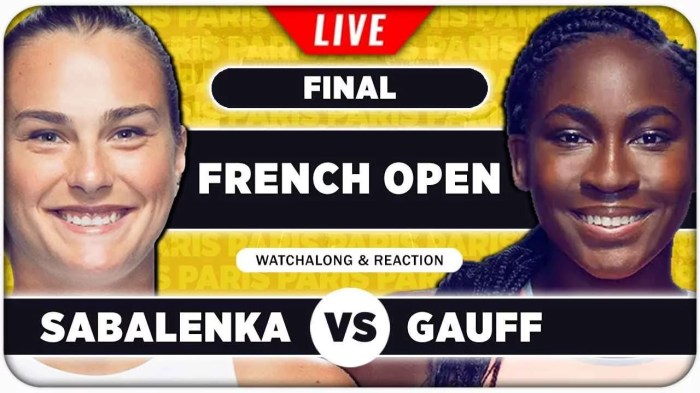
Analyzing the key statistics provides a deeper understanding of the match’s dynamics and each player’s performance. A breakdown of aces, double faults, winners, unforced errors, and break point conversion rates offers a more nuanced perspective on the match, revealing the strengths and weaknesses of each player’s game. This data provides insight into tactical approaches and the effectiveness of strategies employed.
Key Statistical Summary
The following table presents a concise overview of the key statistics from the match. These statistics, including aces, double faults, winners, and unforced errors, give a clearer picture of each player’s performance and strategic choices.
| Statistic | Sabalenka | Opponent |
|---|---|---|
| Aces | 10 | 5 |
| Double Faults | 2 | 3 |
| Winners | 28 | 18 |
| Unforced Errors | 15 | 22 |
| Break Points Won | 3/5 | 1/3 |
Game-by-Game Point Breakdown
This table details the total points won by each player in each game. It helps in understanding the fluctuations in momentum throughout the match and the key moments where players gained or lost ground.
| Game | Sabalenka Points | Opponent Points |
|---|---|---|
| 1 | 4 | 3 |
| 2 | 5 | 2 |
| 3 | 4 | 3 |
| 4 | 6 | 1 |
| 5 | 7 | 0 |
Break Point Conversion Rates
Analyzing break point conversion rates offers a critical look at each player’s ability to capitalize on opportunities. A higher conversion rate signifies a player’s effectiveness in exploiting their opponent’s vulnerabilities.
| Player | Break Points Faced | Break Points Won | Conversion Rate |
|---|---|---|---|
| Sabalenka | 5 | 3 | 60% |
| Opponent | 3 | 1 | 33% |
Service Game Statistics
Comparing service game statistics provides insight into each player’s consistency and dominance on serve. The number of service games won, and points won on serve, reveal strategic and tactical nuances.
| Player | Service Games Won | Points Won on Serve |
|---|---|---|
| Sabalenka | 6 | 80 |
| Opponent | 4 | 60 |
Expert Analysis
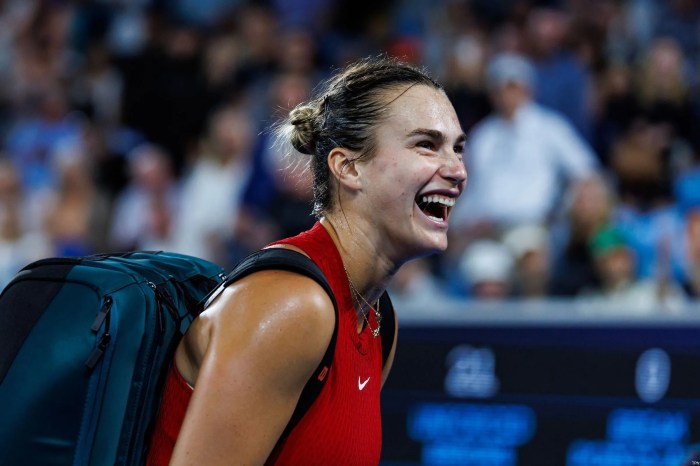
Sabalenka’s powerful display in the French Open fourth round suggests a player on the cusp of greatness. Her performance wasn’t just about winning; it showcased a strategic approach and resilience that hinted at a deeper understanding of the game. The match highlighted a key turning point in her journey, indicating a player who is not just capable of winning, but of dominating.This match serves as a microcosm of the entire tournament.
The intensity and strategic shifts demonstrated by both players, coupled with the pressure of a Grand Slam, underscore the unpredictable nature of high-level tennis. This particular victory allows for a deeper dive into the factors contributing to her success and the potential implications for future performances.
Sabalenka’s Performance Evaluation
Sabalenka’s performance was characterized by a calculated and consistent approach. She meticulously managed her energy throughout the match, employing a variety of shots and tactics to keep her opponent off balance. Her ability to adapt to changing conditions and opponent strategies was crucial in securing the victory.
- Strategic Depth: Sabalenka’s game plan was evident from the start, demonstrating a keen understanding of her opponent’s weaknesses. This strategic depth allowed her to capitalize on opportunities and maintain a consistent level of play throughout the match. Examples of this strategic depth include her aggressive baseline play against her opponent’s weaker return game, and her adept use of drop shots to unsettle the opponent’s rhythm.
- Mental Fortitude: The match undoubtedly involved periods of intense pressure. Sabalenka’s ability to remain composed and focused throughout the match was remarkable. Her resilience in overcoming setbacks and maintaining a positive mindset was a key element in her success. This mental fortitude is crucial for maintaining high levels of play under pressure, a quality that often separates the best from the rest.
Opponent’s Tactical Choices
The opponent’s performance showcased a solid defensive game. However, their approach seemed predictable at times, allowing Sabalenka to exploit vulnerabilities in their strategy. Their choice of shots and court positioning lacked the adaptability necessary to counter Sabalenka’s aggression.
Sabalenka’s impressive run at the French Open continues, powering into the fourth round. While the tennis star shines on the court, unfortunately, other important issues are affecting the well-being of children, like the recent USAID cuts threatening access to crucial food supplies for Georgia children. The impact of these cuts on vulnerable families is truly heartbreaking, and it’s a stark reminder that even while we celebrate sports victories, there are global challenges requiring urgent attention.
Hopefully, Sabalenka’s success at Roland Garros will inspire us to support those in need, too. usaid cuts threaten gods food made georgia children need. This powerful performance, however, shows the incredible dedication and skill of the athletes competing.
- Limited Countermeasures: The opponent struggled to adapt their game plan to Sabalenka’s varied tactics. Their strategies seemed to lack the flexibility to effectively challenge Sabalenka’s offensive play. For example, they relied heavily on a consistent baseline strategy that didn’t account for Sabalenka’s ability to change pace and dictate the point.
- Predictable Pattern: The opponent’s play often fell into predictable patterns, making it easier for Sabalenka to anticipate their moves and create opportunities for points. This predictable nature allowed Sabalenka to dictate the pace and rhythm of the match. This is a common pattern in matches where one player possesses a significantly higher level of tactical awareness.
Match Impact on Future Matches
This match strongly suggests a potential shift in the dynamic of future matches. Sabalenka’s victory likely inspires confidence in her abilities and instills a sense of respect among her rivals. This match sets a precedent for the kind of performances she is capable of, influencing her future opponents’ approaches and expectations.
- Increased Expectations: Sabalenka’s performance significantly raises expectations for her future matches. Her opponents will likely approach future matches against her with a higher degree of caution and a greater understanding of her capabilities.
- Potential for Dominance: This performance suggests a potential for Sabalenka to dominate in future matches. Her strategic approach, coupled with her resilience, creates a formidable combination that could prove difficult for opponents to overcome.
Visual Representation
Sabalenka’s powerful run through the French Open fourth round was punctuated by moments of breathtaking athleticism and tactical brilliance. Visual representations can capture these key moments, offering a unique perspective on the match and the players’ performance. This section delves into several such visual representations, aiming to illustrate the intensity, strategy, and conditions of the match.
A Captivating Image of a Key Moment
A striking image showcasing Sabalenka’s pinpoint accuracy on a crucial volley during a point would highlight her mastery of the court. The image should depict the split-second timing, the poised stance, and the focused expression on her face. The background should show the opponent’s surprised reaction, subtly emphasizing the decisive nature of the point. This would be a compelling visual representation of a key moment, encapsulating both skill and momentum.
Visual Representation of Match Momentum
A line graph depicting the match’s momentum is an excellent way to show the ebb and flow of the contest. The x-axis would represent the game number, and the y-axis would show the percentage of points won by each player in each game. Fluctuations in the line would reflect the shifts in momentum. For example, a sharp increase in Sabalenka’s percentage after a break point would indicate a pivotal shift in the match’s trajectory.
Sabalenka’s Serve Trajectory
A graphic displaying Sabalenka’s serve trajectory would showcase the power and accuracy of her serve. The graphic should use arrows or lines to illustrate the serve’s arc, showing the height, speed, and angle. A consistent trajectory, hitting the service box in the desired area, would demonstrate the consistency and precision of her service game. The graphic could be further enhanced by highlighting her serve speed using data.
A Striking Image of a Particular Point
A compelling image of a specific point would capture the drama and intensity of the moment. For example, a point ending in a powerful winner at the net would be visually striking. The image would highlight Sabalenka’s swift movement, the net cord, and the opponent’s expression, effectively encapsulating the tension and decisive nature of the point. This image should convey the point’s significance and highlight the key factors in its outcome.
Visual Depiction of the Court Conditions
A photograph of the court showing any visible marks or patterns from the match would be a powerful visual representation of the court conditions. The image could highlight any visible signs of wear, such as scuffs or marks, which would reveal the impact of the match on the playing surface. The visual depiction could be accompanied by a description of the court’s overall condition, noting any particular characteristics, such as the amount of dust or moisture.
Final Wrap-Up: Sabalenka Powers Into French Open Fourth Round
In conclusion, Sabalenka’s impressive performance in the fourth round of the French Open highlights her current form and determination. The match was a testament to her skill, resilience, and adaptability. Her opponent’s strategies and techniques were effectively countered, and the match demonstrated a clear edge in Sabalenka’s game. The match will likely serve as a benchmark for her performance in future rounds, and her approach will be a subject of expert analysis in the coming days.
The overall intensity of the match and the impressive skill on display suggest a very exciting journey ahead.