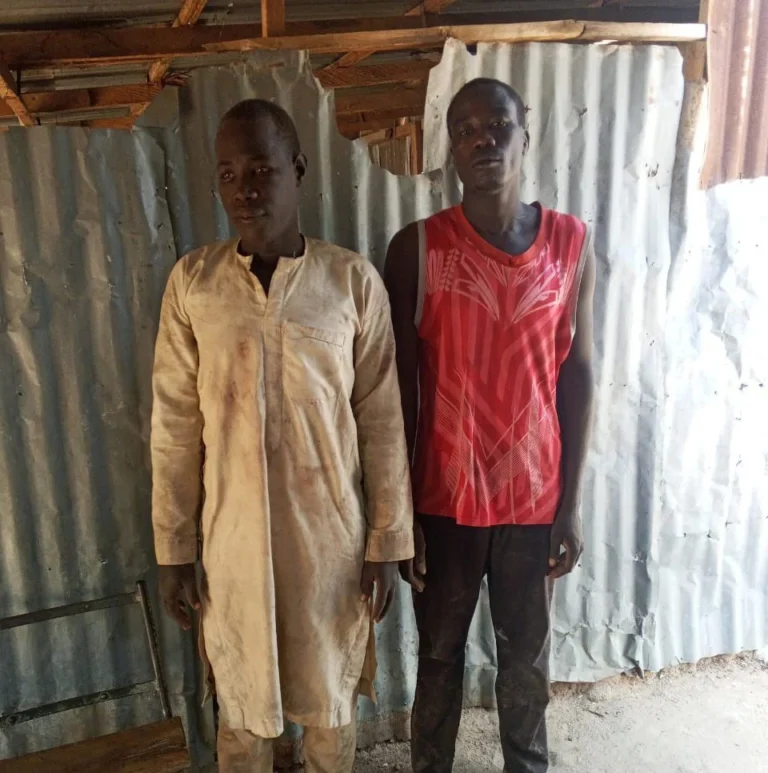
In a significant tactical development within the ongoing counter-insurgency operations in Northeast Nigeria, troops of the Nigerian Army, acting in concert with the Civilian Joint Task Force (CJTF)—often referred to as the Hybrid Force—have successfully apprehended two individuals suspected of serving as informants and logistical collaborators for the Boko Haram terrorist group. The operation, which took place in the strategic town of Beni Sheik in the Kaga Local Government Area of Borno State, marks a continuation of the military’s intensified efforts to dismantle the intelligence networks that underpin insurgent activities in the Lake Chad Basin.
The Operation: A Tactical Overview
The arrests were executed on November 1, 2026, at approximately 2:00 p.m. local time. According to official reports, the operation was spearheaded by the 29 Task Force Brigade, specifically elements of the Guards Battalion operating under Sector 2 of the Operation Hadin Kai theater of command. The suspects were identified as 30-year-old Bukar Usman and 25-year-old Ladan Modu.
Intelligence reports indicate that the two individuals had been under surveillance by military intelligence units for several weeks. Their apprehension was the result of a precise, intelligence-led raid that caught the suspects off-guard, thereby preventing any potential for armed resistance or the destruction of critical communication devices. Following their capture, both men were transferred to a secure military facility where they are currently undergoing intensive interrogation to determine the depth of their involvement in the terror network and to identify other cells operating within the Kaga region.
The Strategic Importance of Beni Sheik
Beni Sheik holds significant strategic value in the Borno State security architecture. Situated along the major Maiduguri-Damaturu highway, the town serves as a vital artery for commerce and military logistics. Historically, this route has been a high-risk corridor, frequently targeted by insurgents seeking to disrupt supply lines and intimidate civilian populations. By maintaining a robust presence in this area, the 29 Task Force Brigade ensures the mobility of goods and services while simultaneously acting as a bulwark against the infiltration of insurgents into the Borno heartland.
The presence of informants within such a locale is a primary challenge for military planners. Informants typically facilitate the movement of insurgents by identifying military checkpoints, documenting troop deployment patterns, and managing the movement of supplies, including fuel, food, and small arms. The arrest of Usman and Modu is viewed as a significant blow to the insurgents’ localized intelligence-gathering capabilities in the Kaga LGA.
Contextualizing the Insurgency: A Decade of Conflict
The arrest occurs against the backdrop of a long-standing insurgency that has claimed thousands of lives and displaced millions since 2009. The Boko Haram conflict, which later splintered into various factions including the Islamic State West Africa Province (ISWAP), has evolved from large-scale territorial control to a more asymmetric form of warfare. This shift has necessitated a heavier reliance on intelligence-led operations by the Nigerian Armed Forces.
The role of the "Hybrid Force"—the Civilian Joint Task Force—cannot be overstated in this context. These local volunteers, who possess deep knowledge of the terrain and the social fabric of the communities, serve as the "eyes and ears" of the military. Their synergy with the Nigerian Army has proven essential in identifying non-combatant collaborators, who are often the most difficult targets to isolate in a civilian environment.
Chronology of Recent Counter-Insurgency Efforts
To understand the weight of the November 1 operation, it is necessary to view it within the timeline of the broader 2026 counter-insurgency campaign:
- September 2026: Increased military activity in the Sambisa Forest region leads to the neutralisation of several high-ranking commanders of the insurgent factions.
- October 15, 2026: A series of town hall meetings are held across Kaga and Konduga LGAs, where military commanders urge local leaders to report suspicious movements.
- October 28, 2026: Intelligence gathered from local sources begins to coalesce around a cell operating within the vicinity of Beni Sheik, pointing toward the activities of two specific individuals.
- November 1, 2026: The 29 Task Force Brigade conducts the raid, successfully apprehending Bukar Usman and Ladan Modu.
- November 4, 2026: Military authorities officially confirm the arrests, signaling an ongoing investigation into the suspects’ associations with wider criminal networks.
Supporting Data and Security Analysis
The persistence of the insurgency is largely maintained by what security analysts call "enabling networks." These networks do not necessarily carry weapons but perform the critical tasks of logistics, surveillance, and recruitment. According to data provided by the Global Terrorism Index (GTI) and regional security think tanks, the reduction in large-scale insurgent attacks in Borno State in 2026 can be partially attributed to the systematic dismantling of these support structures.
In 2025 and early 2026, the military shifted its tactical focus from massive ground offensives to "strangulation tactics." This involves cutting off the supply chains that allow insurgent groups to maintain their fighting strength. The arrests in Beni Sheik are a microcosm of this policy. By removing the informants, the military effectively blinds the insurgent cells, making it difficult for them to plan ambushes on the Maiduguri-Damaturu highway.
Official Responses and Legal Implications
While the Nigerian military has not released a detailed statement regarding the specific evidence recovered from the suspects, standard operating procedure dictates that such individuals undergo a rigorous vetting process. Legal experts emphasize that under the Terrorism (Prevention) Act, collaborators are subject to the same penalties as active combatants.
A spokesperson for the military, speaking on condition of anonymity due to the ongoing nature of the investigation, noted: "Every arrest of this nature provides a roadmap to the next. The individuals currently in custody have provided actionable intelligence that is being analyzed by our tactical units. We are committed to ensuring that the civilian population in Kaga LGA can move freely without the threat of being monitored or targeted by these collaborators."
The civilian population in the region has largely welcomed the move, noting that the presence of informants creates an atmosphere of fear and distrust. Local community leaders have long advocated for stricter vetting of individuals entering the town, suggesting that the success of the military operation reinforces the need for continued community-military collaboration.
Broader Implications for National Security
The arrests carry several significant implications for the future of the counter-insurgency campaign in the Northeast:
- Deterrence: The swift apprehension of the suspects sends a clear message to other potential collaborators that the military’s intelligence-gathering apparatus is functioning effectively and that nowhere in the region is beyond the reach of state security.
- Intelligence Synergy: The operation validates the "Hybrid Force" model. The effectiveness of this operation serves as a blueprint for how state security forces can integrate local knowledge to achieve tactical superiority.
- Stability of Supply Routes: As the Maiduguri-Damaturu highway remains the primary economic lifeline for Borno State, the elimination of intelligence nodes in the surrounding areas is critical for long-term economic stability and the eventual return of displaced persons to their ancestral homes.
- Information Warfare: By neutralizing the information-gathering capabilities of the insurgents, the military can effectively "starve" the terror groups of the information they need to conduct hit-and-run attacks, which are their primary method of maintaining relevance.
As the investigation into Bukar Usman and Ladan Modu proceeds, military authorities remain vigilant. The 29 Task Force Brigade has signaled that further operations are likely to follow as the intelligence gathered from these two suspects is processed. For the people of Borno, the successful conclusion of this operation is a step toward the elusive goal of lasting peace in a region that has suffered far too long under the shadow of extremist violence. The coming weeks will likely see an uptick in security presence in the area as the military continues to sanitize the region of remnant insurgent elements.