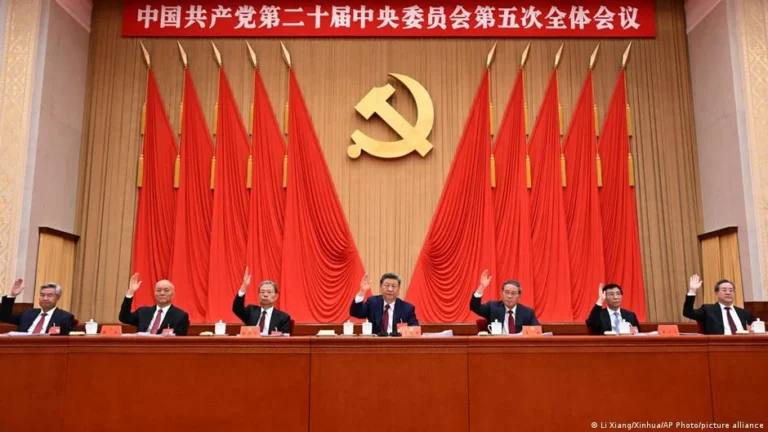
The Chinese Communist Party (CCP) concluded a significant four-day plenary session in Beijing this week, reaffirming its commitment to absolute internal discipline and the centralization of authority under President Xi Jinping. Amidst a complex landscape of cooling economic growth, geopolitical friction, and mounting domestic pressure, the CCP leadership has signaled an intensified campaign to purge "two-faced" officials and mandate unwavering political loyalty across all administrative tiers. The resolution emerging from the meeting serves as a clarion call for "comprehensive and strict Party leadership," effectively narrowing the margin for bureaucratic autonomy while demanding heightened efficiency in the implementation of the central government’s agenda.
The Evolution of the Anti-Corruption Drive
Since ascending to power in 2012, Xi Jinping has utilized the anti-corruption apparatus as a primary instrument of governance. What began as a campaign to address systemic graft has evolved into a sophisticated tool for ideological alignment and organizational purification. The recent plenary session underscored that this effort is not merely a temporary initiative but a foundational pillar of modern CCP rule.
Historical context reveals the scale of this undertaking. Over the past decade, the Central Commission for Discipline Inspection (CCDI) has investigated millions of officials, ranging from local "flies" to high-ranking "tigers." Data released periodically by the CCDI indicates that the focus has shifted from simple bribery to the more nebulous charge of "political disloyalty." By framing administrative failures or policy deviations as breaches of party discipline, the leadership ensures that the entire state apparatus remains tethered to the vision articulated by the General Secretary.
The terminology used in the latest press release—praising the "enormous political courage and strong sense of responsibility" of the current leadership—highlights a shift toward a culture of performative accountability. Officials are now expected to demonstrate "initiative," yet this initiative must be strictly confined to the execution of pre-approved directives.
Defining the Two-Faced Functionary
A critical development from the recent sessions is the explicit denunciation of "two-faced functionaries." In a speech highlighted in the CCP’s theoretical journal, Qiushi, Xi Jinping described these individuals as political opportunists who ostensibly profess adherence to the party line while privately pursuing individualistic agendas or failing to act when confronted with systemic challenges.
This rhetoric addresses a perceived lack of vigor among local cadres. Faced with the pressure of the anti-corruption drive, many officials have adopted a "lying flat" (tang ping) approach, avoiding decision-making to mitigate the risk of error and subsequent investigation. By calling for both loyalty and initiative, the central leadership is attempting to break this deadlock, forcing officials to work harder without granting them the authority to deviate from the center’s mandates.
Economic Pressures and Geopolitical Uncertainty
The emphasis on party discipline occurs against a backdrop of significant economic headwinds. China’s transition from high-speed growth to high-quality development has been hampered by a property sector crisis, sluggish consumer demand, and demographic shifts. External analysts, such as Kerry Brown of the Lau China Institute, suggest that the CCP’s obsession with internal stability is a direct response to these pressures.
"If the CCP isn’t disciplined and united, the party believes it will face the same existential risks as other regimes globally," Brown noted. The logic follows that in an era of international fragmentation and trade instability, the only buffer against collapse is a monolithic and unshakable party structure.
Data regarding China’s current economic performance underscores the difficulty of this balancing act. While GDP growth remains within the targeted range, the structural adjustments required to transition toward technology-led growth require a degree of creative policy implementation that is often stifled by the current climate of fear and strict oversight. When innovation is secondary to obedience, the agility of the state’s economic response is inevitably compromised.
The Dilemma of Succession and Power Dynamics
Perhaps the most significant long-term implication of the recent plenary session is the ongoing question of leadership succession. In 2018, the National People’s Congress passed a constitutional amendment removing term limits for the presidency, effectively allowing Xi Jinping to remain in power indefinitely. This move, while cementing his authority, created a vacuum regarding the future of the party’s leadership.
Political scientists point out that the absence of a designated successor is a double-edged sword. On one hand, it prevents the formation of rival power centers or factions that could challenge the current leader’s agenda. On the other, it introduces a systemic fragility. Without a clear transition path, the party risks a sudden, potentially destabilizing power vacuum should the need for a leadership change arise unexpectedly.
Chong Ja Ian, a political scientist at the National University of Singapore, argues that the current structure forces a trade-off: "Xi would like for officials to act proactively, but he does not want them thinking for themselves so much that they question the prescribed agenda." This environment makes it difficult for any potential successor to distinguish themselves or gain the necessary experience to lead, as any sign of independent ambition could be interpreted as a threat to the current center of gravity.
Chronology of Strengthening Party Control
- 2012: Xi Jinping assumes the role of General Secretary, immediately launching a broad anti-corruption campaign aimed at internal purification.
- 2017: The 19th National Congress solidifies Xi’s status within the party, elevating "Xi Jinping Thought" to the party constitution.
- 2018: Constitutional term limits for the presidency are removed, signaling the potential for indefinite leadership.
- 2021: The party adopts a "Historical Resolution," cementing Xi’s place in history alongside Mao Zedong and Deng Xiaoping.
- 2024 (Mid-October): Publication in Qiushi denouncing "two-faced" officials and "political opportunists."
- 2024 (Late October/Early November): The four-day plenary session concludes, focusing on the solidification of ideological discipline and the necessity of strict, central control to navigate national and international challenges.
Analytical Implications
The ongoing reinforcement of the party structure serves several strategic functions. By institutionalizing the anti-corruption drive, the CCP effectively creates a mechanism for constant personnel turnover. This ensures that no individual can build a sufficiently large power base to challenge the central leadership, as any official can be brought down by a review of their past conduct or a charge of insufficient enthusiasm.
However, the cost of this stability is the potential erosion of the "middle-management" layer of the Chinese state. When the primary incentive for a career in public service is the avoidance of punishment rather than the achievement of policy goals, the capacity of the state to manage crises—whether economic, environmental, or social—diminishes.
Furthermore, the focus on "unity" as a prerequisite for survival reflects a deep-seated apprehension regarding the global environment. The party’s narrative posits that the world is currently in a state of "disorder," and that China is an island of relative stability. To maintain this, the leadership believes it must purge any internal dissent that could be exploited by external actors.
Conclusion
The conclusion of this plenary session confirms that the CCP remains committed to a governance model centered on hierarchy, discipline, and the absolute authority of the General Secretary. As the party looks toward the next cycle of its five-year plans, the tension between demanding initiative and enforcing conformity will remain the central paradox of the Chinese political system. While this model has proven effective in maintaining order and implementing top-down directives, it also creates a rigid structure that may struggle to adapt to the fluid, unpredictable challenges of the coming decade. As the world observes, the question is not just how long the current system can persist, but how effectively it can govern a complex, modern society without the oxygen of internal debate or the predictability of a clear succession process.