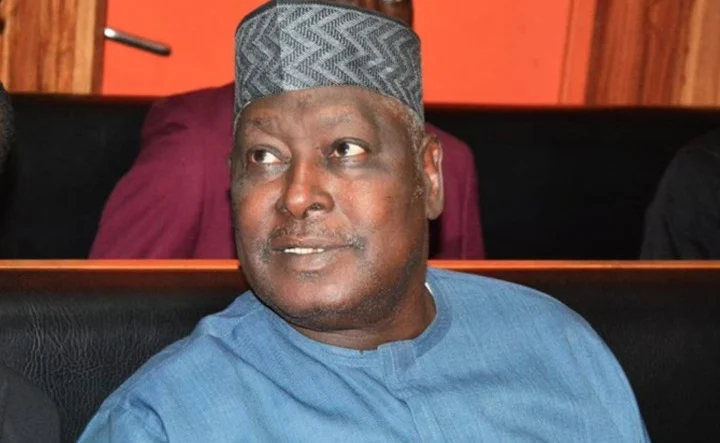
The political landscape leading up to the 2027 general elections has taken a contentious turn as Babachir Lawal, a former Secretary to the Government of the Federation (SGF), issued a stern warning to the Nigerian electorate regarding the perennial presidential ambitions of former Vice President Atiku Abubakar. In a move that highlights deepening fissures within the opposition and regional political structures, Lawal accused Atiku of weaponizing ethnic politics to achieve his personal ambitions, specifically citing alleged interference in the internal affairs of the African Democratic Congress (ADC) in Adamawa State. The controversy centers on the governorship ticket of the ADC, where Lawal claims Atiku is orchestrating a plot to bypass democratic processes and install a preferred candidate, a charge that the Atiku camp has vehemently denied as a fabrication intended to sow discord.
The Adamawa ADC Governorship Dispute
The current friction originated from developments within the African Democratic Congress (ADC) in Adamawa State, the home state of both Atiku Abubakar and Babachir Lawal. According to Lawal, the former Vice President has been actively working behind the scenes to undermine the candidacy of Suleiman Omar, who was purportedly elected as the party’s governorship candidate during its primary elections. Lawal alleged during a telephone interview on Wednesday that Atiku is pushing for Omar to be replaced by Alhaji Tukur Modibbo.
Lawal’s allegations suggest a breach of internal party democracy, where a candidate who emerged through a constitutional process is being sidelined in favor of an individual who did not undergo the same level of scrutiny or electoral validation by party members. "Atiku Abubakar wants to replace Suleiman Omar as the governorship candidate of the African Democratic Congress in Adamawa State with Alhaji Tukur Modibbo," Lawal stated. "He wants to bring Modibbo to replace Omar, who was elected at the primaries." This specific intervention, Lawal argues, is part of a broader pattern of political maneuvering that Atiku employs to maintain a grip on his home state’s political machinery, often at the expense of fairness and equity.
Accusations of Ethnic Politics and the 2027 Warning
Beyond the local governorship dispute, Babachir Lawal transitioned his critique into a national warning. He characterized Atiku’s political philosophy as being fundamentally driven by ethnic considerations rather than national interest. Lawal’s rhetoric taps into a long-standing debate in Nigerian politics regarding the "turn-by-turn" nature of power and the influence of regional blocs. By accusing Atiku of "playing ethnic politics," Lawal is attempting to frame the former Vice President as a divisive figure whose leadership would prioritize certain demographics over the collective progress of the federation.
Lawal’s appeal to Nigerians to reject Atiku in 2027 marks a significant shift in the "Third Force" alignment. Lawal, who was a prominent figure in the All Progressives Congress (APC) before falling out with the party over its "Muslim-Muslim" ticket in 2023, has recently positioned himself as an advocate for alternative political platforms. His warning suggests that even within the opposition, there is no consensus on Atiku as a unifying figure for the next electoral cycle.
Atiku Abubakar’s Rebuttal: "False and Baseless"
The response from the Atiku Abubakar camp was swift and uncompromising. In a statement issued by his media aide, Phrank Shaibu, the former Vice President dismissed Lawal’s claims as "malicious propaganda." The statement characterized the allegations as a product of a "fertile imagination" designed to create unnecessary tension within the ADC and the broader political environment.
Shaibu emphasized that Atiku has no vested interest in the internal candidate selection process of the ADC, noting that Atiku remains a stalwart of the People’s Democratic Republic (PDP). The statement clarified that "at no time has His Excellency, Atiku Abubakar, held any meeting, issued any directive or participated in any discussion aimed at replacing the duly nominated governorship candidate of the party in Adamawa State." The Atiku camp suggested that the allegations were born out of a fear of the growing unity and momentum within the ADC, implying that external actors are threatened by the party’s potential to disrupt the status quo in Adamawa.
The rebuttal also underscored Atiku’s commitment to internal democracy and due process. By distancing himself from the ADC’s internal affairs, Atiku’s team sought to portray him as a statesman who respects the constitutional boundaries of political parties, regardless of his personal or political influence in the region.
Historical Context: Babachir Lawal and the Search for a Third Force
To understand the weight of these accusations, one must look at the political trajectory of Babachir Lawal. A former ally of President Muhammadu Buhari, Lawal served as SGF until his removal following a high-profile investigation into the "grass-cutting" scandal involving contracts for the Presidential Initiative on the North East (PINE). Despite his exit from government, he remained a potent political voice, particularly in the North-East.
In the lead-up to the 2023 elections, Lawal became a vocal critic of the APC’s decision to field Bola Ahmed Tinubu and Kashim Shettima, arguing that a same-faith ticket was insensitive to Nigeria’s religious diversity. This led him to support Peter Obi of the Labour Party, positioning Lawal as a key player in the "Third Force" movement. His current involvement in the ADC’s affairs in Adamawa suggests he is continuing his effort to build or influence a platform outside the two dominant parties (APC and PDP). His friction with Atiku is therefore not just personal but reflects a battle for the soul of the opposition in the North.
Atiku’s Perennial Presidential Ambition
Atiku Abubakar is perhaps the most persistent presidential aspirant in Nigeria’s democratic history. Since 1993, he has sought the presidency under various platforms, including the Social Democratic Party (SDP), the Action Congress (AC), the APC, and most recently, the PDP in 2019 and 2023. Atiku’s influence in Adamawa State is legendary; he is often seen as the "godfather" of the state’s politics, and his support—or opposition—can determine the fate of governorship and legislative candidates.
The accusation that he is interfering in a party other than his own (the ADC) speaks to the complex web of cross-party alliances that define Nigerian politics. In Adamawa, the boundaries between the PDP, APC, and ADC are often blurred by personal loyalties and ethnic affiliations. Lawal’s critique suggests that Atiku’s influence is so pervasive that it transcends party lines, potentially stifling the growth of independent political voices in the region.
The Significance of the African Democratic Congress (ADC)
The ADC has emerged as a significant "mid-tier" party in Nigeria. While it does not possess the national reach of the PDP or APC, it has frequently served as a refuge for disgruntled politicians from the major parties. In the 2019 elections, it gained prominence when former President Olusegun Obasanjo briefly adopted it as the platform for his "Coalition for Nigeria Movement."
In Adamawa, the ADC has been a formidable contender, often playing the role of a "kingmaker" or a credible alternative to the PDP and APC. The dispute over the governorship ticket between Suleiman Omar and Tukur Modibbo is critical because the ADC’s performance could split the votes in the state, either aiding the incumbent Governor Ahmadu Fintiri (PDP) or creating an opening for the APC. Lawal’s defense of Suleiman Omar suggests he views Omar as a candidate who can maintain the party’s integrity against external "encroachment" by Atiku’s interests.
Analysis of Implications for the 2027 Elections
The public spat between Lawal and Atiku is a precursor to the 2027 presidential race. Several key implications can be drawn from this development:
- Fragmentation of the Opposition: The inability of opposition leaders like Lawal and Atiku to find common ground, even on local matters, suggests that a unified front against the ruling APC in 2027 will be difficult to achieve. The "Third Force" remains divided by personality clashes and local disputes.
- The Role of Ethnicity: Lawal’s explicit mention of "ethnic politics" signals that the 2027 campaign may once again be dominated by identity politics. As the North seeks to reclaim or solidify its influence, and the South seeks to retain the presidency, such accusations will likely become more frequent.
- Adamawa as a Microcosm: The political battle in Adamawa serves as a microcosm of the national struggle. If Atiku cannot maintain harmony in his home state, his ability to project himself as a national unifier will be continuously challenged by critics like Lawal.
- Internal Party Democracy: The controversy highlights the ongoing struggle for internal democracy within Nigerian parties. The "substitution" of candidates remains a contentious issue that often leads to litigation and electoral losses.
Chronology of the Dispute
- Primary Season: The ADC conducts governorship primaries in Adamawa State, where Suleiman Omar is declared the winner and the duly nominated candidate.
- Post-Primary Maneuvers: Allegations begin to surface within the state chapter regarding a plot to substitute Omar with Tukur Modibbo.
- Babachir Lawal’s Intervention (Wednesday night): Lawal grants an interview to The PUNCH, naming Atiku Abubakar as the architect of the substitution plot and warning Nigerians against Atiku’s 2027 ambitions.
- Official Denial (Thursday): Phrank Shaibu, speaking for Atiku, issues a comprehensive statement denying any involvement in ADC affairs and labeling the claims as propaganda.
- ADC Party Reaction: The national leadership of the ADC maintains that it will follow its constitution and internal processes, though the local chapter remains divided between the Omar and Modibbo factions.
Conclusion: The Road to 2027
As Nigeria moves closer to the 2027 electoral cycle, the exchange between Babachir Lawal and Atiku Abubakar underscores the volatility of the country’s political alliances. While Lawal seeks to position himself as a watchdog against "ethnic politics" and "godfatherism," Atiku’s camp remains focused on maintaining his relevance as a leading opposition figure. The resolution of the ADC governorship ticket in Adamawa will be a litmus test for the party’s independence and a signal of how the broader opposition might fare in the coming years. For the Nigerian electorate, these early skirmishes provide a glimpse into the narratives of ethnicity, democracy, and power that will define the next general election.