The Federation Internationale de Football Association (FIFA) has officially initiated a comprehensive disciplinary inquiry into the violent altercations that erupted between Spanish and Argentine players following the conclusion of the World Cup final in New Jersey. The match, which saw Spain ascend to the pinnacle of global football with a hard-fought 1-0 victory in extra time, ended in scenes of chaos that have overshadowed the sporting achievement. By defeating the defending champions, Spain effectively ended Argentina’s four-year reign as world leaders, but the transition of power was marked by physical confrontations, technical area skirmishes, and a total breakdown of the "fair play" ethos that the governing body seeks to uphold.
On Monday, FIFA’s headquarters in Zurich confirmed that its Disciplinary Committee had reviewed extensive match reports from the officiating crew and stadium security. The investigation aims to address potential breaches of the FIFA Disciplinary Code (FDC) regarding the post-match incidents that saw players and staff from both nations engage in a melee on the pitch at MetLife Stadium. A spokesperson for the organization confirmed to Al Jazeera that a Disciplinary and Ethics Prosecutor has been appointed to lead the probe, with the possibility of significant sanctions looming for several high-profile athletes and the respective national associations.
A Night of High Tension and Historical Significance
The 2026 World Cup final was always expected to be a high-stakes encounter, pitting the youth-led resurgence of the Spanish national team against the seasoned, battle-hardened squad of Argentina. Spain, seeking their second world title following their 2010 triumph in South Africa, faced an Argentine side desperate to cement their legacy as one of the greatest dynasties in football history.
The match itself was a tactical chess match that remained scoreless through 90 minutes of regulation time. As fatigue set in during the 30-minute extra-time period, Spain managed to break the deadlock with a clinical finish that sent the Spanish supporters into a frenzy and left the Argentine side visibly frustrated. Throughout the game, the officiating team had struggled to maintain order as cynical fouls and verbal provocations increased in frequency. By the time the final whistle blew, the emotional pressure cooker of the tournament reached a breaking point.
Chronology of the Post-Match Conflict
The immediate aftermath of the final whistle was characterized by a jarring dichotomy of emotions. While Spanish players celebrated their victory, the disappointment of the Argentine side quickly curdled into aggression.
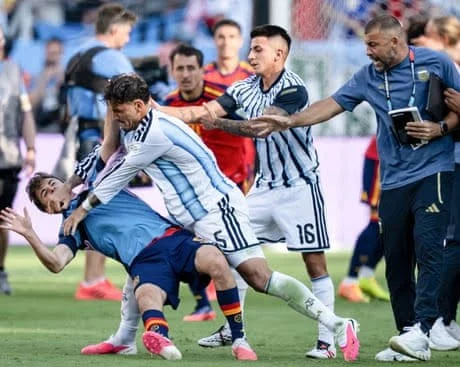
According to video footage and eyewitness accounts, the primary flashpoint occurred near the center circle. Spain’s teenage sensation Lamine Yamal was seen kneeling in prayer and gratitude, seemingly oblivious to the escalating violence occurring meters behind him. At that moment, Argentine midfielder Leandro Paredes was observed grabbing Spanish defender Eric Garcia by the neck, an act that triggered a massive influx of players from both benches.
As Spanish substitute Gavi attempted to intervene and de-escalate the situation, the confrontation turned physical. Gavi was reportedly attacked by both Thiago Almada and Paredes, the latter of whom shoved the young midfielder to the ground with significant force. The scene became increasingly volatile as players from both sides began throwing punches and engaging in wrestling matches on the turf.
Lionel Scaloni, the Argentine manager, was forced to sprint onto the field not to celebrate or console, but to physically restrain his own players. Scaloni was seen pulling Paredes away from the Spanish contingent, though the defender continued to exchange heated words and shoves with Spanish players until he was eventually moved toward the tunnel by security and coaching staff. Amidst the general disorder, a rare moment of sportsmanship was captured when Argentine captain Lionel Messi shared a brief, somber hug with Lamine Yamal, a gesture that stood in stark contrast to the surrounding hostility.
Disrespect at the Medal Ceremony
The tension did not dissipate as the stadium prepared for the official trophy presentation. In a display of traditional sportsmanship, the Spanish squad formed a "guard of honor," lining up to applaud the Argentine players as they walked toward the podium to receive their silver medals. This gesture, intended to acknowledge the outgoing champions’ efforts, was met with a cold reception.
Reports indicate that the Argentine players refused to reciprocate the respect. As the Spanish players were called to receive their gold medals and the iconic World Cup trophy, the Argentine team reportedly turned their backs or looked away, refusing to acknowledge the new champions. This perceived lack of professional courtesy has been noted by FIFA officials and is expected to be part of the broader investigation into the conduct of the Argentine Football Association (AFA).
The Malvinas Banner Controversy: A Growing Pattern of Friction
The brawl in New Jersey is not the only disciplinary headache currently facing the Argentine delegation. FIFA is also investigating a separate incident involving political demonstrations during the tournament. Following Argentina’s semifinal victory over England, several players, including defender Lisandro Martinez and Giovani Lo Celso, displayed a banner that read "Las Malvinas son Argentinas" ("The Falklands are Argentinian").
The display of this banner on the field of play is a direct violation of FIFA’s strict regulations regarding political, religious, or personal messages during sanctioned matches. The Falkland Islands (known as the Malvinas in Argentina) remain a deeply sensitive diplomatic issue between the United Kingdom and Argentina, following the 1982 conflict. The British government reportedly expressed its dissatisfaction to FIFA, leading to a "standard procedure" review by the independent disciplinary committee.
"FIFA’s independent disciplinary committee is currently assessing the match reports and considering the relevant circumstances before deciding on potential further steps based on the FIFA disciplinary code," a FIFA spokesperson stated. The confluence of the political banner incident and the post-final brawl suggests a pattern of behavior that FIFA may choose to penalize heavily to prevent future occurrences.
Supporting Data and Potential Sanctions
Under the FIFA Disciplinary Code, the penalties for "inciting violence" and "bringing the game into disrepute" are severe. History provides a roadmap for what both teams might expect:
- Player Bans: Individual players found guilty of striking opponents could face multi-match bans. If these bans are applied to official FIFA fixtures, players like Leandro Paredes could miss a significant portion of the upcoming continental championships or the next cycle of World Cup qualifiers.
- Financial Penalties: National associations are frequently fined for the "failure to ensure the proper conduct of their players and spectators." For a high-profile event like a World Cup final, these fines can reach hundreds of thousands of Swiss francs.
- Probationary Periods: FIFA may place one or both teams on a probationary period, where any further infractions would result in more severe penalties, such as points deductions in future tournaments or matches played behind closed doors.
In the 2022 World Cup in Qatar, Argentina was also subject to disciplinary proceedings following their heated quarterfinal match against the Netherlands, which saw 18 yellow cards issued. That history of volatility may play a role in the prosecutor’s final recommendations, as FIFA often considers "recidivism" when determining the weight of a punishment.
Broader Implications for International Football
The fallout from the New Jersey final has reignited a debate regarding player conduct in the social media age. With high-definition cameras capturing every shove and verbal exchange, the "heat of the moment" defense is becoming less effective for professional athletes. FIFA is under pressure to maintain the "clean" image of its flagship tournament, especially as it prepares for future expansions and increased commercial partnerships.
Furthermore, the incident highlights the intense rivalry between European and South American football powers. The shift in dominance back to Europe, with Spain’s victory, has seemingly exacerbated the frustrations of a South American contingent that had recently regained the crown.
Official Responses and Next Steps
The Spanish Football Federation (RFEF) has issued a brief statement expressing regret that the "unforgettable sporting achievement" of their team was marred by the post-match scenes, while emphasizing that their players acted largely in self-defense or in an attempt to protect their teammates.
The Argentine Football Association (AFA) has yet to release a formal rebuttal regarding the brawl, though sources close to the camp suggest they may argue provocation by the Spanish side during the closing minutes of extra time.
FIFA has not provided a definitive timeline for the conclusion of the investigation. The process involves a thorough review of multi-angle broadcast footage, "VAR" audio if applicable, and written testimonies from the match officials. Given the gravity of the event—a World Cup final—the football world expects a verdict that serves as a deterrent against similar behavior in the future.
As the Spanish team returns home to celebrate their second star, the shadow of the New Jersey brawl remains. The investigation will serve as a litmus test for FIFA’s ability to enforce its code of ethics on the world’s biggest stage, ensuring that the beautiful game does not lose its integrity to the very passions that make it so popular.