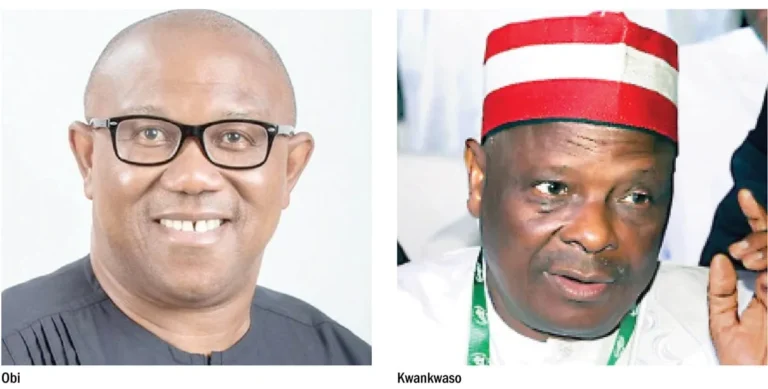
Senator Rabiu Kwankwaso, the vice-presidential candidate for the Nigeria Democratic Congress (NDC), has unveiled a significant political pact with the party’s presidential flagbearer, Peter Obi, stipulating that Obi would serve a solitary four-year term if elected president in the forthcoming 2027 general election. This disclosure, made during a comprehensive interview on Channels Television on Monday, has sent ripples across the Nigerian political landscape, setting the stage for an intriguing electoral contest and reigniting debates on power rotation and regional balancing within the nation’s political calculus.
Kwankwaso, a prominent political figure from Kano State and a former governor, expressed unwavering confidence in Obi’s commitment to honour the agreement. He emphasized that the accord is not merely a verbal understanding but a formally documented pledge, designed to ensure that the presidency returns to the northern geopolitical zone of Nigeria following Obi’s single term in office from 2027 to 2031. This arrangement, according to Kwankwaso, is a cornerstone of their political alliance, aimed at fostering national unity and equitable power distribution.
Details of the Landmark Agreement
The former governor elaborated on the meticulous nature of the agreement, revealing that two distinct documents had been signed to formalize the arrangement. "We have done one for the party, and we have done another one between the two of us," Kwankwaso stated, underscoring the dual commitment: an institutional one binding the Nigeria Democratic Congress and a personal one between the two principal figures. This dual-layered agreement is intended to provide a robust framework for their collaboration and a clear roadmap for the political future of the NDC and, by extension, the nation.
Responding to inquiries regarding the binding nature of Obi’s one-term pledge, Kwankwaso dismissed any potential skepticism, asserting his profound belief in the former Anambra State governor’s integrity. "I personally believe him. Based on what I know about him, I don’t think he will change his mind when the time comes. We are all gentlemen, and we have accepted to put it on paper," he affirmed. This statement not only highlights the trust between the two political heavyweights but also signals a departure from the often-unwritten and frequently contentious ‘gentleman’s agreements’ that have historically characterized Nigerian politics. The formal documentation of such a sensitive power-sharing deal marks a potentially new precedent in the country’s political history.
The core of the agreement, as articulated by Kwankwaso, commits both leaders to a shared vision of a successful administration from 2027 to 2031. Beyond this initial four-year term, the pact envisions continued cooperation, stating, "The agreement is that after four years, we will continue to work together as a party, as friends and brothers, so that after our four-year term, from 2027 to 2031, power returns to the North." This long-term perspective suggests a strategic alignment that transcends immediate electoral cycles, aiming to build a sustainable political partnership and ensure regional inclusivity in the nation’s leadership.
The Rationale: Equity, Fairness, and National Balance
Kwankwaso shed light on his decision to accept the vice-presidential nomination, a position he previously did not seek, having vied for the presidency in past political cycles. He explained that this strategic shift was predicated on an overarching commitment to "equity, fairness, and national balance." In a country as diverse and complex as Nigeria, where ethnic, religious, and regional considerations often play a pivotal role in political calculations, such a principle is deemed essential for stability and cohesion.
Both leaders, Kwankwaso revealed, reached a consensus that the southern region of Nigeria should produce the president for a single term, after which power would explicitly shift back to the North. He characterized this understanding as a "consensus aimed at strengthening national unity." This narrative positions the agreement not as a mere political maneuver but as a patriotic endeavor designed to bridge regional divides and foster a greater sense of belonging among all Nigerians. The emphasis on unity and fairness resonates deeply within a polity that has often grappled with perceptions of marginalization and unequal representation.
Historical Precedents of Power Rotation in Nigeria
The concept of power rotation, or "zoning," is not new to Nigerian politics. While not explicitly enshrined in the constitution, it has become an unwritten convention, particularly within major political parties, to rotate the presidency between the North and the South. This practice gained prominence during Nigeria’s Fourth Republic, which commenced in 1999, largely as a mechanism to assuage regional tensions and promote a sense of inclusivity after decades of military rule and ethno-religious strife.
The unwritten rule dictates that after a president from one region completes two terms (eight years), the presidency should ideally shift to the other major region. However, this convention has often been a source of contention and debate, with various political actors interpreting or challenging its application based on their immediate interests. For instance, the Peoples Democratic Party (PDP), which governed for 16 years from 1999, largely adhered to this principle, alternating presidential candidates between the North and South. The All Progressives Congress (APC), the current ruling party, has also implicitly acknowledged this principle, though its application has faced internal challenges.
Kwankwaso and Obi’s written agreement, therefore, can be seen as an attempt to formalize and solidify this often-fluid convention. By explicitly stating a one-term commitment for the South and a subsequent return of power to the North, they are providing a clear, albeit negotiated, framework that aims to preempt future disputes and ensure a smoother transition of power, at least within their own party. This move could potentially influence how other political parties approach power-sharing discussions in the run-up to future elections.
Kwankwaso and Obi: A Look at Their Political Trajectories
Both Senator Rabiu Kwankwaso and Peter Obi are seasoned politicians with significant national profiles, each bringing a distinct political base and ideological leaning to the NDC’s 2027 ticket.
Senator Rabiu Kwankwaso is a political colossus in Northern Nigeria, particularly in Kano State, where he served two terms as governor (1999-2003 and 2011-2015). His political movement, Kwankwasiyya, is renowned for its distinctive red caps and a loyal, grassroots following built on a platform of education, infrastructure development, and social welfare. Kwankwaso’s influence extends beyond Kano, making him a formidable force in the North-West geopolitical zone. He has previously contested the presidential primaries of major parties, demonstrating his national ambition and extensive political network. His decision to accept the vice-presidential slot, therefore, underscores the strategic importance and potential viability he sees in this particular alliance.
Peter Obi, on the other hand, rose to national prominence through his two terms as governor of Anambra State (2006-2014), where he earned a reputation for fiscal prudence, accountability, and a transformative approach to governance. His appeal, particularly among the youth and a segment of the educated urban population, skyrocketed during the 2023 presidential election cycle, where he contested under the Labour Party. Obi’s campaign resonated with many Nigerians disillusioned with traditional politics, offering a message of economic reform, anti-corruption, and a focus on production rather than consumption. His significant social media presence and ability to mobilize a dedicated base, often referred to as "Obidients," make him a compelling figure in any national election.
The combination of Kwankwaso’s deep-rooted Northern political structure and Obi’s widespread national appeal, particularly in the South and among a younger demographic, presents a formidable electoral challenge. The written agreement, by addressing the sensitive issue of power rotation, aims to consolidate these diverse bases into a cohesive force, minimizing potential regional friction within their alliance.
Implications for the Nigeria Democratic Congress (NDC) in 2027
The revelation of this power-sharing agreement has profound implications for the NDC’s strategy in the 2027 presidential election. Primarily, it positions the party as one that is actively addressing Nigeria’s complex ethno-regional dynamics, potentially attracting voters who prioritize national unity and equitable representation.
- Regional Consolidation: For the NDC, this agreement could be a powerful tool to consolidate support across Nigeria’s diverse regions. By explicitly outlining a path for power to return to the North after Obi’s proposed single term, it aims to reassure Northern voters who might otherwise feel marginalized by a Southern presidency. Simultaneously, Obi’s candidacy would appeal to Southern voters and his existing national base.
- Message of Stability: The pact projects an image of a party committed to long-term stability and structured governance, rather than ad-hoc political arrangements. This could be a compelling message for a populace often wary of political instability and broken promises.
- Internal Cohesion: By clearly defining the roles and the future trajectory of power, the agreement could foster greater internal cohesion within the NDC, reducing potential friction between regional blocs within the party and allowing for a more focused campaign effort.
- Differentiated Campaign: It offers the NDC a unique selling point compared to other parties, who often navigate the zoning debate with less transparency. The NDC can present itself as a party with a clear, documented plan for power transition.
However, the agreement also presents potential challenges. Some political analysts might argue that such a pact, while ensuring regional balance, could be perceived as limiting democratic choice or as an elite arrangement that does not fully reflect the aspirations of the broader electorate, particularly those who advocate for meritocracy over regional considerations.
The Legal and Political Enforceability of Such Pacts
While Kwankwaso stressed the written nature of the agreement, its legal enforceability in Nigeria’s constitutional framework remains a subject of considerable debate among legal scholars and political observers. The Nigerian Constitution does not explicitly provide for power rotation or zoning; presidential candidates are typically elected based on a simple majority of votes nationwide, provided they secure at least 25% of votes in two-thirds of the states.
- Constitutional Supremacy: Any agreement, written or otherwise, would theoretically be subservient to the nation’s constitution. If a future president were to decide to seek re-election, a private party agreement could not legally bar them from doing so, assuming they meet the constitutional requirements for candidacy.
- Political Implications: Despite the legal ambiguities, the political implications of reneging on such a written agreement would be immense. A politician who breaks such a publicized pact would likely face severe backlash from their political base, alliance partners, and the general public, potentially jeopardizing their future political career and the credibility of their party. This "gentleman’s agreement on paper" relies heavily on political will, public trust, and the reputation of the individuals involved.
- Party Discipline: Within the party structure, however, the agreement might have more weight. Party constitutions often include provisions for discipline and adherence to party principles, which could be invoked if a member deviates from an agreed-upon strategic document.
Reactions and Analytical Perspectives
The announcement is expected to elicit varied reactions across the political spectrum.
- Political Analysts: Experts will likely scrutinize the agreement for its potential impact on the 2027 elections. Some might view it as a pragmatic approach to manage Nigeria’s complex political landscape, while others might criticize it as a perpetuation of identity politics over competence. The enforceability and the potential for future disagreements will be key discussion points.
- Other Political Parties: Rival parties will undoubtedly analyze the NDC’s move, seeking ways to counter its narrative or expose perceived weaknesses. They might argue that such an agreement is undemocratic or a cynical ploy for power.
- Civil Society and Youth Groups: Organisations advocating for good governance and youth participation might express concerns about agreements that appear to pre-determine political outcomes or limit choices, potentially seeing it as a continuation of elite pacts. However, some might also appreciate the transparency of a written agreement compared to opaque informal understandings.
- Public Opinion: The Nigerian public, particularly the diverse regional blocs, will react based on their political inclinations and regional affiliations. Northern political stakeholders might welcome the clarity regarding the return of power, while some Southern elements might view the one-term limit as restrictive.
Challenges and the Road Ahead for 2031
While the agreement aims to streamline the NDC’s political trajectory, the path to 2031 is fraught with potential challenges:
- Maintaining Unity: Sustaining the unity of a diverse political alliance over an extended period, especially through a presidential term and subsequent power shift, requires constant negotiation and commitment.
- Public Perception: Managing public perception and ensuring that the agreement is seen as a genuine commitment to national interest rather than a self-serving political arrangement will be crucial.
- Performance in Office: The success of Obi’s potential single term (2027-2031) will heavily influence the public’s acceptance of the subsequent power shift and Kwankwaso’s own presidential aspirations in 2031. A successful administration would bolster the credibility of the entire pact.
- Kwankwaso’s 2031 Ambition: When asked about his plans to contest the presidency in 2031, Kwankwaso reiterated that the party’s immediate priority is securing victory in the 2027 presidential election. However, he also acknowledged remaining "mindful of its long-term political objectives," subtly reaffirming his likely future ambition without committing prematurely. This measured response indicates a strategic foresight, positioning him as a patient and calculating political player.
The unveiling of this written agreement between Senator Rabiu Kwankwaso and Peter Obi represents a pivotal moment in Nigeria’s political discourse. It underscores the enduring significance of regional balancing and power rotation in the nation’s democratic journey. As the 2027 general election approaches, all eyes will be on the Nigeria Democratic Congress and how this unprecedented pact will shape their campaign, the broader political landscape, and ultimately, the future of presidential succession in Nigeria. The agreement, while offering a clear roadmap for power transition within the NDC, also invites critical scrutiny regarding its long-term implications for democratic principles and national cohesion.