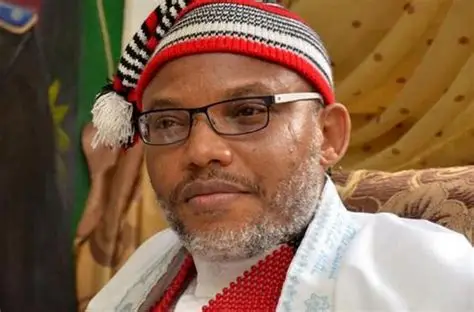
The legal representatives of Mazi Nnamdi Kanu, the detained leader of the Indigenous People of Biafra (IPOB), have formally issued a stern condemnation regarding recent public statements made by an individual identified as Chigozie Nnabugwu. During a live television broadcast on Monday, Nnabugwu allegedly advocated for the extrajudicial execution of the separatist leader, suggesting that such an act would serve as a catalyst for restoring peace and "normalcy" to Nigeria’s embattled South-East region. The legal team, led by Special Counsel Aloy Ejimakor, characterized the remarks as not only reckless and inflammatory but also a direct violation of Nigerian law and a significant threat to the life of their client, who remains in the custody of the Department of State Services (DSS).
The controversy erupted following Nnabugwu’s appearance on a televised program where he argued that the persistent security challenges in the South-East are inextricably linked to Kanu’s influence. In a quote that has since gone viral and sparked intense debate across the country, Nnabugwu stated, "If Nnamdi Kanu is dead today, if the Government of Nigeria will kill Nnamdi Kanu, trust me, normalcy will start coming, and that’s what every Igbo man prays for." He further posited that while addressing root causes of violence is necessary for long-term stability, the immediate removal of Kanu from the equation was a prerequisite for peace.
Legal Implications and the Cybercrimes Act
In a comprehensive statement released on Tuesday, Aloy Ejimakor articulated the legal team’s position, asserting that Nnabugwu’s comments transcend the boundaries of free speech and enter the realm of criminal incitement. Ejimakor argued that the demand for an extrajudicial killing is a blatant affront to the Nigerian judicial system, especially given that Kanu’s case is currently sub judice—pending before a court of competent jurisdiction.
The legal team specifically cited Section 24(1) of the Cybercrimes (Prohibition, Prevention, etc.) Act, which was designed to curb the use of electronic communication for the purpose of inciting violence or threatening lives. Ejimakor noted that the Act criminalizes the intentional transmission of messages via electronic means, including broadcast platforms and social media, that are intended to cause a breakdown of law and order or pose a threat to life. Under the current legal framework, such an offense carries significant penalties, including a fine of up to ₦7 million, a prison sentence of up to three years, or both.
Beyond the Cybercrimes Act, the legal team warned of liabilities under the Criminal Code. They maintained that advocating for the death of a citizen who is currently undergoing trial constitutes an interference with the judicial process and could be treated as actionable contempt of court. The statement emphasized that the Nigerian government is bound by international human rights treaties and domestic laws to ensure the safety of persons in its custody, making any call for "liquidation" a direct challenge to the rule of law.
Demands for Accountability and Media Responsibility
A significant portion of the legal team’s reaction was directed at the television station that hosted Nnabugwu. Ejimakor accused the media outlet of providing a platform for "dangerous and inflammatory content" without exercising the necessary editorial discretion required by the National Broadcasting Commission (NBC) Code. The legal team argued that broadcasters have a duty to prevent the airing of hate speech or calls for unlawful killings, as such content has the potential to incite civil unrest.
Consequently, the legal team has issued a "pre-action notice," demanding two immediate actions:
- An unconditional public retraction of the statement by Chigozie Nnabugwu.
- A formal, televised apology from the media house for allowing the broadcast of remarks that threaten public peace and the life of a high-profile detainee.
Ejimakor warned that failure to comply with these demands would result in the initiation of comprehensive legal proceedings against both the individual and the broadcasting entity.
Historical Context: The Long Road of Nnamdi Kanu’s Detention
To understand the weight of the current controversy, it is essential to examine the timeline of Nnamdi Kanu’s legal battles with the Nigerian state. Kanu, a British-Nigerian citizen, rose to prominence through Radio Biafra, where he advocated for the secession of the South-East and parts of the South-South from Nigeria to form the independent Republic of Biafra.
Kanu was first arrested in Lagos in October 2015 on charges of treasonable felony. After spending nearly two years in detention, he was granted bail in April 2017 by Justice Binta Nyako on health grounds. However, his residence in Abia State was raided by the Nigerian military during "Operation Python Dance II" in September 2017, leading to his disappearance from the public eye for over a year. He later surfaced in Israel and eventually moved to the United Kingdom.
The situation took a dramatic turn in June 2021 when Kanu was intercepted in Kenya and forcibly returned to Nigeria in what his legal team describes as an "extraordinary rendition." Since his return, he has been held at the DSS headquarters in Abuja, facing a multi-count charge bordering on terrorism and treasonable felony. Despite a Court of Appeal ruling in October 2022 that discharged him and criticized the manner of his arrest in Kenya, the Supreme Court later ruled in December 2023 that the trial should proceed, though it condemned the government’s actions during the rendition.
Socio-Political Climate and Public Reaction
The South-East region has faced an unprecedented surge in insecurity since Kanu’s 2021 re-arrest. A faction of IPOB, allegedly led by Finland-based Simon Ekpa, has enforced a "sit-at-home" order every Monday, which has crippled the regional economy. According to data from various economic research groups, the South-East loses an estimated ₦10 billion to ₦50 billion every Monday due to the total shutdown of markets, schools, and transportation.
Nnabugwu’s assertion that "every Igbo man" wants Kanu dead was met with fierce backlash on social media, with many Nigerians pointing out the diversity of opinion within the Igbo community. On the platform X (formerly Twitter), the discourse was polarized but largely critical of the call for violence.
Users pointed to the perceived double standards in the government’s treatment of various figures. One user, #TemitopeOl56085, noted the contrast between the treatment of Kanu and other figures like Ahmad Gumi, who has negotiated with bandits, or Sunday Igboho, the Yoruba nation activist who was recently cleared of charges in Benin Republic. Others, such as #IViktarIdam, argued that killing Kanu would only exacerbate the crisis, citing the "martyrdom effect" where the death of a leader often leads to more radicalized movements. This mirrors the historical precedent of the 2009 killing of Boko Haram founder Mohammed Yusuf, which many analysts believe transformed the group into a more violent and decentralized insurgency.
Analysis of Implications for Regional Stability
The suggestion that the execution of a separatist leader could bring "normalcy" is viewed by security experts as a high-risk proposition. Nigeria’s history with extrajudicial measures has often resulted in blowback. The South-East is currently a tinderbox of grievances, ranging from perceived marginalization to heavy-handed military presence.
If the federal government were to heed such reckless advice, the following implications are likely:
- Radicalization: The vacuum left by Kanu could be filled by more violent factions who view his "legal struggle" as a failure, potentially leading to a full-scale insurgency.
- International Sanctions: Given Kanu’s British citizenship and the international eyes on his case, any extrajudicial harm would likely trigger diplomatic crises and potential sanctions from the UK and the European Union.
- Judicial Integrity: The Nigerian judiciary is already under pressure to prove its independence. Bypassing the court to "liquidate" a defendant would represent a total collapse of the constitutional order.
Conversely, the legal team’s demand for a retraction highlights the growing role of the Cybercrimes Act as a tool for political and legal maneuvering. While the Act has been criticized for being used to suppress journalists, in this instance, it is being invoked as a shield to protect a defendant from incitement to violence.
Conclusion
The demand for the death of Nnamdi Kanu has reignited a fierce national debate about justice, security, and the limits of free speech in Nigeria. As the legal team prepares for potential litigation against Chigozie Nnabugwu and the involved media house, the Federal Government remains silent on the specific broadcast. However, the incident underscores the fragile state of peace in the South-East and the high stakes involved in the ongoing trial of the IPOB leader. For now, the legal battle continues in the courts, while the battle for the narrative rages on the airwaves and across digital platforms. The resolution of Kanu’s case remains one of the most significant litmus tests for the administration of President Bola Ahmed Tinubu and the resilience of the Nigerian judicial system.