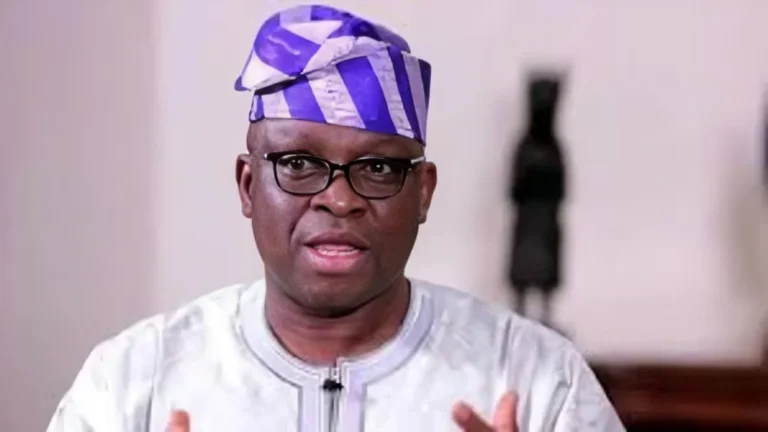
Isaac Fayose, younger brother to the former Governor of Ekiti State, Ayodele Fayose, has publicly implored his elder sibling to reject his recent appointment as Chairman of the Rural Electrification Agency (REA) Board. In a strongly worded video shared on his Instagram page on Monday, Isaac Fayose described the role as beneath the political stature of a former state governor and suggested that his brother should instead allow his son to take up the position. This dramatic public appeal has ignited discussions across Nigeria, drawing attention to the dynamics of political patronage, family relations in public life, and the perceived value of federal appointments.
The Presidency, through a statement issued by the Special Adviser to the President on Information and Strategy, Bayo Onanuga, had announced Ayodele Fayose’s appointment alongside 25 others into the boards of 10 federal agencies and commissions. Specifically, Fayose was named chairman of the REA Board, with Ahmadu Abubakar and Ilyasu Ibrahim Makinta appointed as non-executive directors. The agency’s Director-General, Abba Abubakar Aliyu, and three executive directors were retained, signaling a mix of new and continued leadership within the critical federal body. This announcement, coming at a time of heightened political maneuvering, immediately sparked a variety of reactions, none more public and pointed than that of Isaac Fayose.
A Politician’s Pedigree and Perceived Demotion
Ayodele Fayose’s political career has been marked by significant milestones and controversies. He served as the Governor of Ekiti State twice, first from 2003 to 2006, and again from 2014 to 2018. A prominent figure within the Peoples Democratic Party (PDP), he has often been characterized by his populist appeal and outspoken nature. His tenure as governor saw him as a vocal critic of successive federal administrations, including the immediate past government. Given this background, Isaac Fayose’s central argument is that the position of a board chairman, while significant, does not align with his brother’s extensive political experience and the gravitas associated with having governed a state for two terms.
In his video, Isaac questioned the rationale behind not considering his brother for what he deemed "higher offices." He articulated his disappointment, stating, "They said they gave my brother DG, not a minister, not ambassador. They said they gave him DG, head of parastatal, chairman of a committee. They no give him minister, they no give him ambassador." This sentiment reflects a common perception within Nigeria’s political class, where ministerial or ambassadorial appointments are generally considered to hold greater prestige and influence compared to board chairmanships of parastatals. To further underscore his point, Isaac Fayose drew a comparison with former presidential aide Reno Omokri, whom he claimed was appointed an ambassador, asking, "Even Reno Omokri sef, they gave him ambassador. They couldn’t give my brother ambassador. So why just chairman of a parastatal?" This comparison highlights the internal political calculus and perceived pecking order within the Nigerian political appointment system.
The Timeliness of the Appointment: A "Greek Gift"?
Beyond the issue of political hierarchy, Isaac Fayose strongly suggested that the timing of his brother’s appointment was not coincidental but rather strategically linked to recent political developments, particularly a visit from the presidential candidate of the Labour Party (LP) in the 2023 general elections, Peter Obi. Days before the announcement, Peter Obi had visited Isaac Fayose at his residence. This visit was particularly noteworthy as Isaac had publicly threatened to withdraw his support for Obi’s presidential ambition shortly before. Following Obi’s visit, Isaac Fayose had described him as Nigeria’s "incoming president," while Obi had used the opportunity to address criticisms directed at Isaac on social media.
Isaac Fayose implied that the REA appointment was a calculated move by the ruling All Progressives Congress (APC) to "enter that family" following Obi’s visit. He labeled the appointment a "Greek gift," questioning, "Why didn’t they give you appointment since? Why did they wait till Obi came?" This insinuation suggests a political tactic aimed at either placating or neutralizing potential opposition figures or their influential family members, particularly in the context of the ongoing legal challenges to the 2023 presidential election results. Such strategic appointments are not uncommon in Nigerian politics, often viewed as mechanisms to foster cross-party alliances or to reward perceived loyalty, even if belatedly.
A Vow Broken? Ayo Fayose’s Stance on Government Appointments
Adding another layer of complexity to the situation, Isaac Fayose recalled a past conversation where his elder brother had expressly stated his intention to eschew government appointments after leaving office. According to Isaac, Ayo Fayose had told him, "Isaac, whenever I leave Government House, I will not be a minister, I will not be DG, I will not be senator. I will face my business." This revelation brings into sharp focus the potential conflict between Ayo Fayose’s stated principles and the current appointment.
Ayo Fayose is known to have built a successful business career prior to his foray into politics and was widely perceived to have remained financially independent after his second term as governor concluded. This background further strengthens Isaac’s argument that the REA chairmanship might not align with his brother’s long-term personal and political aspirations, or his desire to operate outside the direct purview of government patronage. The public recall of this vow by his own brother places Ayo Fayose in a delicate position, forcing him to reconcile his past declarations with the present opportunity.
The Rural Electrification Agency (REA): Mandate and Significance
To fully appreciate the context of this appointment, it is crucial to understand the role and significance of the Rural Electrification Agency (REA). Established by the Electric Power Sector Reform Act (EPSRA) of 2005, the REA is the implementing agency of the Federal Government of Nigeria for rural electrification projects. Its primary mandate is to promote, facilitate, and provide access to electricity for rural and unserved communities across the country. This includes developing and deploying various renewable energy solutions such as solar mini-grids, solar home systems, and small hydro projects, as well as extending the national grid to underserved areas.
The importance of the REA’s work cannot be overstated in a country where a significant portion of the population, particularly in rural areas, still lacks access to reliable electricity. Access to energy is a critical enabler for socio-economic development, impacting various sectors including education, healthcare, agriculture, and small and medium-sized enterprises (SMEs). Electrification of rural communities can spur economic growth, create jobs, improve living standards, and reduce rural-urban migration. Despite its crucial mandate, the REA, like many other government agencies, has faced challenges related to funding, project implementation delays, technical capacity, and ensuring the sustainability of its projects. Therefore, the leadership of the REA Board plays a vital role in steering the agency towards achieving its national development objectives. The chairman’s role involves strategic oversight, policy direction, and ensuring accountability, making it a position of considerable responsibility, even if not one of direct executive power.
Broader Implications and Political Analysis
The public spat within the Fayose family, triggered by the REA appointment, carries several implications for Nigerian politics and the perception of governance.
- For Ayodele Fayose’s Political Future: Accepting the appointment could signal a willingness to engage with the current administration, potentially softening his critical stance. It might be interpreted as a strategic move to remain relevant in the political landscape, even if in a less prominent role than his past gubernatorial positions. However, it could also open him up to accusations of compromising his principles or accepting a "lesser" role, as suggested by his brother. Rejecting it, on the other hand, would reinforce his past statements about focusing on private business and maintaining a certain political independence. Such a rejection could be seen as a bold statement of his political worth and a defiance of perceived political co-option.
- For the Tinubu Administration: The appointment of a prominent opposition figure like Ayodele Fayose, even to a board chairmanship, could be viewed as part of President Bola Tinubu’s strategy to foster a government of national unity or to dilute opposition influence. By offering roles to figures across the political spectrum, the administration might aim to broaden its base of support and reduce political friction. However, Isaac’s "Greek gift" assertion suggests that such appointments can also be perceived as manipulative, designed to silence critics or reward political maneuvers. The administration’s approach to such appointments will continue to be scrutinized for its underlying political motives.
- Family Dynamics and Public Scrutiny: The public nature of Isaac Fayose’s plea highlights the unique pressures and expectations placed on political families in Nigeria. It underscores how family members can hold differing views on political engagement and public service, sometimes leading to open disagreements. Such public discourse also provides a rare glimpse into the internal deliberations and values within prominent political families, subjecting them to intense public scrutiny.
- Perception of Federal Appointments: The controversy further fuels the ongoing debate about the criteria and motivations behind federal appointments in Nigeria. Are they based purely on merit and expertise, or are they primarily tools for political patronage, reward for loyalty, or strategic maneuvering? Isaac Fayose’s questioning of the appointment’s "level" reinforces the notion that political appointments are often seen through the lens of power, prestige, and influence rather than purely public service.
Conclusion and the Path Forward
In his concluding remarks, Isaac Fayose offered congratulations to his brother despite his reservations, but reiterated his strong advice: "Congrats on your appointment. You better give your son. Please, don’t use that kind of appointment. You are too big for that. Afobaje ni e," he said, using a Yoruba expression that loosely translates to "You are a kingmaker." This powerful statement encapsulates Isaac’s view of his brother’s political standing – that of a significant political force capable of shaping outcomes rather than merely accepting a role.
As of the time of this report, Ayodele Fayose himself has not publicly responded to his brother’s impassioned appeal or to the appointment itself. His decision – whether to accept, reject, or comment – will undoubtedly be closely watched and will carry significant weight for his political trajectory, the dynamics within his family, and the broader political narrative in Nigeria. The incident serves as a stark reminder of the intricate web of personal ambition, family loyalty, and political strategy that defines public life in the nation.