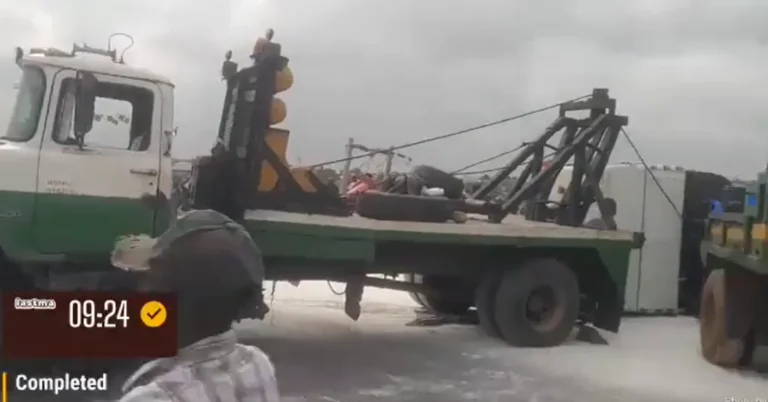
Vehicular movement experienced severe disruption on the Lagos-Ibadan Expressway on Wednesday as emergency responders initiated crucial recovery operations following a solitary accident near the Kara Bridge. The incident, which occurred on a day typically characterized by high traffic volume, led to a near-complete cessation of movement along the affected stretch of the vital artery, resulting in extensive delays for thousands of motorists.
The Lagos State Traffic Management Authority (LASTMA) provided a real-time update on the unfolding situation via its official X (formerly Twitter) handle. Their advisories confirmed that the ongoing recovery operation necessitated a temporary halt in traffic flow, a measure taken to ensure the safety of both the emergency crews and the traveling public while they worked diligently to clear the obstruction and reinstate normalcy.
Chronology of Disruption and Recovery
The initial accident, details of which remain scarce beyond it being a lone vehicle incident, precipitated the immediate deployment of LASTMA officials and potentially other emergency services. The critical phase of the operation involved the careful removal of the damaged vehicle and any debris, a process that, while essential, inherently impedes traffic.
According to LASTMA’s dispatches, the traffic backlog rapidly escalated, extending to the New Garage area and further, significantly impacting commuters journeying towards Ogun State. This geographical reference points to the severity of the snarl-up, suggesting that vehicles were brought to a standstill for a considerable duration. The agency’s updates indicated that the blockage affected traffic moving in both directions, though specific details on the extent of the blockage in each carriageway were not immediately elaborated upon.
In contrast, LASTMA noted a more fluid situation for motorists travelling from the Mowe-Ibafo axis inward Lagos. This suggests that the primary impact of the accident was concentrated on the outbound carriageway towards Ogun State, or that recovery efforts were strategically managed to allow some degree of unimpeded passage in the opposite direction, possibly through temporary lane diversions if feasible. However, the overall narrative from the agency painted a picture of widespread congestion, with commuters facing significantly extended travel times.
Supporting Data and Infrastructure Context
The Lagos-Ibadan Expressway is a cornerstone of Nigeria’s transportation network, serving as a critical link between the nation’s commercial capital, Lagos, and numerous towns and cities in Ogun State, and onward to other parts of the country. Its strategic importance cannot be overstated, facilitating the movement of goods, services, and people daily. The expressway, a dual-carriageway, is designed to handle substantial traffic volumes, but its capacity is often tested, especially during peak hours, weekends, and periods of road incidents.

The Kara Bridge section, where the accident occurred, is a known bottleneck, particularly when any disruption takes place. Its location often exacerbates traffic issues due to the proximity of several markets and the general increase in vehicular density in that area. The nature of a lone accident, while potentially less complex in terms of multiple vehicles involved, can still lead to prolonged delays if the vehicle itself is extensively damaged, requires specialized towing equipment, or if hazardous materials are involved. Without specific details on the vehicle type or its cargo, it is difficult to ascertain the exact challenges faced by the recovery teams.
Data from traffic monitoring agencies consistently shows that the Lagos-Ibadan Expressway experiences some of the highest traffic densities in Nigeria. A single incident, especially one requiring extended recovery operations, can have a ripple effect, causing delays that extend for several kilometers and impact multiple interconnected routes. The economic implications of such gridlock are substantial, encompassing lost productivity, increased fuel consumption, and potential spoilage of perishable goods.
Official Responses and Public Advisory
The Lagos State Traffic Management Authority (LASTMA) played a central role in managing the situation, not only by directing the recovery operations but also by providing crucial, albeit often frustrating, real-time updates to the public. Their advisories served to inform motorists, allowing them to potentially reroute or adjust their travel plans, and to manage expectations regarding delays.
In their official communication, LASTMA urged motorists to exercise patience and extend their full cooperation to the traffic officials on duty. This plea underscores the challenging nature of managing traffic flow during emergency operations, which often require strict adherence to instructions from on-ground personnel. The agency’s emphasis on cooperation highlights the collective responsibility of road users in navigating such disruptions efficiently and safely.
Beyond the immediate incident, LASTMA also provided an update on a separate traffic challenge at the Cater Bridge area, involving a fallen containerized truck. The successful evacuation of this truck, as confirmed by the agency, offered a glimmer of relief, demonstrating that despite the severity of the Kara Bridge incident, other critical routes were being managed. This dual reporting suggests a coordinated effort by traffic management authorities to address multiple issues simultaneously.
The recurring nature of such incidents on major highways has prompted continuous advisories from road safety authorities. These advisories consistently implore road users to maintain a high degree of caution, adhere strictly to traffic regulations, and remain vigilant while traversing major highways. The emphasis on alertness is particularly pertinent during periods of emergency response and recovery operations, as the dynamic nature of such situations can pose unforeseen risks.
Broader Impact and Implications
The gridlock on the Lagos-Ibadan Expressway on Wednesday serves as a stark reminder of the fragility of urban and inter-city transportation networks, particularly in rapidly developing economic hubs like Lagos. The reliance on a limited number of major arteries means that any disruption, regardless of its cause, can have cascading effects.

Economic Consequences: The most immediate implication of such extensive traffic jams is economic. Businesses suffer from delayed deliveries, reduced workforce availability, and increased operational costs due to longer transit times and higher fuel consumption. For individuals, it means lost working hours, missed appointments, and added stress. The perishable nature of many goods transported along this route means that significant financial losses can occur if delays are prolonged.
Social Impact: Beyond the economic ramifications, the social impact is also considerable. Commuters, many of whom rely on public transport, face arduous and prolonged journeys. This can affect family time, social engagements, and overall quality of life. The psychological toll of being stuck in traffic for hours cannot be underestimated.
Infrastructure and Policy: Such incidents also bring into focus the need for continuous investment in and maintenance of critical infrastructure. While the Lagos-Ibadan Expressway is a major project, the sheer volume of traffic it carries necessitates ongoing upgrades, smart traffic management systems, and robust emergency response protocols. The ability of the expressway to recover quickly from incidents is as crucial as its capacity to handle daily traffic.
Safety and Enforcement: The recurring nature of accidents, including those involving heavy-duty vehicles, also points to the importance of stringent enforcement of road safety regulations, regular vehicle inspections, and driver education. While LASTMA is actively involved in managing traffic and responding to incidents, a proactive approach to accident prevention remains paramount. The incident involving the fallen containerized truck at Cater Bridge, for instance, highlights the risks associated with the transportation of heavy cargo and the need for meticulous load securing and route planning.
In conclusion, the traffic gridlock on the Lagos-Ibadan Expressway on Wednesday was more than just a temporary inconvenience; it was a tangible manifestation of the challenges inherent in managing a critical transportation corridor that underpins a vast economic ecosystem. The swift and efficient response from emergency services, coupled with clear communication from LASTMA, helped mitigate the worst effects, but the incident underscores the ongoing need for robust infrastructure, effective traffic management strategies, and a collective commitment to road safety from all stakeholders. The lessons learned from such events are vital for ensuring the continued smooth functioning of Nigeria’s vital economic arteries.