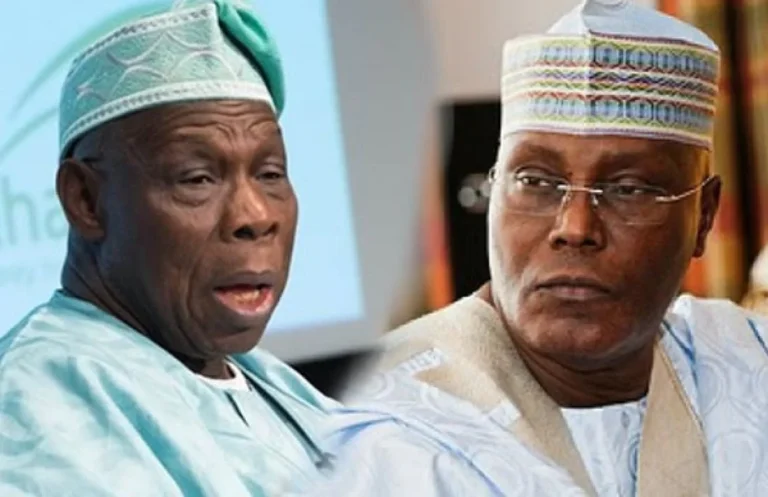
Former President Olusegun Obasanjo has ignited a fresh wave of political discourse by alleging that his then-Vice President, Atiku Abubakar, provided N5 million to the late Speaker of the House of Representatives, Ghali Na’Abba, to initiate impeachment proceedings against him during his first term in office (1999-2003). The explosive claim, made in response to comments by former Ogun State governor Olusegun Osoba regarding political events leading up to the 2003 general elections, sheds new light on the tumultuous relationship between Nigeria’s top two leaders at the dawn of its Fourth Republic. Obasanjo detailed that the impeachment plot began at the presidency itself, orchestrated by the Vice President, who allegedly convinced Na’Abba and a few others that Obasanjo should only serve a single term. This assertion, which resurfaces decades after the alleged incident, points to deep-seated political maneuvering and power struggles that characterized the early years of Nigeria’s return to democratic rule.
A Deep Dive into the Allegation
According to Obasanjo, the critical juncture occurred on a Friday when he was away from the office. "Na’Abba’s impeachment began at the presidency by the Vice-President, who on a Friday when I was out of the office, invited Na’Abba to his office and convinced him, as he had convinced himself and some others but of insignificant number, that I should have only one term as President," Obasanjo stated. He further elaborated on the alleged financial inducement, asserting, "On the Friday, Atiku invited Na’Abba; he gave him N5 million to begin his impeachment work. It was all noted, recorded and reported to me by my Chief of Staff, a professional intelligence officer." This detail underscores the former President’s conviction that the plot was meticulously tracked and confirmed by his inner circle. Despite the gravity of the threat, Obasanjo maintained that he remained unfazed, believing there was no constitutional basis for his removal from office. The allegation, coming from a former head of state, demands scrutiny and contextualization within the broader political landscape of the era.
Background: Nigeria’s Nascent Democracy and Executive-Legislative Tensions (1999-2003)
The period between 1999 and 2003 marked a critical phase in Nigeria’s political development. After decades of military rule, the country was grappling with the complexities of democratic consolidation. Olusegun Obasanjo, a former military head of state, had been elected President on the platform of the Peoples Democratic Party (PDP), with Atiku Abubakar as his running mate. Their victory signaled a new era, but it was one fraught with challenges.
The relationship between the executive and legislative arms of government was particularly strained during Obasanjo’s first term. The National Assembly, keen to assert its independence after years of subservience under military regimes, often clashed with the presidency. Speaker Ghali Na’Abba, known for his fiercely independent stance and commitment to legislative autonomy, emerged as a prominent figure in these confrontations. His House of Representatives frequently challenged presidential policies and appointments, leading to a series of standoffs that often bordered on constitutional crises. The calls for Obasanjo’s impeachment were not isolated incidents but rather symptomatic of this broader struggle for power and checks and balances in a fledgling democracy.
The dynamic between President Obasanjo and Vice President Atiku Abubakar was also a complex and evolving one. Initially perceived as a formidable team that brought together a seasoned statesman and a charismatic politician, their relationship deteriorated significantly over time. Sources close to the presidency at the time often spoke of a power struggle, with Atiku’s perceived presidential ambitions clashing with Obasanjo’s desire to maintain firm control. These internal party dynamics within the then-dominant PDP provided fertile ground for plots and counter-plots, with various factions aligning and realigning in anticipation of the 2003 general elections. The N5 million allegation, if true, would be a stark illustration of the extent to which these internal battles could manifest as direct threats to the stability of the executive.
Chronology of Political Turmoil and Impeachment Threats
The accusation by Obasanjo adds a specific, financially-tinged detail to a well-documented period of intense political maneuvering. While Obasanjo’s claim specifies one particular instance, the threat of impeachment loomed large over his presidency for much of his first term.
- 1999: Olusegun Obasanjo and Atiku Abubakar are inaugurated as President and Vice President, respectively, marking Nigeria’s return to civilian rule. The early months are characterized by the appointment of key officials and the establishment of democratic institutions.
- Early 2000s: Growing friction between the Executive and the National Assembly, particularly the House of Representatives led by Speaker Ghali Na’Abba. Na’Abba’s House often challenged presidential policies, budget implementations, and the perceived overreach of the executive.
- August 2002: The House of Representatives, under Na’Abba, issued an ultimatum to President Obasanjo to resign within two weeks or face impeachment proceedings. This ultimatum was predicated on allegations of corruption, disregard for the rule of law, and non-implementation of budgets. This public threat intensified the political climate.
- September 2002: The House initiated formal impeachment proceedings against Obasanjo, presenting a list of alleged constitutional breaches. This move sent shockwaves across the political landscape, drawing concerns about the stability of Nigeria’s nascent democracy.
- The Alleged Atiku-Na’Abba Meeting: Obasanjo’s current claim places the alleged N5 million transaction around this volatile period in 2002, specifically noting a "Friday when I was out of the office." The timing suggests it was part of the broader effort to garner support for the impeachment move against him.
- Late 2002 – Early 2003: Intense lobbying and negotiations by various political stakeholders, including traditional rulers, religious leaders, and elder statesmen, helped to de-escalate the impeachment crisis. The PDP leadership also intervened to manage the internal party strife.
- 2003 General Elections: Despite the significant internal challenges and impeachment threats, Obasanjo secured the PDP’s presidential ticket and ultimately won re-election for his second term, often seen as a triumph over his political adversaries, including those within his own party.
- Post-2003: The relationship between Obasanjo and Atiku continued to deteriorate, culminating in a public and bitter feud that saw Atiku challenging Obasanjo’s policies and even his attempts to amend the constitution for a third term. Atiku eventually left the PDP for other political platforms.
- 22nd October 2023: Ghali Na’Abba passes away, making it impossible for him to directly respond to Obasanjo’s recent, specific financial allegation.
Supporting Data and Constitutional Context
The sum of N5 million in 2002, while not astronomical in today’s terms, represented a significant amount of money at the time. To put it into perspective, the official exchange rate for the Nigerian Naira to the US Dollar in 2002 fluctuated around N120-N130 to $1. This means N5 million was approximately $38,000 to $41,000, a substantial sum for political mobilization and a compelling incentive, particularly for an emerging democracy with a less robust anti-corruption framework. The alleged payment, if substantiated, would indicate a direct financial inducement aimed at subverting the democratic process.
Obasanjo’s reference to his Chief of Staff as a "professional intelligence officer" is crucial. His Chief of Staff during much of this period was General Abdullahi Mohammed (rtd), a highly respected former military intelligence chief. The implication is that the information was gathered through credible intelligence channels, lending weight to Obasanjo’s assertion that the plot was "noted, recorded and reported." This suggests a sophisticated surveillance and information-gathering operation within the presidency, aimed at monitoring potential threats from both within and outside the government.
Constitutionally, the impeachment of a President or Vice President in Nigeria is a high-threshold process, requiring a two-thirds majority vote by the National Assembly (both the House of Representatives and the Senate) after a thorough investigation of gross misconduct. Obasanjo’s statement that he was not worried because "there was no constitutional basis for removing him from office" reflects his confidence in the legal safeguards and perhaps his belief that the allegations against him lacked sufficient merit to garner the necessary parliamentary support. However, the political process is often driven by factors beyond strict constitutional interpretation, making such threats potent tools in power struggles.
Statements and Reactions from Related Parties (Inferred and Historical)
- Atiku Abubakar: Throughout the years, Atiku Abubakar has consistently denied allegations of disloyalty or plots against Obasanjo during their time in office. While he has not yet publicly responded to this latest specific accusation of the N5 million payment, his historical stance has been one of defending his actions and often counter-accusing Obasanjo of dictatorial tendencies and attempting to undermine his legitimate political ambitions. Atiku’s camp would likely dismiss such claims as a continuation of Obasanjo’s long-standing animosity and an attempt to discredit him politically, especially given Atiku’s continued prominence in Nigerian politics.
- Olusegun Osoba: Obasanjo’s statement was a direct response to comments made by Olusegun Osoba. While the precise details of Osoba’s initial comments are not provided in the original excerpt, Osoba, a veteran journalist and politician from the South-West, has often offered insights into the political machinations of the Obasanjo era. His comments likely touched upon the intense political rivalry and internal party conflicts leading up to the 2003 elections, prompting Obasanjo’s detailed revelation. Osoba’s role here is primarily as a catalyst for Obasanjo’s disclosure.
- Ghali Na’Abba (Posthumous): With Speaker Ghali Na’Abba’s passing in October 2023, he cannot directly address this specific financial allegation. However, during his lifetime, Na’Abba was a vocal advocate for legislative independence and often defended the House’s actions against the executive as part of its oversight function. He consistently maintained that the impeachment threats were a legitimate exercise of parliamentary power to check perceived executive excesses, rather than a personal vendetta or a financially induced plot. Representatives of his estate or former political associates might offer a defense of his integrity and actions as Speaker.
- Political Analysts and Observers: Many political analysts view this latest revelation as characteristic of the enduring and often acrimonious relationship between Obasanjo and Atiku. It underscores the deep animosity that has defined their political careers since their fallout. Such claims, even years later, serve to shape public perception and historical narratives, reminding the populace of the intricate and often shadowy nature of high-stakes politics in Nigeria.
Broader Impact and Implications
The resurfacing of this allegation, particularly with the specific detail of a financial inducement, carries several significant implications for Nigeria’s political landscape and historical understanding.
Firstly, it further illuminates the Executive-Legislative Relations in Nigeria’s Fourth Republic. The initial years were marked by a fervent desire from the National Assembly to establish its independence, often leading to fierce battles with the presidency. This alleged plot, if true, suggests that these battles were not always purely ideological but could involve covert operations and financial incentives, raising questions about the integrity of political processes.
Secondly, it reinforces the narrative of deep Intra-Party Dynamics and Factionalism within the Peoples Democratic Party (PDP) during its dominant years. The PDP, despite its electoral successes, was a coalition of diverse interests, and internal power struggles were common. The Obasanjo-Atiku feud became a defining characteristic of this internal strife, often spilling into the public domain and influencing national politics.
Thirdly, the allegation speaks to the Challenges of Democratic Consolidation in Nigeria. In a young democracy, the stability of institutions is paramount. Threats of impeachment, especially when allegedly fueled by internal presidential ambitions and financial inducements, can undermine public trust in the democratic process and create an environment of political instability. Obasanjo’s claim that he was "not worried" because of a lack of constitutional basis, while perhaps true, does not negate the significant political capital and energy expended on such a maneuver.
Finally, this revelation contributes to the Historical Legacy and Political Memory of Nigeria. Obasanjo and Atiku remain influential figures, and their past actions continue to be scrutinized. Such claims add another layer of complexity to their legacies, offering future historians and political scientists richer material for understanding the formative years of Nigeria’s Fourth Republic. It also highlights the cyclical nature of Nigerian political narratives, where old feuds and allegations resurface, often with renewed intensity, impacting contemporary political discourse. The absence of direct contemporary rebuttal from the late Ghali Na’Abba, and the historical context of Atiku’s consistent denials, mean that this particular allegation will likely remain a contentious point in the retelling of Nigeria’s recent political history.