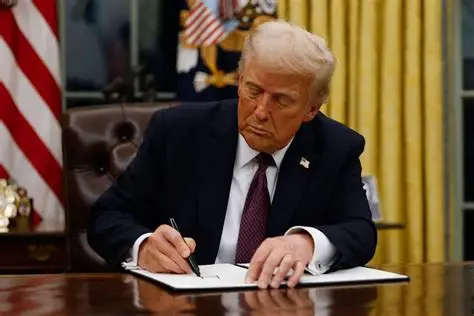
United States President Donald Trump announced on Friday that Venezuela is currently not in a position to hold national elections, speaking more than seven months after a high-profile U.S. military operation resulted in the removal of long-time leader Nicolás Maduro. During a briefing with reporters in the Oval Office, the President emphasized that while "tremendous progress" has been made in stabilizing the South American nation, the internal infrastructure required for a democratic transition remains incomplete.
“As far as the elections in Venezuela, they’re not really ready for them yet, but boy, a lot of progress has been made,” Trump stated when questioned about the timeline for returning the country to civilian-led democratic rule. The President’s remarks signal a cautious approach from Washington, prioritizing economic stabilization and the total dismantling of the previous administration’s influence over immediate polling.
The President also took the opportunity to offer a public endorsement of Venezuela’s acting president, Delcy Rodríguez. Rodríguez, who previously served as Maduro’s Vice President, was allowed to remain in a leadership capacity by U.S. authorities following the January intervention to ensure administrative continuity. Trump described her performance as "fantastic," suggesting that the current interim arrangement would persist for the foreseeable future. “We have to do it right. Elections take care of themselves,” Trump added, pivoting the conversation toward the resurgence of the Venezuelan economy and its vital oil sector.
The Aftermath of the January Intervention
The current political landscape in Caracas is the direct result of the January 3, 2026, military operation that saw U.S. forces enter the country to depose Nicolás Maduro. The operation, which the Trump administration characterized as a "liberation mission," followed years of economic hyperinflation, humanitarian crises, and a deeply disputed 2024 presidential election. The 2024 vote, which Maduro claimed to have won, was widely condemned by the international community, including the United States, the European Union, and several neighboring Latin American countries, as a fraudulent exercise designed to cement authoritarian rule.
Since the removal of Maduro and his wife, Cilia Flores, from the country, the U.S. has maintained a significant presence in the region, working alongside interim officials to overhaul the nation’s security forces and financial institutions. Maduro is currently in U.S. custody and is scheduled to stand trial in a federal court next year on charges ranging from narcoterrorism to human rights abuses.
While the military phase of the intervention was brief, the administrative phase has proven more complex. The decision to retain Delcy Rodríguez as a transitional figurehead was initially met with skepticism by some members of the Venezuelan opposition, yet the Trump administration has defended the move as a necessary step to prevent a total power vacuum and to facilitate a smoother transition for the country’s bureaucracy.
Oil Production and Economic Realignment
A central theme of President Trump’s Friday address was the restoration of Venezuela’s oil industry, which had collapsed under years of mismanagement and sanctions. Under the current interim administration, and with significant technical assistance from American firms, Venezuelan oil exports have seen a sharp increase.
“I’m very popular in Venezuela because we’re bringing tremendous economics back to the country, and they were absolutely dying,” Trump told reporters. He highlighted the strategic importance of these resources, noting that the United States is “taking a lot also” as part of the broader effort to stabilize the global energy market and recoup the costs associated with the January operation.
Before the 2026 intervention, Venezuela’s oil production had plummeted to historic lows, barely reaching 700,000 barrels per day. Industry analysts now suggest that production is trending toward 1.5 million barrels per day, with the goal of returning to the three-million-barrel peak seen decades ago. This economic revival is being touted by the White House as the primary justification for delaying elections, arguing that a hungry and impoverished population cannot effectively participate in a democratic process.
The Electoral Roadblock: Rubio’s Preconditions
The President’s "not ready" assessment aligns with the more detailed criteria laid out by Secretary of State Marco Rubio. In June, Rubio outlined a series of rigorous benchmarks that Venezuela must meet before the U.S. will recognize a national vote. According to the State Department, the "restoration of democracy" requires more than just a ballot box; it requires a complete overhaul of the state’s media and judicial apparatus.
Rubio emphasized that Venezuela must first establish a truly independent press, free from the censorship that defined the Maduro era. Furthermore, the Secretary of State insisted on the creation of a new, non-partisan National Electoral Council (CNE). The previous council was seen as a puppet of the United Socialist Party of Venezuela (PSUV), responsible for the widely discredited 2024 election results.
"You cannot have a free election if the people do not have access to information and if the people counting the votes are the same people who stole the last election," Rubio stated in a June press conference. This stance suggests that the "progress" Trump mentioned includes the vetting of electoral officials and the gradual lifting of restrictions on private media outlets.
A Timeline of the Venezuelan Crisis (2024–2026)
To understand the gravity of the current situation, it is necessary to look at the chronology of events leading to the January 3 intervention:
- July 2024: Nicolás Maduro claims victory in a presidential election marred by reports of voter intimidation and ballot tampering. The U.S. and EU refuse to recognize the results.
- 2025: Economic conditions in Venezuela reach a breaking point. Hyperinflation exceeds 5,000%, and the migration crisis intensifies, with millions fleeing to Colombia, Brazil, and the United States.
- Late 2025: Diplomatic efforts to negotiate a transition fail. The Trump administration increases "maximum pressure" tactics, including a total maritime blockade.
- January 3, 2026: The U.S. launches a targeted military operation. Maduro is apprehended and transported to the United States. Delcy Rodríguez is named acting president under a U.S.-monitored transition framework.
- March 2024: The U.S. Department of the Treasury begins overseeing the restructuring of PDVSA, the state oil company.
- June 2026: Secretary of State Marco Rubio announces that elections are impossible until "foundational democratic pillars" are restored.
- July 2026: President Trump confirms that elections remain off the table for the immediate future, citing the need for continued economic "rebuilding."
Regional and Global Reactions
The delay in holding elections has drawn a mixed response from the international community. Members of the Lima Group, a coalition of Latin American nations, have largely supported the U.S. intervention but are reportedly divided on the timeline for a new vote. While nations like Colombia and Brazil have expressed relief at the removal of Maduro—which they viewed as a regional security threat—there is growing pressure from humanitarian organizations to ensure that the "acting" presidency of Delcy Rodríguez does not become a permanent fixture.
The European Union has maintained a more cautious stance, calling for a "clear and transparent roadmap" toward elections. EU officials have stressed that while economic recovery is essential, the legitimacy of the new Venezuelan government can only be established through the will of the people.
Domestically, the Trump administration’s handling of Venezuela has become a focal point of debate. Supporters argue that the President has successfully neutralized a hostile regime and secured a vital energy source. Critics, however, question the legality of the military operation and express concern over the "extractive" nature of the U.S. involvement in the oil sector.
Implications for the Future
The implications of Trump’s statements are twofold. First, they suggest that the U.S. presence in Venezuela is not a short-term engagement but a long-term project of nation-building. By prioritizing "economics" over "elections," the administration is betting that a more prosperous Venezuela will be less prone to socialist populism in the future.
Second, the continued leadership of Delcy Rodríguez indicates a pragmatic, if controversial, strategy of co-opting elements of the old regime to maintain order. This "stability first" approach mirrors past U.S. foreign policy efforts in other regions, though it carries the risk of alienating the democratic opposition that fought against Maduro for years.
As Maduro’s trial approaches in 2027, the world will be watching to see if the Trump administration can translate its military and economic gains into a lasting democratic success. For now, the streets of Caracas remain under the watchful eye of both local interim forces and U.S. advisors, while the oil flows northward in increasing volumes. The President’s message is clear: the "liberation" of Venezuela is a work in progress, and the ballot box will have to wait until the books are balanced and the oil is flowing.