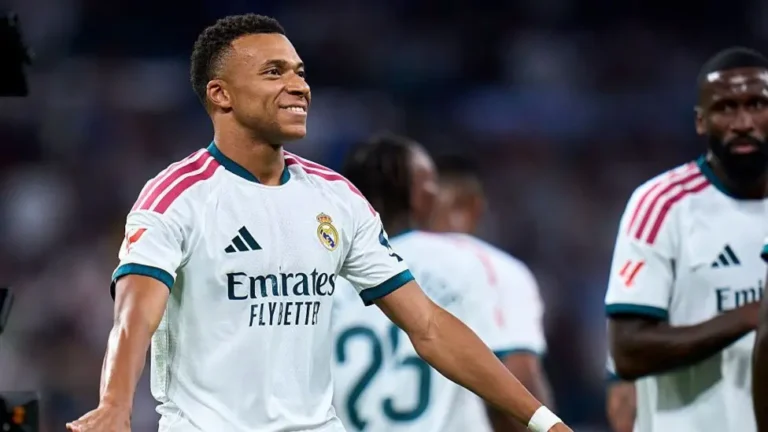
The global football calendar offers few fixtures with the historic weight, tactical chess matches, and sheer cultural gravity of El Clásico. In the latest installment of this fierce Spanish rivalry, Real Madrid traveled to face their arch-catalan rivals, Barcelona, carrying the weight of expectation and the urgent need to assert domestic dominance. When the final whistle blew at a packed and roaring stadium, it was French superstar Kylian Mbappé who stood at the center of the spectacle, delivering a masterclass in clinical finishing that shattered Barcelona’s flawless start to the La Liga campaign and injected a fresh wave of excitement into the race for the league title.
Mbappé, whose integration into Carlo Ancelotti’s tactical framework has been one of the most scrutinized storylines in European football, etched his name indelibly into the lore of this fixture. Scoring in each half of the match, the French forward demonstrated the lethal efficiency that persuaded Real Madrid’s hierarchy to secure his signature. His two-goal haul not only handed Los Blancos a hard-fought 2-1 victory but also served as a stark reminder of his capability to decide matches of the highest magnitude single-handedly.
For Barcelona, the defeat represents more than just a loss of three points. It halts a mesmerizing momentum that had seen Hansi Flick’s side sweep aside domestic opponents with frightening consistency. Entering the match with a perfect record of nine consecutive victories, the Catalan giants were chasing a historic tenth win—a milestone that would have cemented their early-season supremacy. Instead, they were forced to reckon with the resilience and tactical pragmatism of a Real Madrid side engineered to punish the smallest lapses in concentration.
The Anatomy of the Match: How the Drama Unfolded
The tactical battle was set from the opening whistle, with both managers deploying setups designed to exploit their opponent’s defensive transitions. Barcelona, true to their philosophical roots, sought to dictate the tempo through methodical possession and high-pressing sequences, while Real Madrid adopted a compact, highly disciplined defensive block, waiting for opportunities to unleash their explosive pace on the counter-attack.
For much of the first half, the game was a tense affair characterized by midfield duels and tactical sparring. However, the deadlock was broken in the 41st minute, altering the psychological landscape of the fixture. Following a sustained period of pressure from the visitors, a defensive clearance by the Barcelona backline went awry. The ball ricocheted unpredictably in a crowded penalty area, falling invitingly into the path of Kylian Mbappé. With characteristic composure, the French international made no mistake, rifling his shot past the stranded Barcelona goalkeeper to give Real Madrid a crucial psychological advantage heading into the halftime interval.
Trailing by a goal, Barcelona emerged from the dressing rooms with renewed intensity and urgency. Hansi Flick’s tactical adjustments began to bear fruit as the hosts pinned Real Madrid back into their defensive third, orchestrating waves of attacks through the flanks. The sustained pressure finally yielded results in the 61st minute. Barcelona captain Raphinha, who had been a constant thorn in Madrid’s side throughout the evening, rose to the occasion. Connecting with a precise delivery, Raphinha restored parity with a clinical finish that sent the home supporters into raptures, breathing new life into Barcelona’s quest to maintain their unbeaten status.
As the match entered its closing stages, both sides pushed for a winner, knowing that a draw would heavily favor other title contenders lurking in the table. The defining moment arrived in the 87th minute, born out of tactical substitution and sublime execution. Real Madrid manager Carlo Ancelotti had introduced Eduardo Camavinga to inject fresh energy into the midfield. The substitution proved to be a masterstroke. Camavinga picked up the ball in transition and delivered a breathtaking, defence-splitting assist that bypassed the Barcelona backline entirely. Mbappé read the trajectory perfectly, beating the offside trap before dispatching a thunderous strike past the keeper to secure a dramatic 2-1 victory.
Historical Context and Rivalry Dynamics
To fully understand the significance of this encounter, one must look beyond the immediate 90 minutes and examine the historical tapestry of El Clásico. Matches between Real Madrid and Barcelona transcend sport; they are socio-cultural flashpoints that encapsulate the historical rivalry between Spain’s two largest cities, Madrid and Barcelona. Every meeting is scrutinized by millions globally, with historical rivalries, political undercurrents, and fierce sporting pride converging on the pitch.
In recent seasons, the power balance in Spanish football has oscillated. Barcelona’s turbulent financial landscape forced the club to pivot toward youth development and shrewd acquisitions, unearthing a golden generation of talent from La Masia. Under Hansi Flick, this young core had developed a fearless, high-tempo style of play that swept through La Liga opponents during the opening months of the season. Their run of nine consecutive wins was not merely a statistical achievement; it was a statement of intent, signaling that the Catalan club had successfully rebuilt a competitive powerhouse capable of dominating domestic football.
Conversely, Real Madrid’s strategy has relied on a blend of established world-class stars and generational talents, culminating in the marquee acquisition of Kylian Mbappé. The French forward’s arrival in Madrid was heralded as the dawn of a new Galáctico era, designed to secure both domestic hegemony and prolonged European dominance. However, integrating a player of Mbappé’s stature into an already star-studded dressing room required meticulous tactical balancing by Ancelotti. Sunday’s performance provided definitive proof that this integration is reaching its lethal zenith, with Mbappé proving capable of delivering decisive contributions when the stakes are at their absolute highest.
Statistical Breakdown and Tactical Implications
A detailed analysis of the match statistics underscores the razor-thin margins that defined the encounter. While Barcelona dominated possession metrics—controlling the ball for approximately 58% of the match—Real Madrid showcased superior clinical efficiency.
| Metric | Barcelona | Real Madrid |
|---|---|---|
| Possession | 58% | 42% |
| Shots on Target | 6 | 5 |
| Total Shots | 14 | 11 |
| Pass Accuracy | 89% | 83% |
| Corners | 7 | 3 |
| Fouls Committed | 12 | 15 |
The data reveals that while Barcelona dictated the flow of the game and generated more sustained pressure, Real Madrid maximized their transition opportunities. The defensive resilience of Madrid’s backline, marshaled by veteran leadership, successfully restricted Barcelona’s high-volume shooting to low-probability areas, while Mbappé’s two goals materialized from clinical exploitation of defensive errors and rapid transitional play.
The implications of this result for the La Liga title race are profound. Had Barcelona secured a victory or even a draw, their lead at the summit of the table would have stretched significantly, potentially demoralizing chasing packs. Instead, the 2-1 defeat compresses the upper echelons of the league standings. Real Madrid has closed the gap significantly, injecting renewed competitive tension into a title race that many pundits feared might become a runaway affair for the Catalan side.
Furthermore, the psychological impact on both squads cannot be overstated. For Real Madrid, conquering their fiercest rivals away from home validates their tactical trajectory and reinforces belief within the squad. For Barcelona, the defeat serves as an abrupt reality check. It highlights structural vulnerabilities in defensive transitions when committing numbers forward—issues that Hansi Flick will need to address urgently if his side is to sustain a grueling 38-game domestic campaign alongside European commitments.
Post-Match Reactions and Official Statements
In the aftermath of the high-intensity fixture, both managers addressed the media, offering contrasting assessments of their teams’ performances.
Real Madrid manager Carlo Ancelotti praised his players’ defensive discipline and tactical execution, highlighting the collective effort required to halt Barcelona’s momentum. "In matches of this magnitude, you need more than just individual brilliance; you need defensive solidity, mental resilience, and the capacity to suffer when the opponent dominates possession," Ancelotti stated in his post-match press conference. "Kylian showed why he is a world-class player, but this was a victory earned by the entire squad. We executed our game plan precisely, and this result gives us a massive boost in confidence as we continue our campaign."
On the opposing side, Barcelona head coach Hansi Flick expressed frustration with the lapses in concentration that cost his side the match, while simultaneously emphasizing pride in his players’ effort and commitment to their attacking philosophy. "We controlled large phases of the match and played the kind of football our supporters expect to see," Flick noted to reporters. "However, at this level, small details decide games. We made mistakes that against a team of Real Madrid’s quality—and specifically a player like Mbappé—you simply cannot afford to make. We must learn from this disappointment, correct our errors, and focus on the next challenge."
Players from both camps also took to social media and mixed-zone interviews to reflect on the spectacle. Eduardo Camavinga, whose precise assist unlocked the winner, emphasized the collective harmony within the Real Madrid squad. Meanwhile, Barcelona captain Raphinha urged his teammates to maintain their morale, reminding the fanbase that a long season remains ahead with ample opportunities for redemption.
Broader Impact on European Football Landscape
Beyond the immediate confines of La Liga, the outcome of this El Clásico reverberates across the broader European football landscape. The fixture serves as a bellwether for the shifting hierarchies among the continent’s elite clubs. With the implementation of new tournament formats in European competitions and increasingly congested fixture schedules, squad depth and tactical flexibility have become the ultimate determinants of success.
Real Madrid’s ability to secure victory while weathering intense spells of Barcelona pressure underscores the enduring value of pragmatism blended with elite individual talent. As the season progresses into its crucial winter months, teams capable of grinding out results in hostile environments while maintaining defensive stability will invariably emerge as frontrunners for major silverware.
For Spanish football as a global product, the match reaffirmed the unmatched drama and commercial appeal of El Clásico. In an era where football discourse is frequently dominated by financial disparities and structural debates, a tightly contested, high-quality encounter decided by moments of individual genius reminds global audiences of the sport’s intrinsic theatrical power.
As the dust settles on this historic weekend, attention now shifts to how both clubs manage their respective schedules. Real Madrid will look to build upon this momentum, using the psychological boost of the El Clásico victory to establish sustained consistency in domestic and European fixtures. Barcelona, meanwhile, faces a crucial test of character—responding to their first domestic defeat of the season and proving that their early-season brilliance was not a fleeting anomaly, but the foundation of a genuine championship contender.