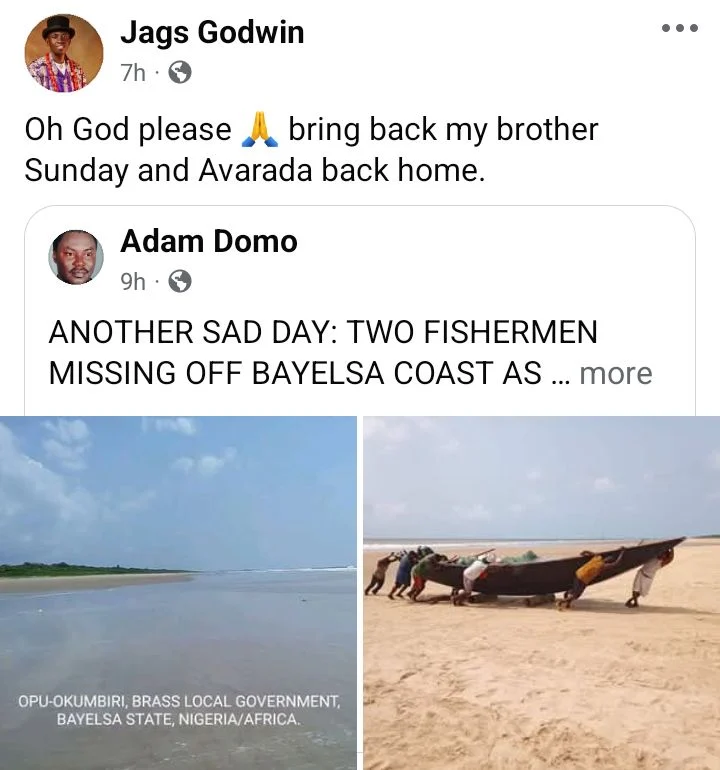
A somber cloud has descended upon the Opu-Okumbiri community in Brass Local Government Area of Bayelsa State, as two fishermen, Elder Sunday Sample Timothy and his assistant, Mr. Avarada, remain missing following the capsizing of their boat. The incident, which occurred on Friday, July 24, 2026, has ignited urgent search and rescue operations along the state’s treacherous coastline, highlighting persistent safety concerns within the region’s vital fishing sector.
The Ill-Fated Expedition
The harrowing ordeal began in the early hours of Friday morning when Elder Sunday Sample Timothy, a respected member of the Opu-Okumbiri fishing community, and his assistant, Mr. Avarada, embarked on their usual fishing expedition. Their journey into the Atlantic waters, a daily ritual for many in the coastal communities of Bayelsa, took a catastrophic turn when the outboard engine of their vessel reportedly malfunctioned at sea.
According to Chief Saturday Akimi-Omunhuo, a prominent community leader and elder, the two men were some distance from shore when the engine failure occurred. In an attempt to mitigate the situation, another boat from the community, equipped for rescue operations, was dispatched to tow the disabled vessel towards the continental shelf. It was during this delicate towing operation, navigating the powerful currents and swells characteristic of the Atlantic coastline, that the faulty boat tragically capsized, plunging Elder Timothy and Mr. Avarada into the turbulent waters.
While those aboard the rescue boat managed to reach the shore safely, the fate of Elder Timothy and Mr. Avarada remains unknown. Their disappearance has sent shockwaves through the close-knit community, where fishing is not merely an occupation but the very bedrock of their economic survival and cultural identity.
Intensified Search and Rescue Efforts
In the immediate aftermath of the incident, community members, driven by a profound sense of solidarity and desperation, launched an extensive search operation. Volunteers, equipped with whatever resources they could muster, scoured the coastline and ventured into the nearby waterways, their eyes scanning the vast expanse of the ocean for any sign of the missing fishermen.
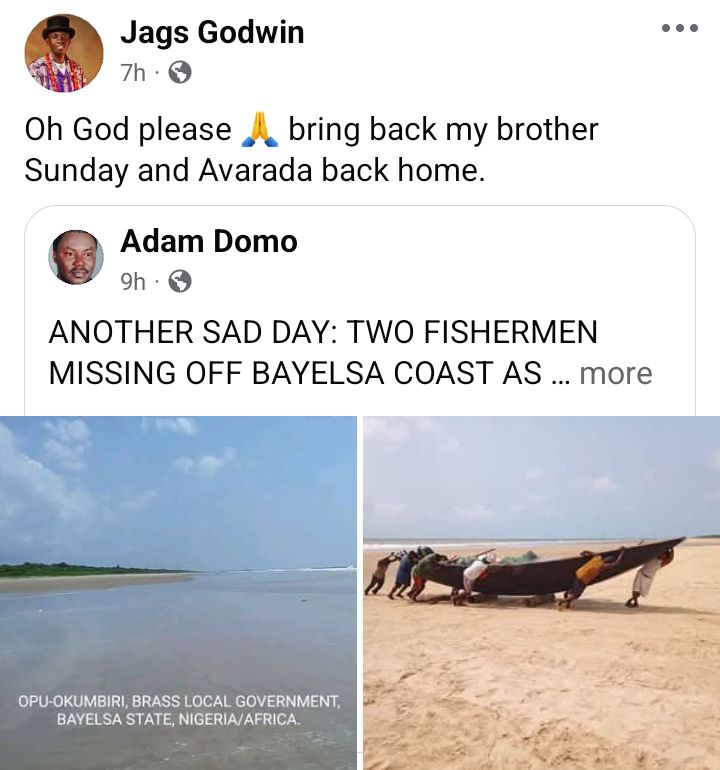
The search efforts, though fueled by hope, have so far yielded only their fishing gear. The recovery of their equipment, while confirming the tragic events, has done little to alleviate the growing anxiety and grief that has enveloped Opu-Okumbiri. As of the time of this report, the search and rescue operations were ongoing, with maritime authorities and local divers also contributing to the daunting task.
A Recurring Tragedy in Bayelsa’s Coastal Communities
Chief Akimi-Omunhuo, speaking with a heavy heart, described the incident as "tragic," but also lamented that such accidents are not isolated events in Bayelsa’s coastal communities. He pointed to a history of similar maritime mishaps, underscoring a systemic vulnerability that has plagued these communities for years.
Bayelsa State, with its extensive coastline and numerous riverine communities, relies heavily on fishing as a primary source of livelihood for a significant portion of its population. However, the inherent risks associated with maritime activities are often exacerbated by a lack of adequate safety infrastructure and resources. Factors such as aging vessels, insufficient life-saving equipment, unpredictable weather patterns, and a general absence of robust maritime safety protocols contribute to a precarious environment for fishermen.
Data from maritime safety organizations, while not specific to this particular incident, often highlight the disproportionate risk faced by small-scale fishermen in developing coastal nations. These fishermen, often operating with limited financial resources, are frequently compelled to use older equipment and may not have access to real-time weather forecasts or advanced navigation tools.
An Urgent Appeal for Enhanced Safety Measures
In the wake of this latest tragedy, Chief Akimi-Omunhuo has issued an impassioned plea to all relevant stakeholders, urging immediate and decisive action to prevent future occurrences. He specifically called upon the Brass Local Government Council, the Bayelsa State Government, the Federal Government, and other maritime and humanitarian organizations to intervene.
His appeal centers on the critical need for improved safety equipment, including the provision of life jackets, distress beacons, and more reliable vessels. Furthermore, he emphasized the importance of establishing effective weather monitoring systems that can provide timely and accurate forecasts to fishermen before they embark on their voyages. The installation of navigation aids and the promotion of safety training programs are also seen as crucial steps in mitigating risks.

"Our people depend on fishing for survival," Chief Akimi-Omunhuo stated emphatically. "We need better safety measures to reduce the loss of lives on our waterways. These are not just statistics; these are fathers, sons, and providers whose families are left devastated by these preventable accidents."
Broader Implications for Bayelsa’s Maritime Sector
The capsizing incident in Opu-Okumbiri serves as a stark reminder of the challenges faced by Nigeria’s coastal communities and the urgent need for a comprehensive approach to maritime safety. The fishing industry in Bayelsa, beyond its economic significance, plays a vital role in food security and contributes to the local economy through the sale of fresh seafood. The loss of life and the constant threat of such accidents can have devastating socio-economic consequences, impacting not only the immediate families but also the broader community’s economic stability and morale.
The incident also underscores the importance of government investment in infrastructure and safety protocols for its maritime sector. This includes not only enhancing the capabilities of search and rescue operations but also proactively implementing measures to prevent accidents in the first place. A robust maritime safety framework would involve:
- Enhanced Surveillance and Monitoring: Utilizing technology to monitor maritime traffic and potential hazards.
- Regular Vessel Inspections: Ensuring that fishing boats meet safety standards.
- Dissemination of Weather Information: Establishing reliable channels for fishermen to receive up-to-date weather forecasts.
- Community Engagement and Training: Educating fishermen on best safety practices and the use of safety equipment.
- Investment in Search and Rescue Capabilities: Equipping and training dedicated rescue teams.
The current situation in Opu-Okumbiri highlights a gap between the risks inherent in the profession and the protective measures in place. As the search for Elder Sunday Sample Timothy and Mr. Avarada continues, the community and the wider Bayelsa State look towards decisive action from authorities to ensure that such tragedies are not repeated, and that the livelihoods of its coastal dwellers are secured against the unforgiving embrace of the sea. The coming days will be crucial in determining the outcome of the ongoing search, but the call for systemic change in maritime safety in Bayelsa has never been more urgent.