A tragic multi-vehicle collision on the outbound section of the Lagos-Ibadan Expressway claimed the life of a physically challenged beggar during the early hours of Saturday. The incident, which occurred at the notorious Car Park C segment in Ogun State, has once again brought the issues of heavy-duty vehicle maintenance and the safety of vulnerable persons on Nigeria’s busiest highway to the forefront of national discourse.
According to official reports from the Ogun State Traffic Compliance and Enforcement Agency (TRACE), the fatal accident involved two heavy-duty trucks and a commercial passenger bus. The primary cause of the collision has been attributed to a mechanical failure in one of the trucks, leading to a loss of control that resulted in a gruesome scene. The deceased, a man who utilized a wheelchair for mobility, was caught in the path of the drifting vehicles while stationed near a turning point, a location frequently used by beggars and hawkers to solicit assistance from slow-moving traffic.
Details of the Vehicles Involved
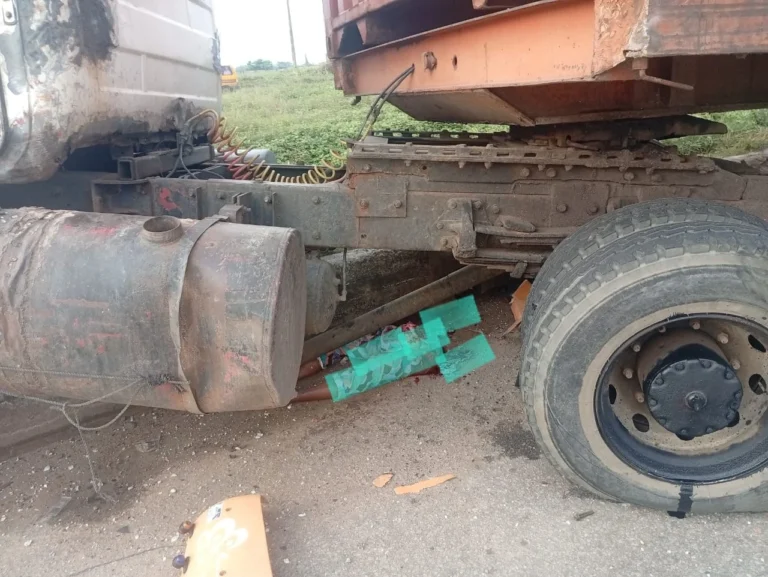
The spokesperson for TRACE, Babatunde Akinbiyi, released a comprehensive statement on Saturday morning detailing the identities of the vehicles caught in the wreckage. The primary vehicle, a Mack truck laden with a shipping container and bearing registration number AGL 374 XX, is believed to be the source of the initial impact.
The collision chain subsequently involved a loaded DAF truck with registration number AKM 476 XB and a white Toyota passenger bus with registration number AKD 137 YA. Eyewitnesses at the scene reported that the Mack truck was approaching a designated U-turn area when it suddenly lost braking capacity. The heavy vehicle, unable to decelerate, plowed into the vehicles ahead that were negotiating the turn, creating a pile-up that blocked a significant portion of the outbound carriageway.
Chronology of the Accident
The incident unfolded in the early hours of Saturday, a period when the Lagos-Ibadan Expressway typically experiences a surge in haulage traffic as trucks attempt to exit Lagos before the peak morning rush. As the Mack truck approached the Car Park C area—a section characterized by high pedestrian and vehicular activity due to its proximity to major religious campgrounds—the driver realized the braking system had failed.
Unable to steer the massive vehicle away from the bottleneck at the turning point, the truck slammed into the DAF truck and the Toyota bus. In the chaos of the impact, the physically challenged beggar, who was positioned near the median to reach motorists, was unable to maneuver his wheelchair out of the path of the colliding steel. The force of the Mack truck fatally struck the victim. TRACE officials described the scene as particularly harrowing, noting that the impact of the heavy machinery resulted in catastrophic injuries to the victim.
Emergency Response and Traffic Gridlock
Immediately following the crash, a coordinated rescue and traffic management operation was launched. Operatives from TRACE were joined by officers from the Federal Road Safety Corps (FRSC) and the Nigeria Police Force to secure the area and prevent secondary accidents.
“Traffic on the outbound Lagos route is highly affected,” Akinbiyi stated during the recovery operations. “TRACE operatives, FRSC, and the police are on the ground doing the needful to ensure the removal of the obstructed vehicles and to restore the free flow of traffic.”
As of mid-morning Saturday, heavy-duty towing equipment was deployed to move the container-laden Mack truck and the DAF truck, both of which had sustained significant damage and were wedged across multiple lanes. The resulting gridlock stretched several kilometers back toward the Long Bridge, leaving hundreds of motorists and travelers stranded in the sweltering morning heat.
A Week of Carnage on the Lagos-Ibadan Expressway
This fatal accident follows a string of similar incidents on the same highway within the last 48 hours. On Friday, the Kara Bridge section of the expressway, which connects Lagos and Ogun states, was the site of multiple crashes that paralyzed movement for the better part of the day.
In the Friday incidents, the FRSC confirmed that one person lost their life while two others sustained varying degrees of injuries. Those crashes occurred on both the inbound and outbound carriageways, suggesting a systemic issue with speed management and vehicle spacing on the bridge. The proximity of the Car Park C tragedy to the Kara Bridge incidents has sparked concerns among commuters regarding the overall safety of the corridor during the current rainy season, which often exacerbates poor road conditions and reduces visibility.

The Scourge of Brake Failure in Nigeria’s Haulage Sector
The preliminary investigation into Saturday’s crash points to brake failure as the definitive cause. This diagnosis is a recurring theme in Nigerian road traffic accident reports, particularly those involving "articulated vehicles" or "trailers."
Industry experts argue that the age of the fleet used by many haulage companies in Nigeria contributes significantly to these tragedies. Many of the Mack and DAF trucks operating on the Lagos-Ibadan corridor are second-hand imports that have surpassed their optimal service life. Furthermore, the culture of "corrective maintenance"—where repairs are only made after a part fails—rather than "preventative maintenance" means that critical systems like pneumatic brakes are often neglected until they fail under the pressure of a heavy load.
The Lagos-Ibadan Expressway is the primary artery for the Nigerian economy, carrying over 70% of the goods coming from the nation’s seaports to the hinterlands. The sheer volume of heavy-duty traffic, combined with the undulating terrain of the Ogun State section of the road, puts immense strain on vehicle braking systems.
The Vulnerability of Roadside Pedestrians and Beggars
The death of the physically challenged beggar also highlights a persistent social and safety crisis on Nigerian highways. Despite numerous bans by the Ogun and Lagos State governments on roadside begging and street hawking, major traffic intersections and U-turn spots remain magnets for the indigent and the disabled.
These individuals often position themselves in the "blind spots" of large trucks or in the middle of high-speed lanes, betting on the empathy of motorists during traffic slow-downs. When a mechanical failure occurs, as it did on Saturday, these individuals are the most vulnerable, as they lack the protection of a vehicle chassis and, in the case of the physically challenged, the ability to flee quickly from oncoming danger.
Implications and Regulatory Oversight
The frequency of these accidents has led to renewed calls for stricter enforcement of the Road Transport Safety Standardization Scheme (RTSSS) by the FRSC. This scheme is designed to regulate the operations of fleet owners and ensure that heavy-duty vehicles undergo rigorous safety checks before being allowed on the road.
However, enforcement remains a challenge. While TRACE and the FRSC maintain a visible presence on the Lagos-Ibadan Expressway, they are often overwhelmed by the sheer volume of traffic and the brazenness of drivers who bypass safety protocols. There are growing demands for the establishment of mandatory automated vehicle inspection centers specifically for heavy-duty trucks at the entry points of major highways.
Furthermore, the ongoing reconstruction of the Lagos-Ibadan Expressway, while nearing completion, has created temporary diversions and narrowing of lanes that require extreme caution. The Car Park C area, located near the Redemption City, is a particularly sensitive zone due to the high volume of pedestrians during religious events, making the presence of malfunctioning trucks even more perilous.
Conclusion and Future Outlook
The loss of life on Saturday is a sobering reminder of the fragility of safety on Nigeria’s roads. As TRACE and the FRSC continue their efforts to clear the wreckage and investigate the specific circumstances of the Mack truck’s failure, the incident serves as a call to action for haulage company owners to prioritize the roadworthiness of their fleets.
For the commuting public, the stretch of road between the Lagos State border and the Sagamu Interchange remains a zone requiring heightened alertness. Authorities have urged motorists to maintain safe distances from articulated vehicles, especially near turning points and hills, where mechanical failures are most likely to result in catastrophic collisions.
The body of the deceased has been evacuated by emergency services, and efforts to identify his next of kin are reportedly underway. Meanwhile, the drivers of the involved vehicles are expected to undergo questioning by the police to determine if negligence played a role in the failure to maintain the vehicle’s braking system. As the expressway eventually cleared later in the day, the echoes of the morning’s tragedy remained, highlighting a desperate need for a paradigm shift in Nigerian road safety management.