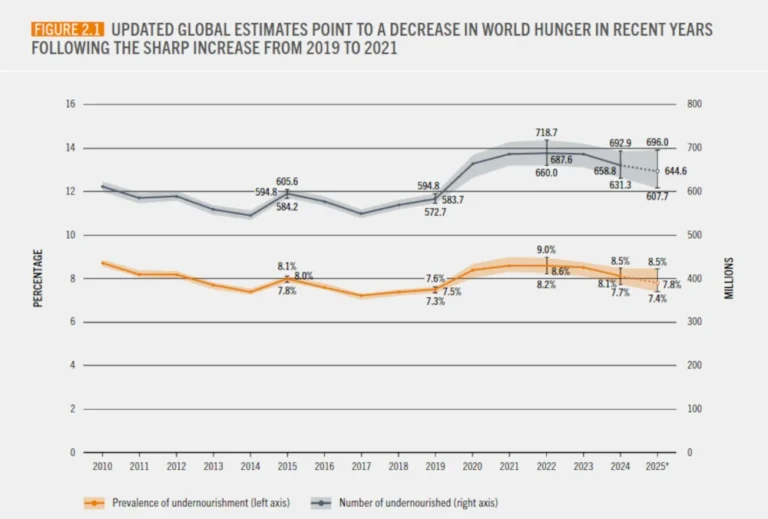
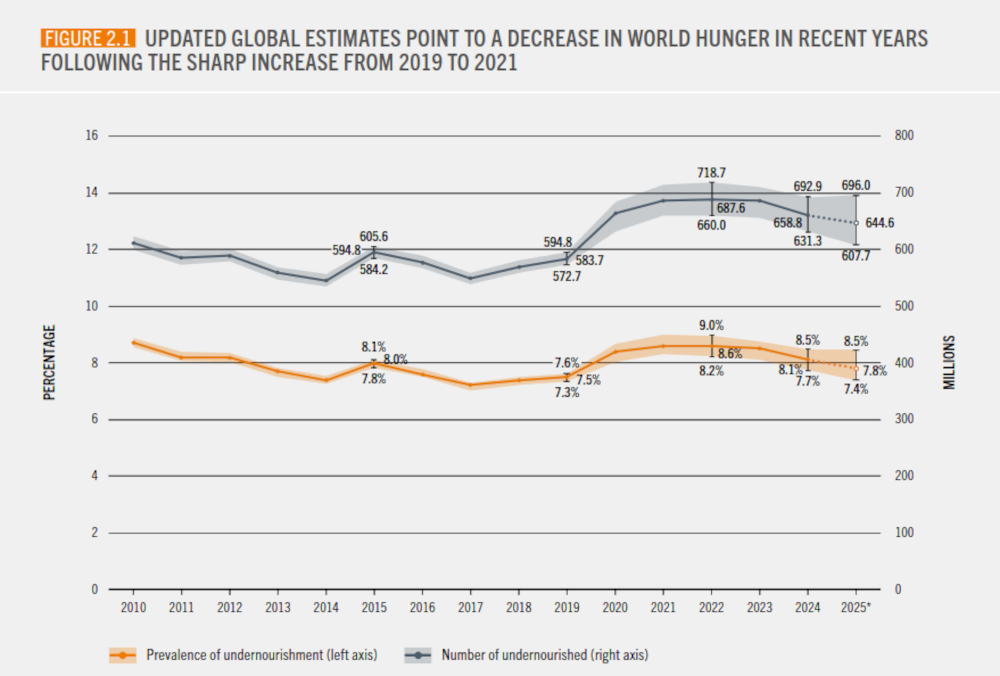
The global landscape of food security and nutrition is currently defined by a stark paradox: while the absolute number of people suffering from chronic hunger has begun a slow descent from its pandemic-era peak, the economic barriers to basic healthy nutrition are reaching unprecedented heights. According to the 2025 State of Food Security and Nutrition in the World (SOFI) report, a flagship publication produced jointly by five United Nations agencies, global hunger fell to approximately 7.8% in 2025, down from 8.1% in the previous year. This translates to roughly 645 million people living in a state of undernourishment—a decrease of 43 million since the height of the COVID-19 pandemic in 2022. However, these gains are described by experts as "fragile and uneven," as the report warns that the world remains significantly off-track to meet the United Nations Sustainable Development Goal (SDG) 2 of Zero Hunger by 2030.
The SOFI report, co-authored by the Food and Agriculture Organization (FAO), the International Fund for Agricultural Development (IFAD), the United Nations Children’s Fund (UNICEF), the World Food Programme (WFP), and the World Health Organization (WHO), paints a sobering picture of the "new normal" in global food systems. The most alarming metric highlighted in the 2025 data is the surging cost of a healthy diet. The global average cost has climbed to $4.28 in purchasing power parity (PPP) per day, a sharp increase from the $3.44 recorded in 2021. This inflationary trend has left approximately one-third of the global population—over 2.8 billion people—unable to afford the fruits, vegetables, and animal-sourced proteins required to maintain long-term health and prevent stunting or wasting in children.
A Chronology of Crisis and Recovery
The trajectory of global hunger over the last decade has been one of stagnation followed by a sharp deterioration. From 2014 to 2019, global hunger levels remained relatively stable, though they were already beginning to creep upward due to climate change and localized conflicts. The onset of the COVID-19 pandemic in 2020 acted as a massive catalyst, disrupting global supply chains, shuttering local markets, and plunging millions into poverty. By 2022, undernourishment had reached a decade-high peak.
The slight recovery observed in 2024 and 2025 reflects the gradual stabilization of some markets and the resumption of international trade. However, this recovery has not been felt equally. While Asia and Latin America have shown resilience and steady improvements in food security, Africa has seen its situation stagnate or worsen in absolute terms. The continent now bears the heaviest burden of the global hunger crisis, hosting 309 million undernourished individuals. Despite the percentage of hungry people in Africa remaining stable, rapid population growth means the sheer number of people lacking food continues to rise, outstripping the pace of agricultural development and aid.

The Economic Barrier: Why Healthy Food is a Luxury
The 2025 SOFI report places a heavy emphasis on the "affordability gap." Dr. Tedros Adhanom Ghebreyesus, Director-General of the WHO, emphasized during the report’s launch that "healthy diets should not be a luxury; they are the foundation of health." Yet, for 66.6% of the population in Africa and significant portions of South Asia, a diet rich in micronutrients is economically impossible.
A primary driver of this cost is the price of animal-sourced foods, such as dairy, eggs, and meat. In low-income nations, these are the most expensive components of the food basket. The report identifies three main reasons for this:
- Low Livestock Productivity: Farmers in developing regions often lack access to high-quality breeds and modern husbandry techniques.
- Feed Costs: The rising price of grain on the international market directly inflates the cost of producing meat and dairy locally.
- Veterinary Services: A lack of accessible animal healthcare leads to high mortality rates in livestock, further reducing supply and raising retail prices.
Furthermore, the report highlights the catastrophic impact of "post-harvest losses." In regions like Sub-Saharan Africa, the lack of a reliable "cold chain"—refrigerated transport and storage—means that between 30% and 40% of all dairy, fish, and fresh produce rots before it ever reaches a consumer. These losses represent a massive waste of resources and a direct tax on the poor, as the cost of the wasted food is factored into the price of the surviving produce.
Geopolitical Shocks and the "Conflict Nexus"
Food security does not exist in a vacuum; it is inextricably linked to global peace and stability. The 2025 report underscores how escalating armed conflicts and broader geopolitical tensions are fracturing the supply chains necessary to keep food prices stable. In Sudan, South Sudan, Nigeria, and the Democratic Republic of the Congo (DRC), ongoing violence has decimated agricultural livelihoods. Smallholder farmers, who provide the backbone of local food systems, have been displaced by the millions, turning formerly productive agricultural zones into humanitarian disaster areas.
The situation in Sudan is particularly dire. The report identifies a "credible risk of famine" across 14 distinct areas. Fighting has blocked vital transport routes, preventing both commercial goods and humanitarian aid from reaching those in need. When agricultural cycles are interrupted by war, the effects are felt for years, as seeds are not planted and irrigation systems fall into disrepair.
Beyond localized violence, the report points to the "macroeconomic fallout" of global power struggles. A significant portion of the recent price spikes in fuel and fertilizer can be traced to tensions in the Middle East, specifically the conflict involving the United States and Iran. The intermittent blockade and instability surrounding the Strait of Hormuz—a vital artery for global energy shipments—have driven up transport costs worldwide. Because modern agriculture and the cold chains required for nutrient-dense foods rely heavily on fuel, these geopolitical tremors have a disproportionate impact on the price of perishable goods like milk and vegetables.
The Legacy of Cash Crops and Import Dependency
An analytical thread throughout the report is the historical vulnerability of many African and Asian nations that shifted their agricultural focus decades ago. Under pressure from international loans and the trends of globalization, many developing countries moved away from indigenous food production toward "cash crops" like cocoa, coffee, and cotton intended for export.
While this strategy was intended to generate foreign currency, it has left these nations as net importers of basic food staples like cereals and grains. When global markets are hit by shocks—such as the war in Ukraine or energy crises in the Persian Gulf—these countries are left highly exposed. They must pay higher prices for imported food using weakened local currencies, creating a cycle of "imported inflation" that makes even basic calories unaffordable for the poorest citizens.
Official Responses and the Call for Financial Reform
The launch of the SOFI 2025 report in Rome was met with calls for a fundamental shift in how the world finances food systems. FAO Director-General Qu Dongyu stated that ending hunger requires "political commitment, sustained investment, and enabling policies." The report argues that current global investment priorities are misplaced.
Historically, governments have heavily subsidized calorie-dense, starchy staples like wheat, maize, and rice. While this helped reduce mass starvation in the mid-20th century, it has created a market failure in the 21st century by neglecting the nutrient-dense crops needed to combat malnutrition and diet-related non-communicable diseases. The UN agencies are now calling for a "repurposing" of agricultural subsidies. Instead of only supporting staples, public funding should be redirected toward:
- Supply Chain Resilience: Investing in rural road networks and modern water management.
- Infrastructure: Building post-harvest storage and cold chain facilities to reduce waste.
- Research and Development: Focusing on climate-resilient, nutrient-rich indigenous crops.
Analysis of Implications: A Race Against Time
The implications of the 2025 SOFI report are profound for global health and economic development. If current trends continue, an estimated 520 million people will still be undernourished by 2030. This is a far cry from the "Zero Hunger" target and suggests that the structural causes of food insecurity—conflict, climate change, and economic inequality—are outpacing current humanitarian efforts.
The persistent "affordability gap" suggests a looming public health crisis. When families cannot afford healthy diets, they often pivot to "ultra-processed" foods that are high in calories but low in nutrients. This is leading to a "double burden of malnutrition," where undernutrition and obesity coexist within the same communities, and even the same households. The long-term economic cost of this—in terms of healthcare expenditures and lost labor productivity—is staggering.
To close the agriculture finance gap, the report suggests that private-sector partnerships will be essential. However, these must be balanced with public policies that protect smallholder farmers and ensure that the drive for efficiency does not come at the expense of food sovereignty.
In conclusion, while the slight dip in global hunger numbers provides a glimmer of hope, the 2025 SOFI report serves as a stark warning. The world is transitioning into an era where food is available, but increasingly unaffordable. Without a radical shift in how food systems are financed, and without a concerted effort to resolve the conflicts driving displacement, the goal of a world without hunger will remain an elusive aspiration rather than a reachable reality. The foundation of global health—the healthy diet—remains, for now, a luxury that billions cannot afford.