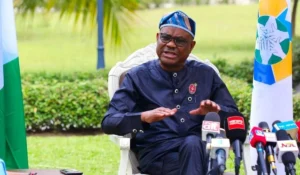
As Nigeria looks ahead to the 2027 general elections, debates surrounding the integrity, transparency, and operational efficiency of the Independent National Electoral Commission (INEC) have once again taken center stage. Senator Victor Umeh, who represents Anambra Central and is seeking re-election under the platform of the Nigeria Democratic Congress, has added a significant voice to these ongoing national discourses. In a comprehensive interview on Channels Television’s flagship political program, Politics Today, Senator Umeh issued a strong, forward-looking recommendation to the electoral umpire: systematically recruit, rigorously train, and permanently deploy a robust cadre of internal personnel to gradually eliminate the commission’s heavy dependence on ad hoc staff.
The lawmaker’s assertions touch on structural vulnerabilities that have historically plagued Nigeria’s democratic exercises. From allegations of deliberate staff juggling across states to the reliance on external temporary workers and academic professionals for high-stakes collation and returning duties, Umeh’s critique underscores systemic challenges that continue to test public trust in the ballot box. With the 2027 electoral cycle fast approaching, these proposals ignite critical conversations on how institutional capacity building can fortify Nigeria’s democracy against manipulation, logistics failures, and declining citizen confidence.
The Core Controversy: The Politics of Ad Hoc Deployments
At the heart of Senator Umeh’s critique is the controversial practice of deploying ad hoc electoral personnel, a system INEC has leaned on heavily for decades due to the sheer logistical scale of conducting nationwide elections in a country of over 200 million people. INEC traditionally maintains a core of permanent administrative and technical staff, but this workforce is vastly outnumbered by the hundreds of thousands of temporary workers required to manage polling units, registration areas, and collation centers during major elections.
These temporary workers—drawn largely from the National Youth Service Corps (NYSC), tertiary institutions, and the wider public—perform critical frontline functions. They serve as Presiding Officers and Assistant Presiding Officers at individual polling units, Supervisory Presiding Officers managing clusters of locations, and Registration Area Centre managers overseeing logistical staging points. Furthermore, INEC routinely recruits external professionals, notably university professors and senior academic staff, to act as Collation and Returning Officers at local government, state, and federal levels.
However, Senator Umeh contends that this reliance on temporary personnel opens the door to manipulation by political actors seeking to subvert the democratic process. According to the lawmaker, intelligence and long-standing observation of Nigerian elections reveal that ad hoc deployment lists are sometimes manipulated to serve the parochial interests of powerful individuals in specific geographical zones.
"If you put your ears on the ground, you know, you see, because I have been part of this process for a lot of time, for a long time now," Umeh stated during the interview. "I know that when election comes, efforts are made to put ad hoc staff that will serve the purpose of certain powerful people in various locations. And there are people who do this. We have warned consistently."
Compounding this issue, Umeh criticized the arbitrary cross-state movement of electoral personnel under pressure from external authorities. He argued that such administrative juggling severely damages the perceived neutrality of the commission. When election officials are abruptly transferred or deployed based on partisan requests, public confidence—already fragile due to historical electoral malpractices—suffers an immediate blow.
Accountability and Institutional Capacity: The Case for Permanent Manpower
To resolve these recurring vulnerabilities, Senator Umeh advocates for a structural shift: replacing temporary workers with a well-remunerated, thoroughly trained, and permanently employed cadre of electoral officers. Drawing attention to the substantial financial appropriations allocated to INEC by the National Assembly over successive budget cycles, the lawmaker insisted that the commission possesses the financial backing necessary to expand its permanent workforce significantly.
Umeh contrasted the transient nature of ad hoc workers with the professional accountability expected of career civil servants. "An ad hoc staff is a temporary staff. He comes on duty, does what he wants to do, makes money, and goes away," Umeh explained. In contrast, he argued that career officers whose job security, pension, and professional standing depend on the institution would be far less susceptible to external inducement and coercion.
The economic and logistical argument for a permanent workforce also centers on institutional memory and skill retention. Under the current ad hoc model, INEC is forced to recruit and train a largely new army of temporary workers every four years, resulting in steep learning curves, persistent technical glitches with electronic devices like the Bimodal Voter Accreditation System (BVAS), and recurring field operational errors. A permanent, professionalized electoral corps would retain institutional knowledge, master technological tools through continuous deployment, and maintain operational readiness year-round.
Reforming Collation and Returning Officer Protocols
One of the most radical aspects of Senator Umeh’s proposal targets the upper echelons of election result management: the Collation and Returning Officers. Currently, INEC recruits high-ranking academics—frequently professors and vice-chancellors from federal and state universities—to serve as returning officers who tally votes and officially declare winners in senatorial, gubernatorial, and presidential contests.
While this tradition was originally introduced to infuse integrity into the process by leveraging the perceived moral authority of the academia, it has faced mounting criticism in recent years. Academics deployed to volatile political environments have occasionally found themselves subjected to intense intimidation, physical threats, bribery allegations, and compromises. Furthermore, critics argue that pulling university dons from their primary educational duties disrupts the academic calendar.
Umeh firmly believes that the responsibility for managing and declaring election results should begin and end within the institutional boundaries of INEC. He criticized the current practice of transporting academics across vast geographic distances—such as flying a professor from a university in Sokoto State to serve as a returning officer in Anambra State—arguing that it creates unnecessary logistical risks and deflects institutional accountability.
"INEC should be able to have its own trained personnel to be collation officers and be returning officers, so that anything that happens starts and ends with INEC," Umeh asserted. By cultivating a specialized internal corps of senior administrative officers trained specifically in data collation, legal compliance, and result verification, the commission could insulate itself from controversies involving external actors.
Chronology of Electoral Reform Debates in Nigeria
The debate over ad hoc staffing and institutional autonomy is not new in Nigeria’s electoral history. It forms part of a continuous evolution driven by legislative amendments, technological innovations, and civil society advocacy:
- 2010–2011 Electoral Cycle: Following widespread criticisms of the 2007 general elections—widely condemned as deeply flawed by international and domestic observers—Prof. Attahiru Jega assumed leadership of INEC. Reforms were introduced to clean up voter registers and restructure ad hoc recruitment, largely leveraging NYSC members to improve neutrality.
- 2015 General Elections: The introduction of the Smart Card Reader marked a major technological shift. While it reduced certain forms of ballot box stuffing, it exposed severe training deficits among ad hoc personnel who struggled to troubleshoot technical failures in the field.
- 2019 General Elections: Persistent logistical failures, late deployment of materials, and reliance on ad hoc workers led to a last-minute postponement of the polls by one week, sparking intense national outrage and renewed calls for professionalization within INEC.
- 2022 Electoral Act Amendment: Signed into law by former President Muhammadu Buhari, the new Electoral Act legalized electronic transmission of results and BVAS deployment. However, the operational reliance on temporary workers remained largely unchanged, creating friction during the 2023 general elections when electronic upload portals experienced delays.
- Present Era (2024–2026 Preparations): As INEC begins preliminary recruitment and strategic mapping for the 2027 general elections, stakeholders like Senator Umeh are reigniting debates on workforce permanence, transparency, and structural independence to preempt historical pitfalls.
Broader Implications and Stakeholder Perspectives
Senator Umeh’s recommendations open a wider debate regarding the operational realities, financial sustainability, and administrative hurdles facing Nigeria’s electoral commission.
From an economic perspective, expanding INEC’s permanent workforce to handle nationwide elections would entail a significant, recurring expenditure on personnel overhead, pensions, and continuous training. Critics of full-scale professionalization often argue that maintaining a permanent staff large enough to independently manage hundreds of thousands of polling units across 36 states and the Federal Capital Territory during a single election cycle could place an unsustainable burden on the federal budget during non-election years.
Conversely, proponents of reform argue that the hidden costs of ad hoc-induced electoral failure—ranging from expensive election tribunal litigations and rerun polls to broader economic disruptions caused by political instability—far outweigh the financial investment required to build a permanent, professional electoral corps.
Civil society organizations (CSOs) focused on good governance have frequently noted that the integrity of an election depends as much on the integrity and competence of its human elements as it does on legal frameworks and voting technology. When technological innovations like the BVAS or the INEC Result Viewing (IReV) portal are deployed, their success relies entirely on the capability of the field personnel operating them. Poorly trained temporary workers under political pressure can easily compromise the efficacy of even the most advanced digital systems.
Conclusion and Looking Ahead to 2027
As political parties and aspirants position themselves for the 2027 general elections, institutional reform proposals like those put forward by Senator Victor Umeh provide a valuable framework for critical self-assessment within Nigeria’s electoral ecosystem. While acknowledging INEC’s recent recruitment drives, the lawmaker’s challenge to the commission is clear: transition away from the vulnerabilities of temporary, easily influenced ad hoc labor, and build a permanent, highly trained, and fully accountable civil service corps dedicated exclusively to democratic stewardship.
Whether INEC will adopt a phased approach to reducing its reliance on temporary workers remains to be seen. However, as public scrutiny intensifies and citizens demand greater transparency, the imperative for structural administrative reform within Nigeria’s electoral management body has never been more urgent.