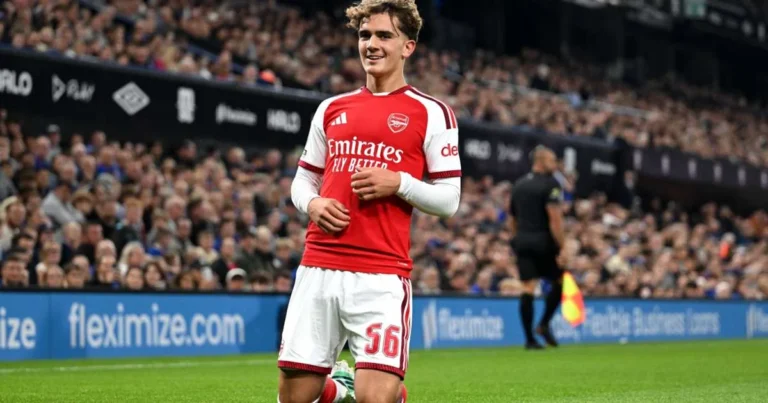
The evening at Portman Road on Tuesday served as a profound reminder of the vitality pulsing through Arsenal’s Hale End academy, as a 4-2 victory over Ipswich Town propelled the Gunners into the fourth round of the Carabao Cup. While the scoreline reflects a comfortable progression in a tournament often used to test squad depth, the narrative was dominated by 16-year-old Max Dowman, whose brace marked a historic milestone in English football. In a match defined by tactical rotation and the emergence of youth, Arsenal’s dominance was underscored by a blend of seasoned Premier League experience and the fearless ambition of its youngest prospects.
A Night of Records and Tactical Dominance
The match began with an immediate statement of intent from Mikel Arteta’s side. Dowman, making his first competitive start of the season, required only six minutes to announce his presence on the senior stage. His opening goal was not merely a strike of precision; it etched his name into the annals of the competition. At 16 years and 258 days old, Dowman became the third-youngest scorer in Carabao Cup history. This milestone places him in elite company, trailing only Arsenal legends Cesc Fabregas—who netted against Wolverhampton Wanderers at 16 years and 212 days—and Jack Wilshere, who scored at 16 years and 266 days.
The intensity did not dissipate after the opener. Noni Madueke, demonstrating the clinical edge that has made him a constant threat in the final third, doubled Arsenal’s advantage shortly thereafter. By the time the referee signaled for halftime, Arsenal had established a level of control that stifled any hopes of a Portman Road upset. The visitors returned from the break with even greater urgency, as Dowman found the back of the net again within 90 seconds of the restart. This second strike elevated him to a rare echelon of historical achievement: he became only the second 16-year-old to score twice in a single game for a Premier League club in all competitions, matching the legendary feat achieved by Wayne Rooney for Everton in October 2002.
Chronology of a Controlled Performance
The progression of the match reflected a systematic dismantling of the Ipswich defense. Arsenal’s 4-2 victory was built on a foundation of quick transitions and high-pressing football.
- 6th Minute: Max Dowman opens the scoring, signaling his arrival in the senior squad.
- 18th Minute: Noni Madueke doubles the lead, consolidating Arsenal’s authority over the fixture.
- 46th Minute: Dowman completes his brace, putting Arsenal 3-0 ahead and effectively sealing the result.
- 56th Minute: Mikel Merino adds a fourth, confirming the team’s superiority in midfield control.
- 62nd Minute: Anis Mehmeti pulls one back for Ipswich, briefly shifting the momentum.
- 90+ Minute: Former Arsenal striker Chuba Akpom finds a consolation goal for the hosts, but the final whistle confirms Arsenal’s passage to the round of 16.
Youth Integration: The Arteta Philosophy
Manager Mikel Arteta’s decision to integrate youth into the competitive structure of the Carabao Cup is a testament to the club’s long-term strategic planning. Beyond Dowman’s heroics, the match saw 17-year-old Marli Salmon earn a starting role in the heart of the defense, partnered alongside the seasoned Gabriel. This pairing provided a necessary balance between raw potential and established discipline. Furthermore, the introduction of Theo Julienne as a second-half substitute for his competitive debut highlighted the depth of the Arsenal pipeline.
The strategy of fielding teenagers in high-stakes environments is not without risk, but it serves to accelerate the development of the next generation. By placing Salmon alongside a leader like Gabriel, Arteta ensures that the tactical instructions and defensive positioning expected at the top flight are absorbed in real-time. Such rotations are vital for managing the physical workload of the senior squad, particularly as the team navigates the demands of both European and domestic campaigns.
Historical Context and Statistical Significance
To understand the magnitude of Dowman’s achievement, one must look at the historical data surrounding the Carabao Cup. The competition has long served as a laboratory for the Premier League’s elite to test their academy graduates. The fact that the three youngest scorers in the history of the tournament are all products or representatives of the Arsenal system speaks volumes about the club’s scouting and coaching infrastructure.
Comparing Dowman’s performance to that of a young Wayne Rooney underscores the rare nature of his output. In 2002, Rooney’s emergence at Everton changed the landscape of the Premier League, proving that age was not a barrier to impact. Dowman’s ability to remain composed in front of goal—finding space and timing his runs with maturity—suggests that he possesses the psychological resilience required for the highest level of professional football. His statistical performance, characterized by high conversion rates and clinical finishing, suggests that he is not merely a passenger in the squad but a player capable of influencing results.
Official Responses and Managerial Perspective
While post-match reactions from the coaching staff were measured, the implicit message was one of pride in the academy’s trajectory. Arteta has consistently maintained that the path from Hale End to the Emirates Stadium is open for those who demonstrate the requisite technical and mental fortitude. By providing these young players with a platform, the club is cultivating a culture of meritocracy.
The players themselves have spoken sparingly, focusing on the team’s collective success rather than individual accolades. However, the energy in the dressing room post-match was described by observers as highly positive. The seamless integration of debutants like Julienne and the confidence shown by Salmon suggest that the team’s chemistry remains robust even when the starting XI is significantly altered.
Broader Implications for the Season
As Arsenal prepares for the international break, the implications of this victory extend beyond the scoreline. The Carabao Cup, while secondary to the Premier League and Champions League in terms of prestige, serves as a vital barometer for squad health. By securing a victory at a challenging venue like Portman Road, Arsenal has validated the depth of its bench.
The upcoming fixture against Brighton & Hove Albion will be the primary focus as the team looks to maintain momentum before the domestic pause. The ability to rotate players and still secure a comprehensive win allows the technical staff to manage injuries and fatigue more effectively. If the youngsters who featured on Tuesday can maintain this level of performance, they may find themselves involved in more frequent rotations throughout the remainder of the season.
Conclusion: A Blueprint for the Future
The victory at Portman Road was a showcase of Arsenal’s dual-pronged approach to the season: the pursuit of immediate silverware and the sustained investment in youth talent. Max Dowman’s performance will undoubtedly be the highlight, serving as a reminder that the club’s history is built on the shoulders of those who dare to perform at a young age.
As the competition moves into the round of 16, the tactical lessons learned against Ipswich will be instrumental. Arsenal has proven that its squad possesses both the depth to challenge for titles and the courage to integrate the next generation of stars. Whether these young players become permanent fixtures in the starting lineup remains to be seen, but their performance on Tuesday evening has provided a compelling glimpse into the future of the club. The journey to the Carabao Cup final remains long, but for a club with Arsenal’s ambition, the path forward appears well-fortified by the talent currently emerging from within its ranks. With the Brighton match on the horizon, the focus will now shift back to the Premier League, carrying the confidence and historical significance of a memorable night in Suffolk.