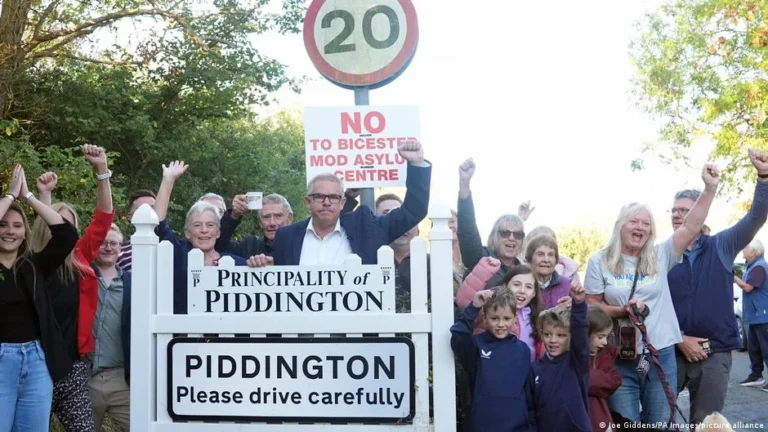
In a dramatic and highly unconventional act of local resistance, the residents of Piddington, a quiet village of approximately 350 inhabitants located 25 kilometers northeast of Oxford, have voted overwhelmingly to "secede" from the United Kingdom. While the move holds no legal standing, the symbolic referendum marks a significant escalation in the ongoing national debate surrounding the British government’s strategy for housing asylum seekers. The protest, which culminated in residents celebrating beneath a "Principality of Piddington" banner, serves as a manifestation of the mounting tension between Whitehall’s infrastructure mandates and the concerns of rural communities across England.
The focal point of this localized rebellion is the MoD Bicester (Site A), a disused military installation. The government has identified the site as a potential hub to house up to 1,250 male asylum seekers aged 18 to 65. For the villagers, the arrival of a population more than three times the size of their own community represents an existential threat to the village’s character and safety, leading them to pursue what they describe as "self-determination."
Chronology of the Disputed Site
The conflict is rooted in the government’s long-term objective to phase out the use of expensive, often controversial, hotels for asylum accommodation. This initiative, which gained momentum under previous administrations, has been inherited by the current government under Prime Minister Andy Burnham.
- July 2026: The UK government publishes a formal Q&A regarding MoD Bicester, suggesting the site could provide "basic, safe accommodation" that would be largely self-sufficient.
- August 2026: Initial feasibility studies and environmental assessments begin, drawing immediate criticism from local council members who cite the lack of local infrastructure to support such a large population.
- September 16, 2026: Piddington residents hold a formal ballot on the question: "I support Piddington seeking to secede from the United Kingdom and pursuing self-determination."
- September 17, 2026: Official results are declared, showing a 92% turnout with 285 votes in favor of secession and 26 against.
The Anatomy of the Protest
The Piddington Parish Council spearheaded the ballot, framing the issue as one of proportionality and administrative overreach. Tim McNally, chair of the parish council, has been the primary spokesperson for the initiative, arguing that the government’s timeline is rushed and fails to account for the sociological impact on a rural community.
"How does a small village of 350 odd people assimilate with 1,250 males?" McNally asked in a statement to Sky News. His comments highlight a recurring theme in the British asylum debate: the mismatch between the logistical capacity of remote, under-resourced rural areas and the scale of the government’s relocation plans.
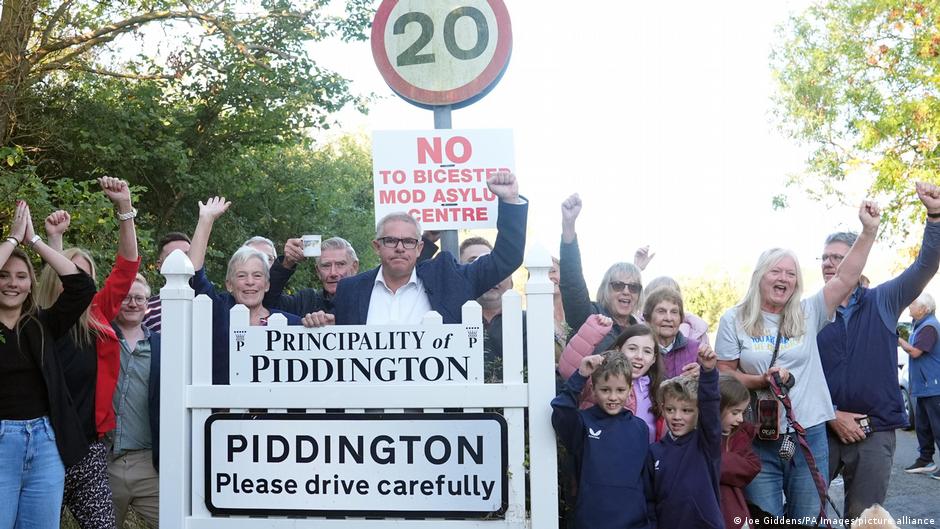
While the vote was "tongue-in-cheek" in its legal application, its execution was rigorous. The 92% turnout is remarkably high for a local ballot, signaling a unified front among residents. However, the move has not been without controversy. Observers and local officials have expressed concern that the high-profile nature of the "secession" could attract far-right agitators who seek to co-opt local grievances for broader anti-migration agendas. An Oxfordshire County Council official noted that the village now risks becoming a "lightning rod" for protests that could lead to public disorder.
Government Policy and the Housing Dilemma
The Labour government finds itself in a precarious position. Prime Minister Andy Burnham, who recently ascended to the premiership, has pledged a new economic and political model for the country, but the legacy of the asylum backlog remains a significant political liability.
The Cabinet’s position, articulated by Culture Secretary Lisa Nandy, maintains that using former military bases is a more ethical and efficient alternative to the hotel industry. Proponents of this policy argue that hotels are not only prohibitively expensive—costing the taxpayer millions daily—but also fail to provide the structured environment necessary for processing asylum claims.
However, the strategy is riddled with practical drawbacks. Military sites are often selected for their seclusion, which is ideal for security but poor for integration. Critics argue that placing individuals in remote areas, away from support networks, legal services, and urban infrastructure, creates "open-air detention centers" that exacerbate isolation and mental health issues for the asylum seekers themselves.
Data and Infrastructure Realities
The MoD Bicester site is a former military facility with existing security infrastructure, which the government argues makes it "ready-to-use." Nevertheless, the government’s own documentation admits that the site is subject to stringent "red tape," including planning permission and environmental impact assessments.
The Home Office has committed to a "phased approach," promising that the site will not reach its 1,250-person capacity immediately. Furthermore, the government has vowed that the site would be monitored 24/7 via surveillance technology, with laundry and communal facilities built on-site to ensure self-sufficiency. Despite these assurances, the local population remains skeptical. The disparity between the government’s promise of "self-sufficiency" and the reality of a small village’s limited access to healthcare, transport, and law enforcement remains the core of the impasse.

Implications for National Cohesion
The Piddington case is not an isolated incident. Across the United Kingdom, similar tensions have flared in coastal towns and rural parishes, reflecting a deepening divide between centralized policy-making in London and the localized concerns of rural communities. The emergence of populist parties, such as Reform UK and Restore Britain, has capitalized on this frustration, often framing asylum policy as a betrayal of local interests.
The "Principality of Piddington" represents a symbolic protest that may have real-world consequences for how the government communicates its policies. If the government continues to push forward with site conversions without sufficient local consultation, it risks further erosion of trust in rural constituencies.
Furthermore, the involvement of online "influencers" and agitators in the Piddington matter suggests that the local asylum debate is increasingly susceptible to digital polarization. The risk of violence, as recently witnessed in Portsmouth during anti-migrant demonstrations, looms over the Oxfordshire project. Law enforcement and local government officials are now tasked with the delicate balance of upholding the right to peaceful protest while preventing the exploitation of local concerns by extremist elements.
The Path Forward
As the government moves toward its 2029 target for ending the use of hotel accommodation for asylum seekers, the lessons from Piddington will likely influence future site selections. The case has demonstrated that community consent, or at least the perception of being heard, is a vital component of national infrastructure planning.
Prime Minister Burnham’s promise to "look at the issues raised by the community" suggests a possible softening of the government’s stance, or at least an acknowledgment that the current method of deployment is creating unnecessary friction. Whether the government will offer concessions—such as limiting the number of occupants, providing additional funding for local services, or abandoning the site altogether—remains to be seen.
Ultimately, the Piddington referendum is a symptom of a larger, systemic crisis. The UK government must reconcile its international obligations to provide sanctuary with the domestic reality of a population that feels excluded from the decision-making process. Until a more robust, collaborative framework for asylum housing is established, the "Principality of Piddington" may well serve as a template for other disgruntled villages, transforming quiet rural hamlets into the front lines of Britain’s most contentious political battle.