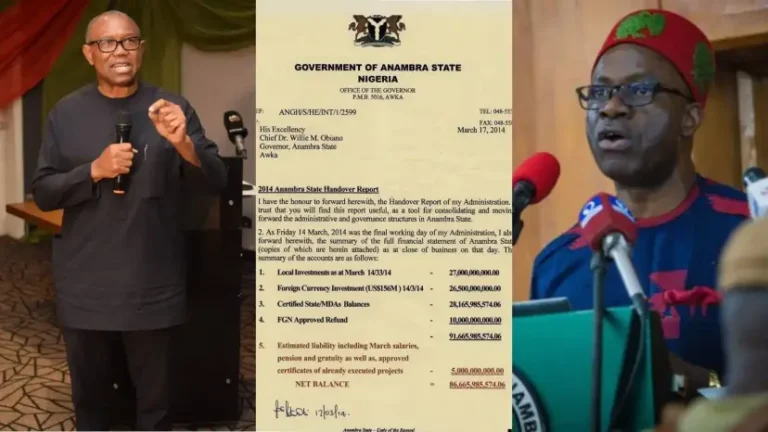
The political landscape in Nigeria has been set abuzz following a fierce war of words between former Anambra State Governor Peter Obi and the incumbent administration led by Governor Chukwuma Soludo. At the heart of the controversy is a lingering dispute over the state’s financial health, legacy debts, and the true state of the treasury at the time Obi handed over power. In a dramatic escalation of the feud, the presidential hopeful has published his official handover documents, asserting that his administration left the state in a robust financial position characterized by a net positive balance of over ₦86 billion, thereby categorically refuting claims that he saddled the state with crippling liabilities.
The publication of the documents marks a new turning point in a high-stakes public debate that has drawn intense scrutiny from political analysts, economists, and citizens alike. The ongoing dispute not only highlights the friction between successive state administrations in Nigeria but also underscores the broader national conversation regarding fiscal transparency, public debt management, and the accountability of political leaders long after they have left office. As both sides dig in their heels with conflicting data, the controversy has transformed into a major talking point ahead of the 2027 general elections, placing Obi’s financial legacy under a public microscope.
Origins of the Financial Dispute
The genesis of the current friction can be traced back to statements made by the Anambra State Government regarding its ongoing fiscal responsibilities. According to the state’s financial handlers, the current administration under Governor Soludo has been grappling with the burden of servicing and repaying loans obtained by previous administrations. These inherited liabilities allegedly encompass obligations accrued not only during the tenure of Peter Obi but also under his immediate successor, former Governor Willie Obiano.
The matter gained renewed momentum when the Anambra State Commissioner for Finance, Izuchukwu Okafor, addressed the public during an episode of the Ndi Anambra podcast, produced by the state government’s New Media team. Okafor disclosed that despite the Soludo administration’s strict fiscal policy of avoiding fresh commercial bank loans since assuming office, the state remains legally and financially bound to service inherited credit facilities. He emphasized that these legacy obligations continue to exert pressure on the state’s internally generated revenue and federal allocations, effectively constraining the current government’s capacity to execute capital-intensive projects at an accelerated pace.
In response to these assertions, Peter Obi issued a vehement denial, challenging the Soludo administration to provide verifiable, unassailable evidence to substantiate its claims. Raising the stakes significantly, Obi declared that he would permanently halt his political campaign for the 2027 presidency if the state government could conclusively prove that he left behind unpaid commercial bank loans or unhedged financial obligations that compromised the state’s economy. Obi maintained that his administration operated with utmost prudence, leaving behind substantial savings in both local and foreign currencies rather than a mountain of debt.
Publication of the Handover Notes
To back his assertions with empirical proof, allies of the former governor stepped into the fray. Dr. Yinusa Tanko, the Interim National Coordinator of the Obedient Movement—a prominent political support base aligned with Obi—publicly released the official handover document on a Wednesday. The document, dated March 17, 2024, provides a comprehensive audit and summary of Anambra State’s financial standing as of the exact close of business on the final day of Obi’s gubernatorial tenure.
According to the published document, the state treasury boasted a net positive balance exceeding ₦86 billion. This figure purportedly included various investments, cash reserves, and dedicated funds left in trust for infrastructural development and institutional growth. The release of this document was designed to dismantle the narrative that Obi’s administration prioritized short-term populism at the expense of long-term fiscal stability.
Dr. Tanko argued that transparency remains the ultimate antidote to political propaganda, asserting that the published figures are open to forensic auditing by independent financial experts. By laying the documents bare for public scrutiny, the Obi camp sought to shift the burden of proof back to the state government, demanding that officials point out any discrepancies in the official transition records rather than relying on generalized claims of inherited debt.

The State Government Counters With Detailed Data
Unfazed by the release of the handover notes, the Anambra State Government doubled down on its position, maintaining that Obi’s claims regarding the debt-free status of his administration are fundamentally misleading. In a strongly worded official statement titled "Gov Peter Obi and Record of Public Debt in Anambra: Facts Beyond Propaganda and Lies," the State Commissioner for Information and Value Reorientation, Law Mefor, dissected the state’s historical financial records to counter the former governor’s narrative.
Mefor argued that focusing solely on cash balances at the point of handover ignores the critical long-term liabilities that successive administrations are mandated to service. He disclosed that the state government’s records indicate that a total of eight external loans—connected to major infrastructural, educational, and developmental projects initiated during Obi’s tenure or subsequently inherited by it—remain active and outstanding.
Providing specific figures, the commissioner stated that these external credit facilities carry a combined outstanding balance of $92.35 million. According to the state government’s financial conversions, this foreign debt obligation is equivalent to approximately ₦127.37 billion as of June 30, 2026. Mefor maintained that these obligations constitute a factual part of the public debt register of Anambra State and cannot be wished away by presenting selective cash balances that exclude long-term multilateral and bilateral loan commitments.
Chronology of the Leadership and Fiscal Transitions in Anambra
To fully comprehend the depth of the current controversy, it is essential to examine the chronological evolution of governance and financial management in Anambra State over the past two decades:
- 2006 – 2014 (The Peter Obi Administration): Peter Obi governs Anambra State across two terms, focusing heavily on public-private partnerships, education revival, and infrastructure development. His administration consistently boasts of leaving substantial financial savings and investments, which form the bedrock of his current defense.
- 2014 – 2022 (The Willie Obiano Administration): Governor Willie Obiano succeeds Peter Obi, inheriting ongoing projects and existing financial portfolios. During this period, the state secures additional loans and financing arrangements to fund infrastructural expansion, such as the Anambra International Cargo Airport.
- 2022 – Present (The Chukwuma Soludo Administration): Professor Chukwuma Soludo assumes office, instituting a strict fiscal austerity and debt-management framework. The administration announces a policy prohibiting new commercial bank borrowing while prioritizing the servicing of inherited liabilities from both Obi and Obiano administrations.
- March 2024: Amid rising public debates over legacy debts, supporters of Peter Obi publicly release detailed archival transition documents to prove the state’s positive financial standing at the exit point of his tenure.
- Mid-2026: The Anambra State Government, through its Ministries of Finance and Information, releases comprehensive data pointing to outstanding multilateral and external loan portfolios totaling $92.35 million, reigniting the intense political debate.
Implications for Public Governance and Political Accountability
The ongoing public dispute between Peter Obi and the current Anambra State administration extends far beyond regional politics, offering critical insights into the structural challenges of fiscal governance in Nigeria. At its core, the clash highlights the perennial ambiguity surrounding the definition of "debt" and "financial liabilities" in public sector accounting across the country.
Economists and public policy analysts point out that state transitions in Nigeria frequently suffer from a lack of standardized accounting frameworks when documenting liabilities. While outgoing administrations typically measure their financial success based on short-term liquid assets, cash reserves, and unencumbered bank balances at the exact hour of departure, incoming governments evaluate the broader macro-fiscal picture. This broader perspective often includes long-term multilateral loans, contingent liabilities, contractual obligations, and contractor arrears that may not immediately reflect on day-to-day cash flow statements.
Furthermore, the involvement of high-profile political figures amplifies the national significance of the dispute. As Peter Obi positions himself as a leading voice in opposition politics and a contender for the 2027 presidential race, his economic track record as a two-term governor remains one of his primary political selling points. Detractors seeking to diminish his fiscal reputation naturally target his legacy in Anambra State, making financial transparency a high-stakes battleground. Conversely, any successful defense mounted by Obi reinforces his credential as a prudent manager of public resources—a core pillar of his broader political appeal.
Conclusion and Future Outlook
As the war of words continues, citizens and civil society organizations in Anambra State and across Nigeria are calling for a transparent, independent forensic audit of the state’s financial history spanning the transitions from Obi to Obiano, and subsequently to Soludo. Such an audit, experts argue, is the only definitive way to clear the air and separate objective economic reality from politically motivated rhetoric.
Until an independent panel or auditor-general provides a universally accepted reconciliation of the state’s ledger—separating short-term cash liquidity from long-term external loan commitments—the debate will likely persist. For now, the Anambra debt controversy remains a potent reminder of the complexities of public finance in Nigeria, where the figures of yesterday continue to shape the political battles of tomorrow.