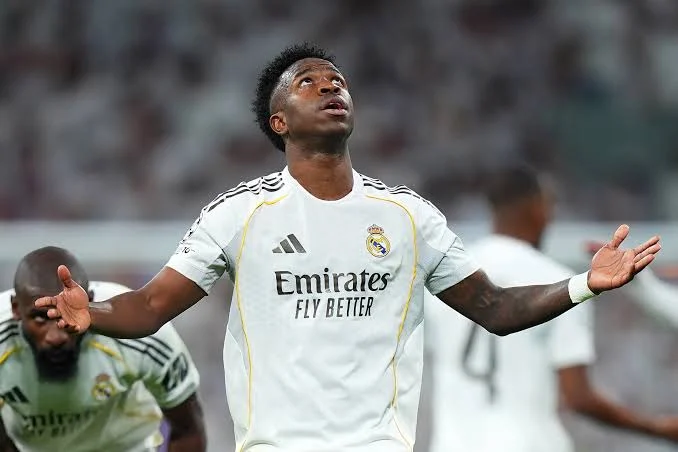
Real Madrid forwards Kylian Mbappe and Vinicius Junior have found themselves at the center of a burgeoning public relations crisis following their actions ahead of the club’s La Liga fixture against Elche. The high-profile players are facing sharp criticism from fans, activists, and social media commentators after appearing to deliberately obscure a solidarity message printed on their pre-match warm-up jerseys. The controversy has ignited a fierce debate across Spain regarding the intersection of sports, social activism, and the autonomy of professional athletes in choosing political or community causes.
The incident occurred during pre-match routines on Tuesday, ahead of a hard-fought league encounter that ultimately ended in a 3-2 victory for Los Blancos, courtesy of a late goal. Video footage captured by spectators and broadcast widely on digital platforms shows Vinicius Junior instructing Kylian Mbappe on how to adjust his shirt. Alongside teammate Ibrahima Konate, the players were observed rolling up or positioning their garments in a manner that concealed the prominently displayed slogan: "Todos somos caballas" (We are all citizens of Ceuta).
Context and Background of the Ceuta Solidarity Initiative
The pre-match shirts were part of an official, league-wide initiative organized by La Liga to express solidarity with Ceuta, a Spanish autonomous city located on the northern coast of Africa. In recent times, Ceuta has found itself at the epicenter of a complex and prolonged humanitarian and migrant crisis. Due to its unique geographic position sharing a land border with Morocco, the enclave has frequently experienced significant migratory pressures, straining local infrastructure and sparking intense national and international debate over border security, European Union immigration policies, and humanitarian aid.
The "Todos somos caballas" campaign was designed by league officials to foster national unity and draw positive attention to the residents of the enclave, who have borne the brunt of the geopolitical tensions. Clubs across the Spanish top-flight were encouraged to wear the commemorative apparel during warm-ups to demonstrate collective backing from the wider Spanish football community. However, the decision by several of Real Madrid’s star players to alter how the garments were worn quickly overshadowed the intended message of unity.
Chronology of Events on Matchday
The sequence of events leading to the controversy unfolded rapidly in the minutes preceding the opening whistle at the stadium:
- Arrival and Warm-up Initialization: Real Madrid players took to the pitch wearing the mandated La Liga solidarity shirts alongside the rest of the squad.
- The Adjustment: Video evidence highlights Vinicius Junior gesturing to Kylian Mbappe, with both players—joined by Ibrahima Konate—manipulating the fabric of their shirts to fold or roll the material inward, effectively hiding the printed text from television cameras and spectators.
- Removal of Apparel: In standard protocol, the players wore the warm-up gear for a designated period before returning to the tunnel. However, the deliberate obstruction of the text remained noticeable throughout their time on the pitch.
- The Match: Real Madrid proceeded with the fixture, securing a narrow 3-2 triumph over Elche following a dramatic late-game winner, though post-match media coverage was rapidly dominated by the unfolding online controversy rather than the sporting result.
- Viral Outrage: Within hours of the final whistle, video clips of the incident disseminated across X (formerly Twitter), Instagram, and other social media networks, triggering widespread condemnation.
Public Reaction and Social Media Outcry

The digital response was swift and polarized, illustrating deep societal divisions regarding how athletes should engage with public campaigns. A significant portion of the fanbase expressed outrage, interpreting the players’ actions as a direct insult to Spanish citizens affected by the migrant crisis.
Prominent social media accounts did not hold back in their assessments. A user identified as #elsemiyero posted a condemnation under the hashtags "#TodosSomosCaballas #MbappéViniciusTRAIDORES," labeling the forwards as traitors while reiterating support for the autonomous city. Another user, #SportyScience, voiced extreme frustration, writing: "I hope the fans boo them for the rest of the season and until the end of their contracts. You are not welcome in Spain."
Calls for disciplinary measures also targeted the club’s leadership. User #WillyTolerdoo suggested that club president Florentino Perez intervene, arguing that a lengthy suspension without pay would quickly put an end to such behavior. Similarly, #Ja_ari97 criticized the socio-economic disconnect between the millionaires and everyday citizens, posting: "It’s a shame that Real Madrid allows this contempt toward our compatriots from Ceuta by these millionaires who live in luxurious gated communities with private security."
Conversely, a counter-narrative emerged defending the players’ autonomy. Supporters of the athletes argued against the compulsory nature of socio-political messaging in sports. User #Gracie_Blue89 encapsulated this sentiment by stating, "Keep politics out of football," and added a "round of applause for the players" for seemingly resisting forced participation in public relations campaigns.
Broader Implications for Football and Club Governance
The episode highlights a recurring dilemma for modern football administration: the boundary between corporate social responsibility and individual freedom of expression. Governing bodies like La Liga increasingly utilize matches as platforms to address socio-political issues, ranging from anti-racism campaigns to humanitarian disaster relief. However, when high-profile athletes—particularly global icons of the magnitude of Mbappe and Vinicius—opt out or appear to protest such initiatives, it risks undermining the unified front organizations attempt to project.
Real Madrid has not yet issued an official statement addressing the viral video or the conduct of the players involved. The silence from the club hierarchy leaves open questions regarding whether internal discussions or disciplinary reviews will take place behind closed doors. Given Vinicius Junior’s history of being a prominent voice against racial abuse in Spanish football—coupled with Mbappe’s status as one of the most marketable athletes in world sport—the incident places club management in a delicate diplomatic position.
As the season progresses, the pressure from supporters and critics alike will likely influence how both the club and league officials handle mandatory participation in solidarity campaigns. Whether this event will result in a policy shift regarding voluntary versus compulsory messaging remains to be seen, but the controversy has undoubtedly added an extra layer of tension to Real Madrid’s domestic campaign.