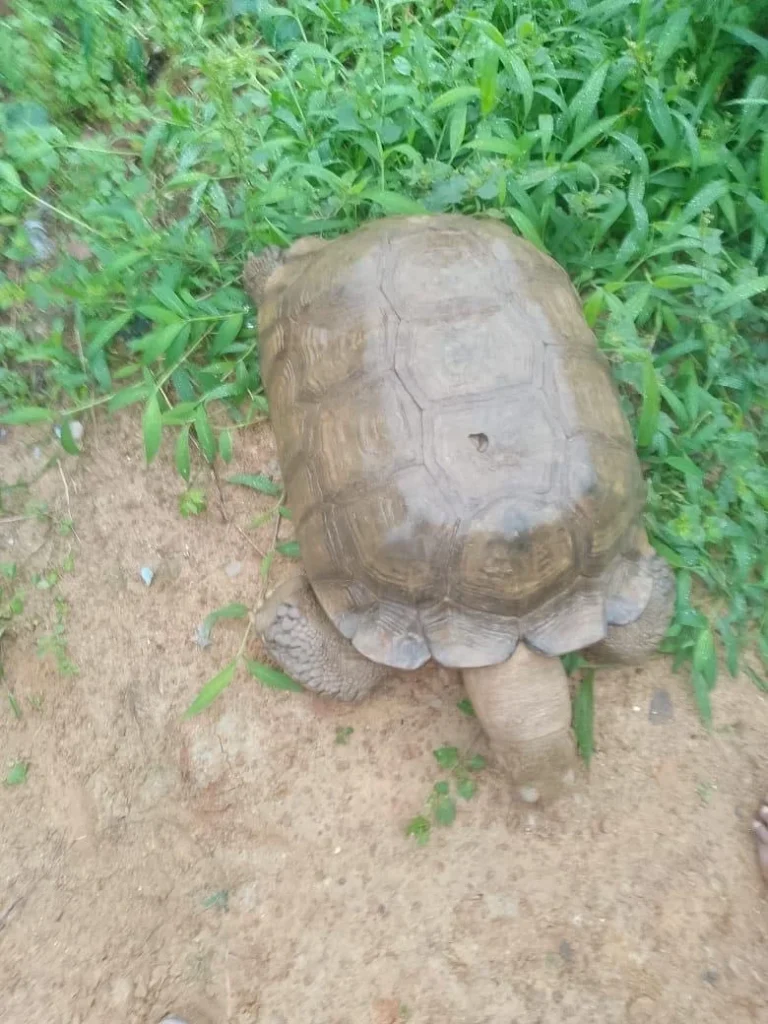
The venerable walls of the Alaafin of Oyo’s palace, a site steeped in the architectural and cultural grandeur of the Oyo Empire, are currently shrouded in a somber atmosphere following the passing of one of its most enigmatic inhabitants. Baba, a tortoise estimated to be 420 years old and widely revered as the oldest living entity within the Yorubaland region, succumbed to a brief illness on Monday. His death marks the end of an era, as the creature served as a bridge between the historical seat of the Old Oyo Empire and the modern-day monarchy.
The passing of Baba was confirmed by Bode Durojaiye, the Director of Media and Publicity to the Alaafin of Oyo. According to palace records, the tortoise had exhibited signs of declining health early in the week, manifesting as a sudden loss of appetite and lethargy. Despite the specialized care provided by palace attendants, the creature passed away hours later. In accordance with the respect accorded to him during his life, Baba has been interred within the palace grounds, ensuring that his physical remains stay within the sanctuary he called home for over four centuries.
A Living Chronicle of the Oyo Kingdom
To understand the significance of Baba’s death, one must examine the role he played in the cultural fabric of the Oyo people. Baba was not merely a pet; he was an institution. Oral tradition suggests that the tortoise was originally brought from Oyo-Ile, the ancient capital of the Oyo Empire, during a period of significant geopolitical transition. As the empire shifted its administrative center to the present-day Oyo town, Baba was transported as a living relic, preserved through generations of monarchs.
The tortoise functioned as a silent witness to the evolution of the Yoruba nation. He outlived dozens of Alaafins, serving as a constant in a world defined by the cyclical nature of human leadership. While the political and social landscapes shifted—from the pre-colonial era to the colonial administration and into the contemporary democratic dispensation—Baba remained an anchor. His presence allowed successive kings to connect physically with the ancestral heritage of their predecessors.
The Stewardship of an Ageless Icon
The daily life of Baba was characterized by a level of care usually reserved for high-ranking palace officials. Two dedicated staff members were assigned the responsibility of managing his diet and environment. His nutritional requirements, which were meticulously documented by these stewards, consisted primarily of watermelon, locally sourced corn pap wrapped in traditional leaves, and fresh grass.
His enclosure was arguably the most visited site within the palace complex. Tourists, researchers, and local indigenes would travel from across the country to glimpse the creature that had seemingly defied the biological limitations of his species. The moniker "Baba"—a term of profound respect for an elder—was adopted by the public and palace staff alike, as the use of his birth name had long since been lost to time. Calling him by a name other than the honorific "Baba" was considered a violation of the deep-seated reverence the community held for him.
Historical Context and Cultural Symbolism
The death of such an iconic animal invites a broader discussion regarding the intersection of nature and cultural heritage. The connection between the palace and its animal inhabitants is a common trope in Yoruba literature and folklore. Nobel Laureate Professor Wole Soyinka, in his seminal work Death and the King’s Horseman, famously explored the ritualistic and spiritual links between the living, the dead, and the unborn, often utilizing the imagery of palace animals to denote the status and continuity of the monarchy.
However, Baba’s existence defied the ritualistic expectations often attributed to palace animals in traditional literature. Unlike the horse or the dog of the Elesin Oba, which were historically expected to transition to the afterlife alongside their master to continue their service in the spiritual realm, Baba remained a symbol of earthly continuity. He survived the transitions of power, providing a sense of stability that transcended the mortality of the monarchs themselves. His survival was perceived by many as an auspicious sign, a living proof of the resilience of the Oyo lineage.
Official Response and Future Preservation
The incumbent Alaafin of Oyo, Oba Akeem Owoade I, has expressed deep personal loss regarding the demise of his long-time companion. Having met Baba upon his own ascension to the throne, the Alaafin maintained a close, albeit silent, bond with the creature.
Recognizing the immense historical value Baba represented, the palace has announced preliminary plans to preserve his remains. The objective is to ensure that the physical embodiment of this centuries-old legacy is maintained for posterity. By employing modern taxidermy or preservation techniques, the palace hopes to allow future generations to engage with this piece of oral history, effectively giving the creature a second life in the archives of the Oyo Kingdom.
The Implications of a Lost Living Relic
The loss of Baba raises pertinent questions about the preservation of intangible heritage. In many traditional African societies, history is not merely found in textbooks; it is embedded in physical relics, sacred sites, and, occasionally, the natural world. The death of the tortoise is, in a very literal sense, the loss of an archival source.
From a scientific perspective, the longevity of the tortoise—if the 420-year estimate is substantiated—would place him among the longest-lived animals in recorded history. While tortoises of the genus Testudo or Aldabrachelys are known for their extreme longevity, a lifespan exceeding four centuries would be an extraordinary anomaly that warrants rigorous biological study. Even if the age is viewed through the lens of oral history rather than biological precision, the mythos surrounding his age serves a vital social function: it reinforces the perceived longevity and permanence of the Oyo monarchy.
A Legacy Beyond the Shell
The impact of Baba’s death extends beyond the palace walls. It serves as a moment of reflection for the broader Yoruba community. In an era of rapid modernization and digital displacement, the presence of an animal that bridged the gap between the 17th century and the 21st century provided a rare, tangible link to the past.
As the palace prepares to honor the memory of the tortoise, the event serves as a reminder of the fragility of cultural memory. The "Oyo experience," as described by palace officials, is built upon layers of tradition that are often invisible to the outside observer. Baba was a cornerstone of that experience.
For the visitors who traveled to Oyo, the tortoise was the primary reason for their pilgrimage. His absence will leave a noticeable void in the palace tourism ecosystem. Yet, the discourse surrounding his life has sparked a renewed interest in the history of the Oyo Empire and the importance of preserving the "living relics" that define the identity of the region.
As the dust settles on the burial site within the palace, the legacy of Baba remains secure in the stories told by those who cared for him and the records kept by the palace media office. He was a creature who stood the test of time, a silent observer of history, and a beloved member of the Oyo royal family. While the palace has lost an ageless companion, the narrative of his life will undoubtedly be woven into the tapestry of the Yoruba race for generations to come, ensuring that the legend of the 420-year-old tortoise continues long after his passing.