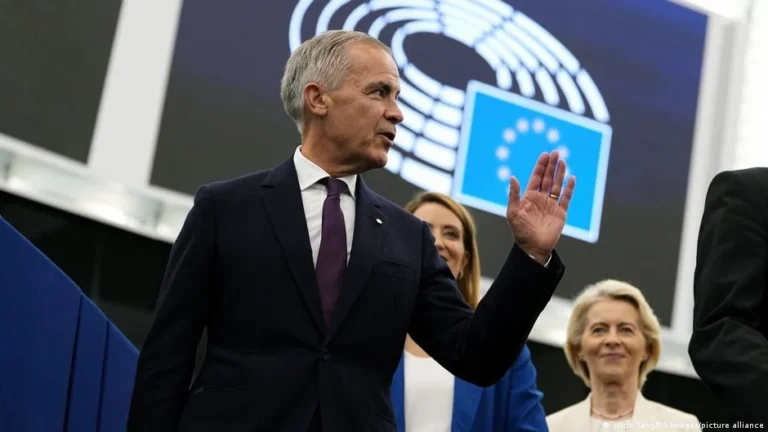
As geopolitical volatility intensifies across the Atlantic, Canadian Prime Minister Mark Carney has embarked on a high-stakes diplomatic mission to Europe, aimed at forging a unique, multifaceted alliance with the European Union. This pivot comes at a defining moment in global history, characterized by what Carney previously termed a "rupture in the world order" at the World Economic Forum in Davos earlier this year. With the United States engaged in an escalating trade war with its northern neighbor and shifting its own global priorities, Ottawa is looking toward Brussels not merely as a trading partner, but as a long-term strategic anchor.
The diplomatic outreach, which has been described in various reports as a potential "associate membership" status, signals a significant departure from traditional North American foreign policy. While both Canadian and European officials have clarified that full EU membership is not on the table, the scale of the proposed cooperation is unprecedented. The partnership seeks to integrate defense production, critical mineral supply chains, and advanced technology research, creating a robust bloc capable of asserting its interests in a multipolar world.
A Chronology of the Strategic Pivot
The momentum for this rapprochement has been building throughout 2026, driven by a convergence of economic necessity and security concerns:
- January 2026: During the World Economic Forum in Davos, Prime Minister Mark Carney warns of the "rupture in the world order," famously stating that for middle powers, "if we are not at the table, we are on the menu."
- August 2026: Tensions peak as the United States implements aggressive import bans and 50% tariffs on key Canadian exports, pushing Ottawa to fast-track its search for diversified markets.
- September 2026 (Early): Preliminary talks between Canadian cabinet ministers and European Commissioners establish the framework for a "Special Partnership Agreement."
- September 2026 (Wednesday): European Commission President Ursula von der Leyen officially signals openness to the partnership during her State of the European Union address in Strasbourg.
- September 2026 (Thursday): Prime Minister Carney prepares to address the European Parliament, where he is expected to present a white paper on the future of EU-Canada security and economic alignment.
Strengthening the Security Umbrella
The cornerstone of this proposed alliance is defense. For decades, Canada and Europe have relied heavily on the United States to guarantee their collective security. However, as Washington’s commitment to traditional alliances appears increasingly transactional, the necessity for a "European-Canadian security pillar" has become a matter of existential urgency.
Patrick Leblond, an expert in international economic relations at the University of Ottawa, notes that the era of relying on the American security umbrella as a static given is effectively over. "We have underinvested in our militaries, both in Europe and in Canada," Leblond stated. "The current focus is now on joint force multiplication, particularly in the production of high-end military equipment and the development of next-generation defense technologies."
Canada’s participation in the EU’s Security Action for Europe (SAFE) program serves as the blueprint for this new era of cooperation. By paying a fee to access the €150 billion ($173 billion) fund, Canadian firms are gaining unprecedented access to European procurement markets. Anand Sundar, a senior security analyst at the European Council on Foreign Relations, argues that this is a win-win scenario. "Canada is an underrated defense power," Sundar explains. "They spend more on defense than the 14 smallest EU member states combined. By integrating their supply chains with the EU, Canada gets more ‘bang for their buck,’ and Europe gains a partner that is technically sophisticated and financially stable."
Economic Integration Beyond CETA
While the Comprehensive Economic and Trade Agreement (CETA) has been in effect on a provisional basis since 2017, the current administration in Ottawa feels its potential remains largely untapped. Critics argue that Canadian businesses have historically been too focused on the US market, often ignoring the vast opportunities within the EU’s common market.
The proposed "associate" framework aims to go beyond the tariff-free trade established by CETA. It targets:
- Critical Minerals and Energy: Leveraging Canada’s vast reserves of lithium, nickel, and cobalt to fuel the EU’s transition to green energy and battery production.
- Technological Sovereignty: Collaborating on artificial intelligence, quantum computing, and cybersecurity to reduce dependence on external proprietary technologies.
- Infrastructure Resilience: Joint operation of satellite constellations and the physical protection of trans-Atlantic fiber-optic cables, which are critical to global finance and communication.
Official Responses and Political Realities
President von der Leyen’s endorsement of the partnership during her address to European lawmakers was met with broad support, emphasizing the EU’s prerogative to choose its allies. "We believe that power does not belong to the strongest, the richest, or the loudest, but to all of us," she remarked. "That democracies have the freedom to choose with whom to work."
The sentiment in Ottawa is equally pragmatic. While no political leader in Canada suggests cutting ties with the United States, the consensus is that the country needs a "Plan B" that is as robust as the current, strained relationship with Washington. The European bloc is viewed as a trustworthy, rule-based partner that aligns with Canadian values on human rights, climate change, and international law.
However, challenges remain. There are significant regulatory hurdles to clear. For instance, the EU’s procurement rules, which often favor internal manufacturers to protect the European industrial base, will need to be adjusted to accommodate Canadian firms. Furthermore, there is the question of how this partnership will impact the United Kingdom and other non-EU states that maintain their own unique relationships with Brussels.
Broader Implications for Global Stability
The shift toward an EU-Canada axis represents a significant reordering of Western power structures. Should this partnership succeed, it could set a precedent for other "middle powers"—such as Australia, South Korea, or Japan—to develop similar cross-continental security and economic frameworks.
Analysts suggest that the success of this initiative will hinge on the speed of implementation. The current trade war with the US serves as a powerful catalyst, but internal EU bureaucracy and the complex nature of harmonizing defense industries could slow progress. Nevertheless, the political will is currently at an all-time high.
As Prime Minister Carney prepares to take the podium at the European Parliament, the message is clear: Canada is no longer content to be a passive observer of a shifting global order. By leaning into the European project, Ottawa is betting that its future prosperity and security lie in the creation of a more integrated, resilient, and collaborative Atlantic community. Whether this leads to a formal "associate" status or a series of deep-sectoral treaties, the message to the international community is unmistakable: the transatlantic bridge is being reinforced to withstand the pressures of a new, more uncertain century.