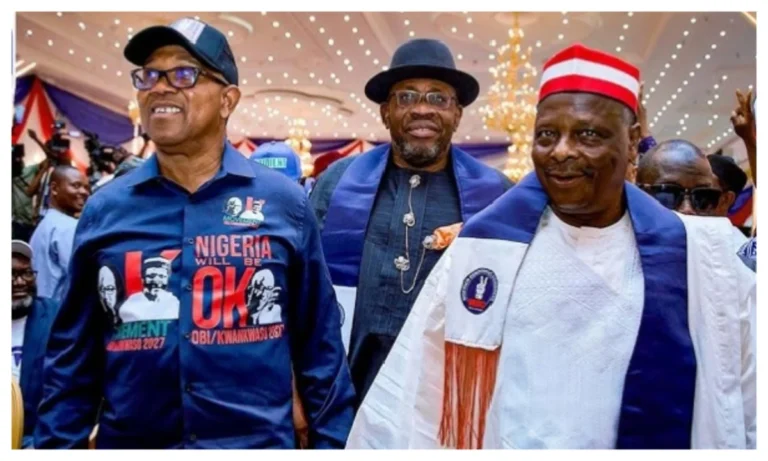
The political landscape leading up to Nigeria’s anticipated 2027 general elections has experienced an early tremor following a definitive statement from the leadership of the Nigeria Democratic Congress (NDC). The opposition party has officially distanced itself from a recently announced 59-member Presidential Campaign Council (PCC) unveiled by a support faction known as the OK Movement. The council was purportedly established to champion the joint presidential and vice-presidential ambitions of Peter Obi and Rabiu Musa Kwankwaso under the banner of the NDC.
According to an official communique issued on Saturday by the National Chairman of the NDC, Senator Cleopas Moses, the party holds no prior knowledge, association, or involvement with the formation of the campaign council. The announcement, which had previously gained traction across various media platforms and digital spaces, was attributed to John Ugulu, a prominent figure within the OK Movement. Senator Moses has categorically dismissed the unveiling as an unauthorized action, urging the general public, political stakeholders, and media organizations to completely disregard the purported list and its associated zonal and state coordinators.
The swift repudiation highlights deep-seated procedural fault lines regarding how political parties, their candidates, and allied support groups interact in the build-up to Nigeria’s high-stakes electoral cycles. By asserting strict institutional control over campaign apparatuses, the NDC leadership has underscored the limits of volunteerism and grassroots enthusiasm within formal political structures.
Anatomy of the Controversy and the OK Movement Unveiling
The controversy erupted earlier in the week when the OK Movement—a political coalition drawing its nomenclature from the surnames of Peter Obi and Rabiu Musa Kwankwaso—released a comprehensive roster detailing a 59-member campaign council. The group also went a step further by outlining a hierarchical framework that included designated zonal coordinators and state-level representatives intended to spearhead mobilization efforts across Nigeria’s thirty-six states and the Federal Capital Territory (FCT).
For political observers, the ambition behind the OK Movement’s premature rollout was clear: to lock in momentum, establish early dominance, and project an image of an unstoppable political coalition well ahead of the official Independent National Electoral Commission (INEC) timetable for the 2027 elections. Both Peter Obi, a former governor of Anambra State and the Labour Party’s standard-bearer in the 2023 presidential race, and Rabiu Musa Kwankwaso, a former governor of Kano State and the leader of the New Nigeria People’s Party (NNPP), command massive regional and demographic followings. Speculation surrounding their potential fusion into a single, formidable mega-ticket has dominated political discourse, making any operational blueprint concerning their joint campaign a subject of intense public interest.
However, this enthusiasm collided harshly with the internal administrative protocols of the Nigeria Democratic Congress. In political party management, the constitution of a presidential campaign council is not merely an administrative exercise; it is a strategic instrument of power-sharing, coalition-building, and legal compliance under Nigerian electoral laws. By unilaterally publishing a list of council members, the OK Movement bypassed critical internal vetting processes, creating an awkward vacuum of authority that forced the NDC national secretariat to intervene decisively.
The NDC National Secretariat Responds: Law, Order, and Party Supremacy
Addressing journalists and party faithful over the weekend, Senator Cleopas Moses emphasized that the sanctity of party authority remains non-negotiable. He reiterated that under the extant guidelines of the NDC, the constitutional power to constitute, vet, and formally announce a Presidential Campaign Council rests exclusively with the national leadership, acting through the National Working Committee (NWC).
"The attention of the national leadership of the Nigeria Democratic Congress has been drawn to a purported Presidential Campaign Council recently announced by the OK Movement for our prospective candidates, Peter Obi and Rabiu Musa Kwankwaso," Senator Moses stated. "We wish to state categorically that this action was neither authorized, approved, nor sanctioned by the party. The public and the media are hereby advised to treat the announcement with the utmost disregard."
The NDC chairman was unequivocal in his warning to other volunteer organizations, support groups, and ambitious individuals within the party’s broader ecosystem. He stressed that no single individual, irrespective of their financial or logistical contributions to the party, possesses the unilateral prerogative to establish alternative campaign structures, regional organs, or parallel secretariats without securing explicit prior approval from the NWC.
While the party acknowledged the invaluable role played by grassroots mobilizers and support groups in driving political engagement, it drew a firm red line between supportive advocacy and structural usurpation. The leadership noted that allowing disparate groups to float independent campaign organs without central coordination breeds factionalism, dilutes the party’s official messaging, and creates vulnerabilities that political opponents could exploit.
Disciplinary Measures Against John Ugulu
The fallout from the unauthorized campaign council announcement quickly moved from the realm of public relations to internal disciplinary action. In the statement released on Saturday, Senator Moses confirmed that John Ugulu, the central figure behind the OK Movement’s unveiling, has been officially referred to the appropriate disciplinary organ of the NDC for immediate investigation and review.
The disciplinary referral is not entirely isolated to the current controversy surrounding the campaign council. According to the party leadership, Ugulu’s actions fit into a troubling pattern of behavior characterized by repeated disregard for party directives and internal protocols. Senator Moses specifically cited Ugulu’s alleged "excesses" during the contentious Lagos State primary elections, where internal party friction reportedly threatened the cohesion of the NDC’s local chapters.
By moving swiftly to invoke internal disciplinary mechanisms, the NDC leadership is signaling a zero-tolerance policy toward insubordination. Political analysts note that as parties position themselves for the grueling electoral marathon of 2027, maintaining party discipline is vital to preventing defections, factional lawsuits, and public embarrassment. By formally probing Ugulu, the party aims to reassert its institutional authority and deter other support groups from taking independent steps that could undermine the collective strategy of the organization.
The Broader Context of Coalition Politics in Nigeria
The friction between the NDC and the OK Movement provides a fascinating window into the complex mechanics of coalition-building in contemporary Nigerian politics. As the dust settles from the fiercely contested 2023 general elections, political actors across the divide have recognized that defeating entrenched ruling-party machinery requires broad-based alliances, consolidation of regional strongholds, and the seamless integration of diverse political movements.
The pairing of Peter Obi—whose support base spans urban youth, middle-class professionals, and significant portions of the Christian South—with Rabiu Musa Kwankwaso—whose "Kwankwasiyya" movement commands a formidable, disciplined voting bloc in the populous Northwest, particularly Kano State—presents a compelling arithmetic on paper. Such a ticket would theoretically bridge regional, religious, and demographic divides, creating a formidable electoral juggernaut.
However, translating theoretical electoral arithmetic into practical party organization is notoriously difficult. Support groups, while energized by the prospect of such a coalition, often operate with a degree of operational autonomy that clashes with the bureaucratic and legal requirements of registered political parties. Political parties are bound by strict regulatory frameworks overseen by INEC, requiring transparency, internal democracy, and centralized control over candidate nomination and campaign financing. When enthusiastic support groups attempt to accelerate this process outside official channels, institutional friction is almost guaranteed.
Implications for the NDC and the 2027 Horizon
The public disowning of the OK Movement’s campaign council carries several important implications for the NDC and its prospective standard-bearers as preparations for 2027 gather momentum.
Firstly, it highlights the delicate balance the party must strike between harnessing grassroots energy and maintaining organizational discipline. Support groups are the lifeblood of modern Nigerian political campaigns, providing essential foot soldiers, crowd-funding, and door-to-door mobilization. Alienating these groups entirely could dampen voter enthusiasm and starve the campaign of vital grassroots momentum. Conversely, giving them a free rein to announce campaign structures without central oversight risks creating administrative chaos and legal vulnerabilities that could disqualify candidates or invalidate campaign expenditures under electoral laws.
Secondly, the incident underscores the intense pressure and early maneuvering characterizing the 2027 cycle. Even though the general elections are years away, the premature unveiling of campaign councils suggests that political actors and their supporters are eager to stake early claims, lock down influential positions, and project an aura of inevitability. This hyper-competitive environment often leads to friction, as ambitious actors seek to outpace formal party bureaucracies.
Despite the turbulence caused by the OK Movement’s premature announcement, the NDC leadership has sought to project a steady and focused demeanor. In the concluding sections of his Saturday statement, Senator Moses reaffirmed the party’s steadfast commitment to running an issue-based, policy-driven campaign. He reiterated the party’s overarching vision of building what it terms "a New Nigeria that is Possible"—a slogan that echoes the reformist, change-oriented rhetoric that has defined the political movements surrounding both Peter Obi and Rabiu Musa Kwankwaso.
As the political drama unfolds, all eyes will remain on the NDC secretariat to see how the disciplinary proceedings against John Ugulu are handled and whether the party will eventually formalize a unified campaign structure that satisfies both institutional requirements and the boundless ambitions of its grassroots support base. For now, the message from the leadership is clear: while the journey toward 2027 has begun, every step must be taken strictly in accordance with party rules and under the direct supervision of its authorized organs.